World Heritage Identification Number: 1299
World Heritage since: 2012
Category: Natural Heritage
WHE Type: Protected Areas & National Parks
Transboundary Heritage: No
Endangered Heritage: No
Country: 🇷🇺 Russian Federation
Continent: Europe
UNESCO World Region: Europe and North America
Map
Lena Pillars Nature Park: A Geological Marvel in Eastern Siberia
The Lena Pillars Nature Park, located in the heart of the Sakha Republic (Yakutia), Russia, is a testament to the power of nature and the intricate interplay of geological processes over millions of years. Inscribed as a UNESCO World Heritage Site in 2012, this unique landscape offers a glimpse into Earth's ancient history while showcasing the resilience of life in one of the world's most extreme climates.
More to come…UNESCO Description of the World Heritage Site
Lena Pillars Nature Park is marked by spectacular rock pillars that reach a height of approximately 100 m along the banks of the Lena River in the central part of the Sakha Republic (Yakutia). They were produced by the region’s extreme continental climate with an annual temperature range of almost 100 degrees Celsius (from –60 °C in winter to +40 °C in summer). The pillars form rocky buttresses isolated from each other by deep and steep gullies developed by frost shattering directed along intervening joints. Penetration of water from the surface has facilitated cryogenic processes (freeze-thaw action), which have widened gullies between pillars leading to their isolation. Fluvial processes are also critical to the pillars. The site also contains a wealth of Cambrian fossil remains of numerous species, some of them unique.
UNESCO Justification of the World Heritage Site
Criterion (viii): The Lena Pillars Nature Park displays two features of significant international interest in relation to the Earth sciences. The large cryogenically modified pillars in the region are the most notable pillar landscape of their kind known, whilst the internationally renowned and important exposures of Cambrian rocks provide a second and important supporting set of values. The celebrated pillars (up to c.200m in height) that line the banks of the Lena River are rocky buttresses isolated from each other by deep and steep gullies developed by frost shattering directed along intervening joints. The pillars form an outstanding discontinuous belt that extends back from the river’s edge along the incised valley sides of some rivers in a zone about 150 m wide. The Lena Pillars Nature Park property contains among the most significant record of events related to the ' Cambrian explosion ' which was one of the pivotal points in the Earth’s life evolution. Due to platformal type of carbonate sedimentation within the tropical belt of the Cambrian Period, without subsequent metamorphic and tectonic reworking, and magnificent impressive outcrops, the property preserves an exceptionally continuous, fully documented, and rich record of the diversification of skeletal animals and other biomineralised organisms from their first appearance until the first mass extinction event they suffered. The Lena Pillars include among the earliest and the largest, in both temporal and spatial senses, fossil metazoan reef of the Cambrian world. The Lena Pillars shows exceptional processes of the fine disintegration of the rocks dominating the shaping of the carbonate pillar relief. These karst phenomena are enriched by thermokarst processes developed in the area of a great permafrost thickness (up to 400-500 m).
Encyclopedia Record: Lena Pillars
The Lena Pillars are a natural rock formation along the banks of the Lena River in far eastern Siberia. The pillars are 150–300 metres (490–980 ft) high, and were formed in some of the Cambrian period sea-basins. The highest density of pillars is reached between the villages of Petrovskoye and Tit-Ary. The Lena Pillars Nature Park was inscribed on the World Heritage List in 2012.Additional Site Details
Area: 1,387,000 hectares
Number of Components: 2
Coordinates: 60.6666666667 , 127
IUCN World Heritage Outlook
The 2025 Conservation Outlook on Lena Pillars Nature Park reports the following assessment:
Source: International Union for Conservation of Nature (IUCN) · View assessment
Image
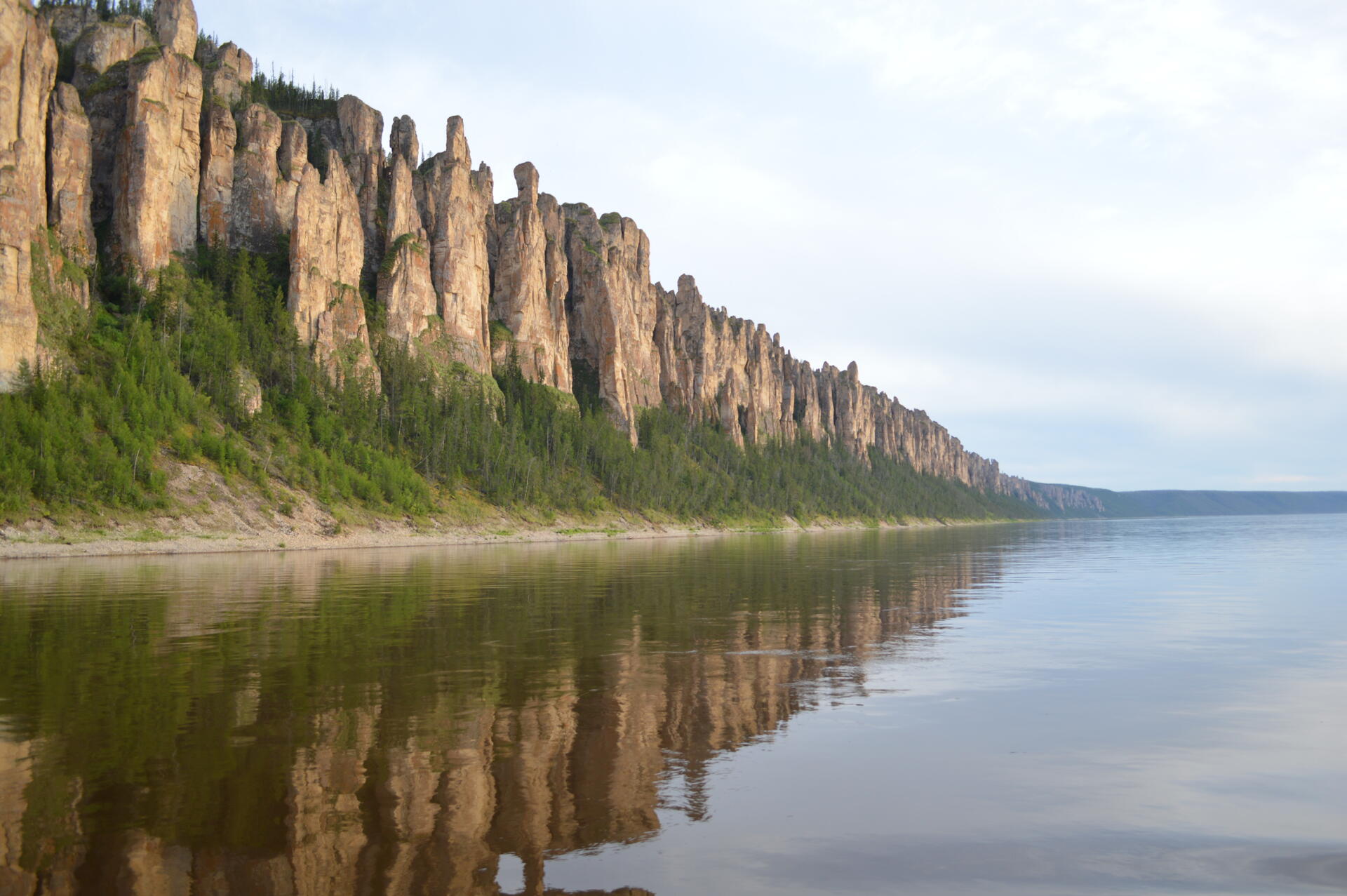
© VasilyevaED, CC BY-SA 4.0 Resized from original. (This derivative is under the same CC BY-SA license.)
World Heritage Research
Discover scientific research and academic studies that deepen our understanding of Lena Pillars Nature Park from its history and significance to its conservation, management, and contemporary challenges.
-
Integrated Environmental Management on the Example of the Khangalassky Ulus of the Republic of Sakha (Yakutia): Analysis and Trends
Integrated environmental management in the Khangalassky Ulus of the Republic of Sakha (Yakutia) reveals complex, interdependent challenges and solutions across forestry, agriculture, conservation, indigenous traditional practices, and industry. The Lena Pillars Nature Park emerges as a critical site for geological and historical preservation, while 8 Evenk tribal communities sustain traditional lifestyles on over 600,000 hectares of protected land. Forest lands dominate the landscape (73%), but agriculture (2%) and conservation areas (>17%) hold significant economic and social value. Mining activities, primarily for building materials, further shape industrial management. The study identifies trends in balancing resource extraction with preservation, emphasizing the need for sustainable development in this understudied Arctic region.
Khorechko, I. (2025). INTEGRATED ENVIRONMENTAL MANAGEMENT ON THE EXAMPLE OF THE KHANGALASSKY ULUS OF THE REPUBLIC OF SAKHA (YAKUTIA): ANALYSIS AND TRENDS. Moscow Economic Journal, 38–53. https://doi.org/10.55186/2413046x_2025_10_12_275
View Publication Record | Read Publication -
Gloeotrichia cf. natans (Cyanobacteria) in the Continuous Permafrost Zone of Buotama River, Lena Pillars Nature Park, in Yakutia (Russia)
A rare and significant discovery of mass proliferation of benthic epilithic macrocolonies of the cyanobacterium Gloeotrichia cf. natans has been documented for the first time in water bodies within the continuous permafrost zone of the Buotama River, Lena Pillars Nature Park, Yakutia (Russia). This finding expands our understanding of this species' ecology and habitat preferences, which differ from more commonly studied planktonic cyanobacteria. The study characterizes the environmental conditions and chemical composition of the water, providing insights into the ecological niche of Gloeotrichia cf. natans. Importantly, no cyanotoxins (microcystins, cylindrospermopsin, saxitoxins, or anatoxin-a) were detected in the biomass using advanced analytical methods, including liquid chromatography–mass spectrometry and PCR techniques.
Gabyshev, V., Davydov, D., Vilnet, A., Sidelev, S., Chernova, E., Barinova, S., Gabysheva, O., & Zhakovskaya, Z. (2023). Gloeotrichia cf. natans (Cyanobacteria) in the Continuous Permafrost Zone of Buotama River, Lena Pillars Nature Park, in Yakutia (Russia). Water, 15(13), 2370. https://doi.org/10.3390/w15132370
View Publication Record | Read Publication -
New Data on the Pleistocene Mammoth Fauna from the Territory of the Lena Pillars Nature Park (Middle Lena River, Yakutia)
A groundbreaking discovery reveals that the Lena Pillars Nature Park, a UNESCO World Heritage Site candidate, was home to a diverse Pleistocene mammoth fauna during the Karginian interstadial (60–24 thousand years ago). New radiocarbon dating and fossil remains identify 11 large mammal species, including the first recorded presence of cave lions in this region. The findings suggest that this period was optimal for mammoth fauna distribution in Yakutia, with ecological insights indicating that Ovis nivicola's Late Pleistocene habitat differed from its current range. This study significantly advances our understanding of Pleistocene biodiversity and environmental conditions in Northeast Asia.
Boeskorov, G. G., Maschenko, E. N., Ponomarev, I. V., Solomonov, N. G., Nogovitsyn, P. R., Shchelchkova, M. V., Stepanov, A. D., & Oleinikov, O. B. (2023). New Data on the Pleistocene Mammoth Fauna from the Territory of the Lena Pillars Nature Park (Middle Lena River, Yakutia). Paleontological Journal, 57(1), 63–72. https://doi.org/10.1134/s0031030123010045
View Publication Record | Read Publication -
The Discovery of Potentially Toxigenic Gloeotrichia CF. natans (Cyanobacteria) in the Continuous Permafrost Zone of Buotama River, Lena Pillars Nature Park in Yakutia, Was Made through the Observation of Epilithic Macrocolonies
Researchers report the first documented mass proliferation of benthic epilithic macrocolonies of potentially toxic cyanobacteria, Gloeotrichia cf. natans, in water bodies within a continuous permafrost zone—the Lena Pillars Nature Park in Yakutia, North-East Russia. This discovery underscores the ecological adaptability of this species under extreme environmental conditions, expanding our understanding of its habitat requirements and chemical composition. Despite its potential toxigenicity, no cyanotoxins (microcystins, cylindrospermopsin, saxitoxins, or anatoxin-a) were detected in the biomass using advanced analytical methods, including liquid chromatography-mass spectrometry and PCR. The study highlights the need for further investigation into benthic cyanobacteria, particularly as climate change alters vegetation periods and permafrost dynamics.
Gabyshev, V., Davydov, D., Vilnet, A., Sidelev, Sergeу, Chernova, E., Barinova, S., Gabysheva, O., & Zhakovskaya, Z. (2023). The Discovery of Potentially Toxigenic Gloeotrichia CF. natans (Cyanobacteria) in the Continuous Permafrost Zone of Buotama River, Lena Pillars Nature Park in Yakutia, Was Made through the Observation of Epilithic Macrocolonies. https://doi.org/10.20944/preprints202305.1977.v1
View Publication Record | Read Publication -
Parasite Fauna of Wood Bison (Bison bison athabascae Rhoads, 1897) Living in the Ust’-Buоtоmа Nursery, Lena Pillars Nature Park, Republic of Sakha (Yakutia)
A study of wood bison (Bison bison athabascae) in the Ust’-Buоtоmа Nursery, Lena Pillars Nature Park, Yakutia, identified six endoparasite species, including one protozoan and three helminths common to both wild and domestic ungulates in Yakutia and Canada. The findings suggest potential parasite exchange between natural and agricultural ecosystems, with implications for natural selection and livestock management. No zoonotic risks were detected, but parasites must be monitored to prevent clinical issues, particularly in young animals. The research supports reacclimatization efforts by providing insights into parasite dynamics in introduced populations.
Shelamova, Sivkova, & Smetanin. (2022). PARASITE FAUNA OF WOOD BISON (BISON BISON ATHABASCAE RHOADS, 1897) LIVING IN THE UST’-BUОTОMА NURSERY, LENA PILLARS NATURE PARK, REPUBLIC OF SAKHA (YAKUTIA). Theory and Practice of Parasitic Disease Control, (23), 517–521. https://doi.org/10.31016/978-5-6046256-9-9.2022.23.517-521
View Publication Record | Read Publication -
UNESCO World Karst Natural Heritage Sites: Geographical and Geological Review
Lena Pillars Nature Park, the only Russian karst area nominated for UNESCO World Heritage status, stands out due to its unique 'ground frozen karst' formation. This study reviews 37 global World Karst Natural Heritage sites, analyzing their distribution and significance, with a focus on extreme climate conditions like cold or arid environments. It highlights the need for recognizing new properties that represent sulfate and salt rock karst development. The research employs geographical and geological analysis to emphasize the outstanding universal value of Lena Pillars Nature Park, while also considering broader implications for karst heritage conservation.
Trofimova, E. (2018). UNESCO WORLD KARST NATURAL HERITAGE SITES: GEOGRAPHICAL AND GEOLOGICAL REVIEW. Geography, Environment, Sustainability, 11(2), 63–72. https://doi.org/10.24057/2071-9388-2018-11-2-63-72
View Publication Record | Read Publication -
Thrips (Insecta, Thysanoptera) of Lena Pillars Nature Park
A pioneering study identifies ten species of thrips (Thysanoptera) from the Lena Pillars Nature Park, marking the first documentation of these insects in this UNESCO-listed region. Collected at the Buotama River mouth in 2005 by S.N. Nogovitsyna, the findings belong to three distinct families and contribute critical baseline data for biodiversity research in Sakha Republic, Russia. The study highlights the ecological significance of the Lena Pillars' unique landscape while underscoring gaps in insect diversity studies within Arctic and sub-Arctic protected areas.
Evdokarova, T. G. (2010). THRIPS (INSECTA, THYSANOPTERA) OF LENA PILLARS NATURE PARK. Amurian Zoological Journal, 2(4), 293. https://doi.org/10.33910/1999-4079-2010-2-4-293
View Publication Record | Read Publication