World Heritage Identification Number: 243
World Heritage since: 1983
Category: Cultural Heritage
WHE Type: Archaeological Sites
Transboundary Heritage: No
Endangered Heritage: No
Country: 🇮🇳 India
Continent: Asia
UNESCO World Region: Asia and the Pacific
Map
Exploring the Timeless Wonders of the Ellora Caves: A Testament to Ancient Indian Artistry and Tolerance
The Ellora Caves, nestled in the heart of Maharashtra, India, stand as a testament to the rich cultural heritage and architectural prowess of ancient India. Inscribed as a UNESCO World Heritage Site in 1983, these 34 monasteries and temples carved into a basalt cliff span over 2 kilometers, offering visitors a glimpse into the vibrant tapestry of beliefs and artistic expressions that flourished during the period spanning from the 6th to the 10th centuries.
More to come…UNESCO Description of the World Heritage Site
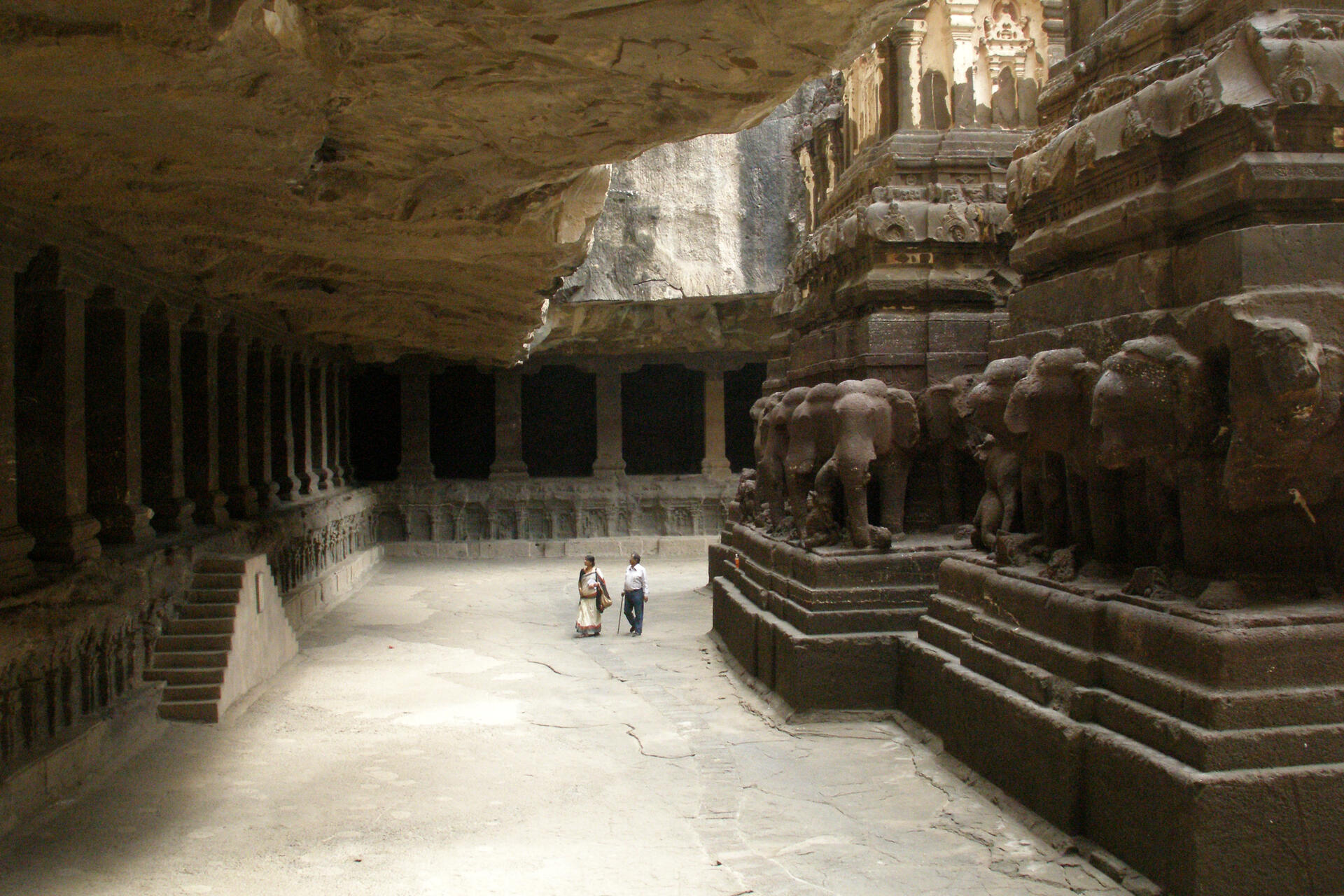
These 34 monasteries and temples, extending over more than 2 km, were dug side by side in the wall of a high basalt cliff, not far from Aurangabad, in Maharashtra. Ellora, with its uninterrupted sequence of monuments dating from A.D. 600 to 1000, brings the civilization of ancient India to life. Not only is the Ellora complex a unique artistic creation and a technological exploit but, with its sanctuaries devoted to Buddhism, Hinduism and Jainism, it illustrates the spirit of tolerance that was characteristic of ancient India.
UNESCO Justification of the World Heritage Site
Criterion (i): The ensemble of Ellora is a unique artistic achievement, a masterpiece of human creative genius. If one considers only the work of excavating the rock, a monument such as the Kailasa Temple is a technological exploit without equal. However, this temple, which transposes models from “constructed” architecture, offers an extraordinary repertory of sculpted and painted forms of a very high plastic quality and an encyclopaedic program.
Criterion (iii): Ellora brings to life again the civilization of ancient India with its uninterrupted sequence of monuments from AD 600 to 1000.
Criterion (vi): The Ellora Caves not only bear witness to three great religions, i.e. Buddhism, Brahmanism, and Jainism, they illustrate the spirit of tolerance, characteristic of ancient India, which permitted these three religions to establish their sanctuaries and their communities in a single place, which thus served to reinforce its universal value.
Encyclopedia Record: Ellora Caves
The Ellora Caves are a UNESCO World Heritage Site in Aurangabad, India. It is one of the largest rock-cut cave complexes in the world, with artwork dating from AD 600–1000, including Hindu, Buddhist, and Jain caves. The complex is a leading example of Indian rock-cut architecture, and several are not strictly "caves" in that they have no roof. Cave 16 features the largest single monolithic rock excavation in the world, the Kailash temple, a chariot-shaped monument dedicated to the god Shiva. The Kailash temple excavation also features sculptures depicting various Hindu deities as well as relief panels summarizing the two major Hindu epics.Additional Site Details
Area: Not available
Number of Components: 1
(iii) — Unique or exceptional testimony to a cultural tradition
(vi) — Directly associated with events or living traditions
Coordinates: 20.02639 , 75.17917
World Heritage Research
Discover scientific research and academic studies that deepen our understanding of Ellora Caves from its history and significance to its conservation, management, and contemporary challenges.
-
Destination Brand Personality: Case Study of the World Heritage Site of Ellora Caves
A study of Ellora Caves, India's first UNESCO World Heritage Site, identifies 18 novel brand personality traits—such as 'Intelligent,' 'Resourceful,' and 'Astute'—that were previously undocumented in its marketing literature. These traits could help target new tourist segments like millennials and eco-tourists. Researchers used factor analysis on data from tourism stakeholders (n=23) and domestic tourists (n=90), followed by Cronbach’s Alpha reliability testing, to refine the most relevant brand attributes. The findings offer dual value: academic insight into destination branding strategies and practical guidance for policymakers aiming to enhance Ellora’s appeal.
Ragde, N., & Ragde, S. (2020). Destination Brand Personality: Case Study of the World Heritage Site of Ellora Caves. Euro-Asia Tourism Studies Journal, 1(December 2020). https://doi.org/10.58345/uaea4407
View Publication Record | Read Publication -
Tourist Satisfaction and Destination Loyalty: A Case study of the World Heritage Site of Ellora Caves
A strong positive relationship exists between tourist satisfaction and destination loyalty at UNESCO World Heritage Sites, as demonstrated by a study of 60 tourists visiting Ellora Caves in India. The research found that adhering to strict rules and regulations, along with quality training for service providers, could significantly enhance visitor delight and encourage repeat visits. This insight is particularly relevant for destination planners and tourism authorities aiming to improve long-term loyalty at heritage sites.
Gaikwad, S. T., Ragde, R., & Sawant, M. (2020). Tourist Satisfaction and Destination Loyalty: A Case study of the World Heritage Site of Ellora Caves. Atna Journal of Tourism Studies, 15(1), 17–31. https://doi.org/10.12727/ajts.23.2
View Publication Record | Read Publication -
Carving Devotion in the Jain Caves at Ellora
A groundbreaking reconstruction of medieval Jain activities at Ellora, the first of its kind, reveals the significance and interplay of Jain caves alongside Hindu and Buddhist monuments. This study integrates art historical, epigraphical, and textual evidence to shed light on an understudied aspect of Ellora's cultural heritage. By examining these caves in tandem with other religious sites, it provides a comprehensive understanding of their role within the broader context of medieval Indian devotion and architectural expression.
Owen, L. (2012). Carving Devotion in the Jain Caves at Ellora. https://doi.org/10.1163/9789004206304
View Publication Record | Read Publication