World Heritage Identification Number: 242
World Heritage since: 1983
Category: Cultural Heritage
WHE Type: Archaeological Sites
Transboundary Heritage: No
Endangered Heritage: No
Country: 🇮🇳 India
Continent: Asia
UNESCO World Region: Asia and the Pacific
Map
Ajanta Caves: A Journey Through Time and Art
The Ajanta Caves, nestled within the lush greenery of the Waghora hills in Aurangabad district, Maharashtra, India, offer a captivating glimpse into the rich cultural heritage of ancient India. Inscribed as a UNESCO World Heritage Site in 1983, these 30 rock-cut Buddhist cave monuments span over a thousand years, from the second century BCE to around 480 CE.
More to come…UNESCO Description of the World Heritage Site
The first Buddhist cave monuments at Ajanta date from the 2nd and 1st centuries B.C. During the Gupta period (5th and 6th centuries A.D.), many more richly decorated caves were added to the original group. The paintings and sculptures of Ajanta, considered masterpieces of Buddhist religious art, have had a considerable artistic influence.
UNESCO Justification of the World Heritage Site
Criterion (i): Ajanta is a unique artistic achievement.
Criterion (ii): The style of Ajanta has exerted a considerable influence in India and elsewhere, extending, in particular, to Java.
Criterion (iii): With its two groups of monuments corresponding to two important moments in Indian history, this rupestral ensemble bears exceptional testimony to the evolution of Indian art, as well as to the determining role of the Buddhist community, intellectual and religious foyers, schools and reception centres in India during the Satavahana and Vakataka dynasties.
Criterion (vi): Ajanta is directly and materially associated with the history of Buddhism.
Encyclopedia Record: Ajanta Caves
The Ajanta Caves are 30 rock-cut Buddhist cave monuments dating from the second century BCE to about 480 CE in Aurangabad district of Maharashtra state in India. Ajanta Caves are a UNESCO World Heritage Site. Universally regarded as masterpieces of Buddhist religious art, the caves include paintings and rock-cut sculptures, described as among the finest surviving examples of ancient Indian art, particularly expressive paintings that present emotions through gesture, pose and form.Additional Site Details
Area: 8,242 hectares
Number of Components: 1
(ii) — Significant interchange of human values
(iii) — Unique or exceptional testimony to a cultural tradition
(vi) — Directly associated with events or living traditions
Coordinates: 20.553111 , 75.70025
Image
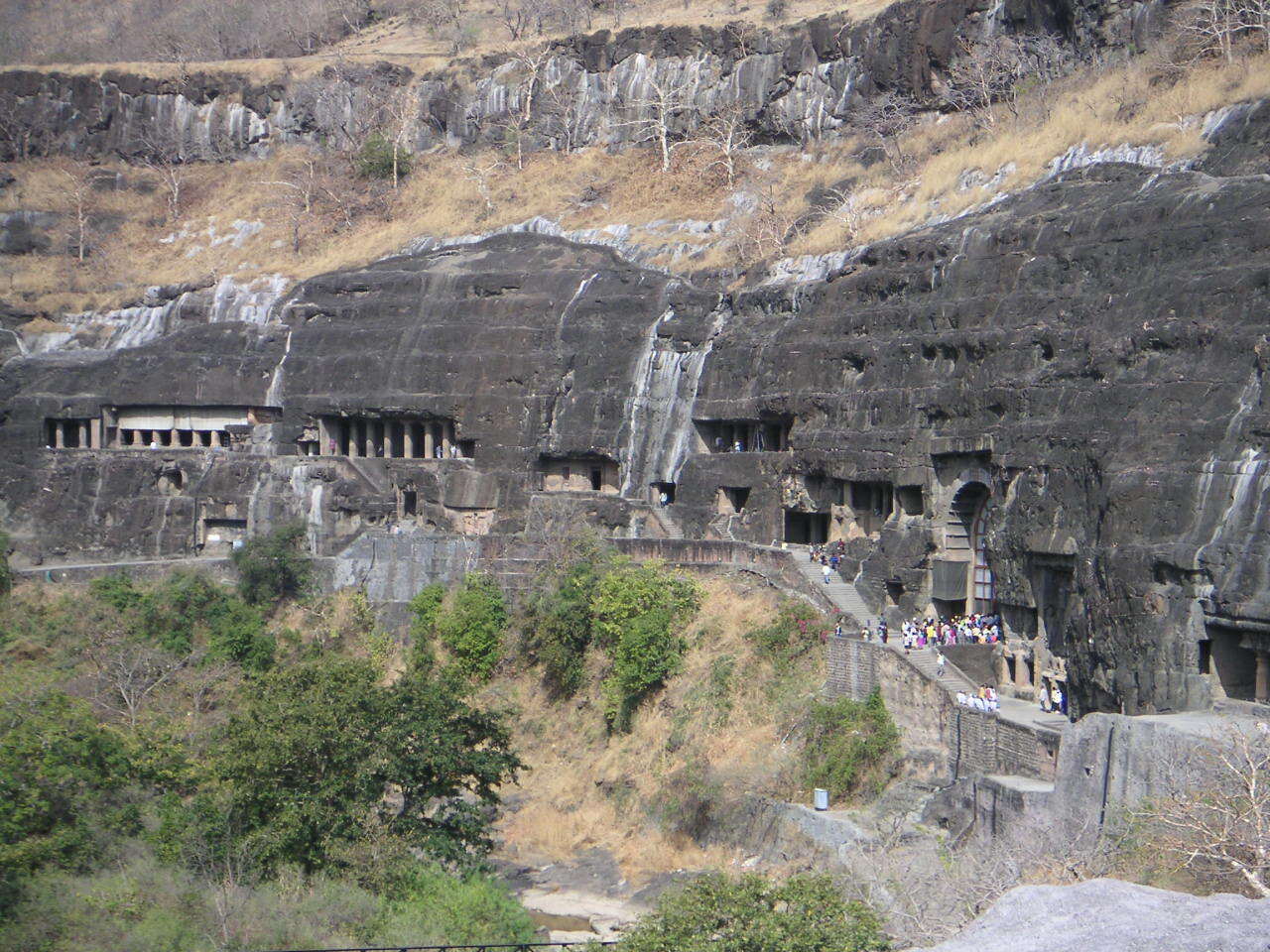
© No machine-readable author provided. Soman assumed (based on copyright claims)., CC BY 2.5 Resized from original.
World Heritage Research
Discover scientific research and academic studies that deepen our understanding of Ajanta Caves from its history and significance to its conservation, management, and contemporary challenges.
-
Sketch of a ship based on a mural in Ajanta Caves, ca. 6th century
A 6th-century AD mural from the Ajanta Caves depicts an ancient Indian ship with distinctive features, including a high stem and stern, three oblong sails attached to masts, and double quarter rudders. This sketch provides valuable insights into maritime technology of the period, particularly during the Chola Navy era. The study relies on visual analysis of historical murals, offering a rare glimpse into ancient ship design and naval architecture.
Editors of the JIOWS. (2026). Sketch of a ship based on a mural in Ajanta Caves, ca. 6th century. The Journal of Indian Ocean World Studies, 9(1-2). https://doi.org/10.26443/jiows.v9i1-2.218
View Publication Record | Read Publication -
Indian knowledge System with Reference to Ajanta Elora Caves and Lord Gautam Buddha and his Teaching
Ajanta Caves, an ancient rock-cut monument, serve as a living testament to India's rich cultural and spiritual heritage. This study underscores the relevance of Indian knowledge systems in addressing contemporary societal challenges such as moral decay, communal tensions, and mental health issues. The research highlights the moral teachings embedded in ancient texts like the Atharva Veda and Upanishads, which advocate for universal brotherhood and offer solutions through practices like yoga and meditation. It also emphasizes the significance of Sanskrit, one of the world's oldest classical languages, for its systematic and scientific grammar. Furthermore, the study delves into the life and teachings of Lord Gautam Buddha, drawing parallels between his philosophy and the Indian knowledge system. By integrating these elements, the research aims to inspire a renewed interest in India's cultural and spiritual legacy, offering potential solutions to modern societal ills.
Parmar, I. (2026). Indian knowledge System with Reference to Ajanta Elora Caves and Lord Gautam Buddha and his Teaching. New Research Publishers, Ujjain (Madhya Pradesh) India. https://doi.org/10.5281/ZENODO.19236941
View Publication Record | Read Publication -
Elegant Sculpture of History Tells the Creativity of Heritage Ajanta & Ellora Caves where Archeology Becomes Speechless & Spell Bound
Ajanta and Ellora caves, UNESCO World Heritage Sites since 1983, represent masterpieces of Buddhist religious art with profound influence on India's artistic development. These rock-hewn complexes, spanning from the 2nd century BC to the 6th Century AD, showcase exceptional craftsmanship, including the world's largest single monolithic excavation, Cave 16 (Kailasa) at Ellora. Ajanta features 30 well-preserved murals depicting iconic themes such as the 'Wheel of Life,' celestial beings, and Buddha's teachings, while Ellora comprises 34 caves constructed between the 5th to 10th centuries AD. The study highlights the artistic and historical significance of these sites, illustrating their enduring impact on global heritage.
Subhajit Samanta and Dr. Dhrubo Jyoti Sen*. (2026). ELEGANT SCULPTURE OF HISTORY TELLS THE CREATIVITY OF HERITAGE AJANTA & ELLORA CAVES WHERE ARCHEOLOGY BECOMES SPEECHLESS & SPELL BOUND. EJBPS. https://doi.org/10.5281/ZENODO.21371614
View Publication Record | Read Publication -
An analysis of Ajanta Art: Its features and contemporary significance
Ajanta Caves, a UNESCO World Heritage Site in Maharashtra, India, stand as a testament to the pinnacle of ancient Indian art and architecture from 2nd century BCE to 6th century CE. This study reveals Ajanta's artistic brilliance through its thematic richness, stylistic innovations, and sophisticated techniques, particularly in depicting Buddhist narratives like Jataka tales with profound emotional depth and naturalism. The integration of architecture, sculpture, and painting within the caves showcases a rare holistic artistic vision. Beyond historical significance, the research explores Ajanta's contemporary relevance, including its influence on modern Indian art movements such as the Bengal School, its role in cultural diplomacy, heritage tourism, and conservation challenges. The study underscores Ajanta's enduring impact on global art history and its deep-rooted connection to ancient Indian religious, philosophical, and cultural traditions.
Kumar, R. (2025). An analysis of Ajanta Art: Its features and contemporary significance. International Journal of History, 7(5), 29–32. https://doi.org/10.22271/27069109.2025.v7.i5a.400
View Publication Record | Read Publication -
The Artistic and Architectural Marvels of Ajanta and Ellora Caves: A Scholarly Review
Ajanta Caves stand as a monumental testament to India's cultural and artistic legacy, representing one of the world's most significant rock-cut constructions. This scholarly review reveals their evolution over time, highlighting their pivotal role in shaping Buddhist, Hindu, and Jain traditions through intricate rock carvings. It also explores stylistic differences between Ajanta and Bagh Caves, along with conservation efforts led by the Archaeological Survey of India (ASI). A key insight is that sustainable heritage management remains critical to preserving these ancient marvels amid ongoing challenges. The study underscores their enduring influence on global cultural heritage.
Nagul Yogendra S.J. (2025). The Artistic and Architectural Marvels of Ajanta and Ellora Caves: A Scholarly Review. Indian Knowledge System: Aesthetics, Philosophy, Cultural Semiotics , Skill Education and Contemporary Relevance. https://doi.org/10.70593/978-93-7185-779-6_7
View Publication Record | Read Publication -
The Use of Blue in the Ajanta Paintings
The use of lapis lazuli, a rare and expensive blue pigment, emerged distinctly in the Ajanta Caves' wall paintings by the 5th century CE. Initially absent in 1st-century BCE artworks, its application varied significantly: sparse in central caves (XVI and XVII) but more abundant in peripheral ones (I, II, and XXVI). This shift is linked to historical factors such as trade routes and political changes, offering insights into the cultural and economic dynamics of ancient India. The study analyzed pigment distribution and contextualized it within broader historical narratives.
Tortorici, M. (2025). The Use of Blue in the Ajanta Paintings. Acta Asiatica Varsoviensia, 38(2025), 237–272. https://doi.org/10.60018/acasva.ptir8584
View Publication Record | Read Publication -
Assessing the carrying capacity for the environmental protection of the ancient artworks of India’s Ajanta caves
A doubling of visitors over 25 years at Ajanta Caves has significantly increased CO₂ levels and particulate matter, directly threatening the preservation of ancient murals. This study quantifies the environmental impacts—including humidity, microbial growth, sunlight exposure, and air quality—on mural deterioration, providing data-driven insights to guide sustainable tourism practices. By establishing a carrying capacity regime, it offers practical strategies for balancing public access with conservation, ensuring the protection of this UNESCO World Heritage Site for future generations. The research integrates art conservation, environmental science, and social aspects, offering globally applicable solutions for heritage management.
Singh, M., Gupta, D. A., & Sawant, D. M. (2024). Assessing the carrying capacity for the environmental protection of the ancient artworks of India’s Ajanta caves. Tourism Review, 80(10), 1739–1756. https://doi.org/10.1108/tr-11-2023-0791
View Publication Record | Read Publication