World Heritage Identification Number: 925
World Heritage since: 2003
Category: Cultural Heritage
WHE Type: Archaeological Sites
Transboundary Heritage: No
Endangered Heritage: No
Country: 🇮🇳 India
Continent: Asia
UNESCO World Region: Asia and the Pacific
Map
The Rock Shelters of Bhimbetka: A Window into Prehistoric India
The Rock Shelters of Bhimbetka, nestled in the foothills of the Vindhyan Mountains, offer a unique glimpse into the rich prehistoric past of India. Inscribed as a UNESCO World Heritage Site in 2003, these rock shelters span various periods, from the Paleolithic and Mesolithic eras to the historic period. Located in the Raisen district of Madhya Pradesh, approximately 45 kilometers southeast of Bhopal, the site comprises seven hills and over 750 rock shelters spread across a 10-kilometer area.
More to come…UNESCO Description of the World Heritage Site
The Rock Shelters of Bhimbetka are in the foothills of the Vindhyan Mountains on the southern edge of the central Indian plateau. Within massive sandstone outcrops, above comparatively dense forest, are five clusters of natural rock shelters, displaying paintings that appear to date from the Mesolithic Period right through to the historical period. The cultural traditions of the inhabitants of the twenty-one villages adjacent to the site bear a strong resemblance to those represented in the rock paintings.
UNESCO Justification of the World Heritage Site
Criterion (iii): Bhimbetka reflects a long interaction between people and the landscape, as demonstrated in the quantity and quality of its rock art. Criterion (v): Bhimbetka is closely associated with a hunting and gathering economy as demonstrated in the rock art and in the relicts of this tradition in the local adivasi villages on the periphery of this site.
Encyclopedia Record: Bhimbetka rock shelters
The Bhimbetka rock shelters are an archaeological site in central India that spans the Paleolithic and Mesolithic periods, as well as the historic period. It exhibits the earliest traces of human life in India and evidence of the Stone Age starting at the site in Acheulean times. It is located in the Raisen district in the Indian state of Madhya Pradesh, about 45 kilometres (28 mi) south-east of Bhopal. It is a UNESCO World Heritage Site that consists of seven hills and over 750 rock shelters distributed over 10 km (6.2 mi). At least some of the shelters were inhabited more than 100,000 years ago.Additional Site Details
Area: 1,893 hectares
Number of Components: 2
(v) — Outstanding example of traditional human settlement
Coordinates: 22.92777778 , 77.58333333
Image
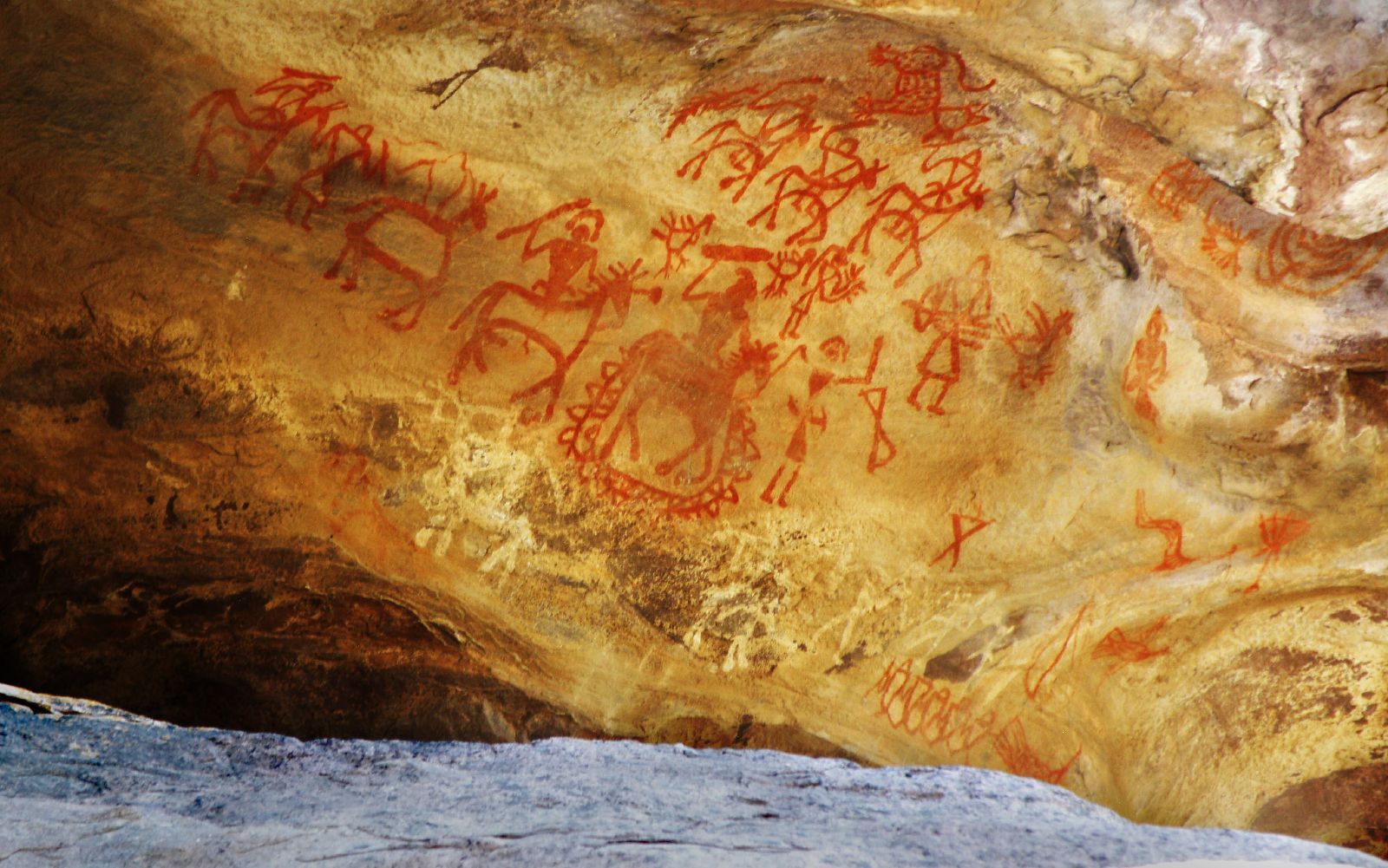
© Raveesh Vyas, CC BY-SA 2.0 Resized from original. (This derivative is under the same CC BY-SA license.)
World Heritage Research
Discover scientific research and academic studies that deepen our understanding of Rock Shelters of Bhimbetka from its history and significance to its conservation, management, and contemporary challenges.
-
Modular Symmetry and Cognitive Erasure: Reassessing Procedural Interpretation in the Bhimbetka Cross-Form Grids
A groundbreaking analysis of geometric grids in the rock art of Bhimbetka challenges conventional symbolic interpretations, revealing structural evidence for procedural abstraction in early South Asian cultures. By applying modular symmetry mapping and stochastic simulation to two cross-form grid compositions, researchers demonstrate that these designs exhibit architectural capacity for rule-governed multi-agent systems, suggesting a functional, possibly ludic purpose rather than purely symbolic meaning. The study highlights the potential marginalization of operational cognition when geometric forms are prematurely assigned symbolic significance, advocating for a methodological shift that prioritizes structural diagnostics before attributing meaning.
Gemsofindology, & M K. (2026). Modular Symmetry and Cognitive Erasure: Reassessing Procedural Interpretation in the Bhimbetka Cross-Form Grids. Zenodo. https://doi.org/10.5281/ZENODO.18812303
View Publication Record | Read Publication -
The Primordial Palette: Global Reverberations of Symbolic Cognition in Deep Time Art
A global analysis of deep time art reveals shared cognitive underpinnings in human symbolic thought, transcending geographical and temporal barriers. The study synthesizes archaeological evidence from sites like Chauvet, Lascaux, Blombos Cave, Sulawesi, and Bhimbetka with insights from cognitive science and anthropology to identify recurring themes, motifs, and techniques across the Paleolithic to early Holocene epochs. By employing a comparative framework, researchers argue that complex symbolic art reflects universal cognitive architectures, suggesting parallel evolutionary trajectories in abstract thinking worldwide. This work challenges region-specific narratives by highlighting the interconnectedness of early human artistic endeavors, offering a holistic perspective on the origins of cultural diversity and the enduring role of art in shaping human cognition.
Revista, Z., & HISTORY, 10. (2025). The Primordial Palette: Global Reverberations of Symbolic Cognition in Deep Time Art. Zenodo. https://doi.org/10.5281/ZENODO.17790843
View Publication Record | Read Publication -
Social- cultural Significance of Similar Motifs of The Raigarh District, Chhattisgarh: Wooden Art Vs Ancient Rock Art
A striking similarity between ancient rock art and contemporary wooden art of tribal communities in Raigarh, Chhattisgarh, suggests shared cultural motifs across millennia. This study reveals that motifs found in the Rock Shelters of Bhimbetka—part of a vast distribution spanning India—mirror those crafted by present-day tribal artisans, hinting at enduring traditions. By analyzing 700 concentrated rock shelters, the research sheds light on social and cultural aspects of past societies, including material culture, economic activities, and human-animal relationships. The investigation employs ethno-archaeological methods to compare ancient rock art with modern wooden art, offering insights into the enduring significance of these motifs despite their cryptic functions and hidden locations.
Rathia, M. K., & Kumar, A. (2024). Social- cultural Significance of Similar Motifs of The Raigarh District, Chhattisgarh: Wooden Art Vs Ancient Rock Art. Research Journal of Engineering and Technology, 59–64. https://doi.org/10.52711/2321-581x.2024.00009
View Publication Record | Read Publication -
Biodeterioration Activity of Lichens Communities on Rock Shelters of Bhimbetka World Heritage Zone, Madhya Pradesh, India
A diverse array of 40 lichen species, organized into 10 distinct communities, thrives on the rock shelters of Bhimbetka. Dominated by crustose and squamulose lichens (21 species), followed by Physioid (8) and Teloschistacean (7) communities, these organisms play dual roles: they contribute to biodeterioration while also offering bioprotection. The study highlights the ecological significance of these lichen communities in a micro-climatic environment conducive to their colonization, providing insights into their complex interactions with the heritage structures.
Bajpai, Aahuti., Mishra, G. K., Upreti, D. K., & Tandon, P. K. (2022). Biodeterioration Activity of Lichens Communities on Rock Shelters of Bhimbetka World Heritage Zone, Madhya Pradesh, India. International Journal of Plant and Environment, 8(01), 64–71. https://doi.org/10.18811/ijpen.v8i01.07
View Publication Record | Read Publication -
Exploration and Documentation of Rock Art Sites in the Vindhyan hills of Madhya Pradesh (Central India) and implications for their conservation
A systematic survey of the Vindhyan hills, north of the Narmada River in Madhya Pradesh, India, has uncovered over 1,479 individual rock paintings spread across 75 shelters. This discovery significantly expands the known inventory of rock art sites in this region, which had previously been understudied compared to nearby complexes like Bhimbetka and Adamgarh. The findings highlight the cultural richness of the central Narmada Basin and underscore the need for targeted conservation efforts to preserve these fragile heritage assets.
Poojari, R. A. (2022). Exploration and Documentation of Rock Art Sites in the Vindhyan hills of Madhya Pradesh (Central India) and implications for their conservation. Boletín APAR, 9(27), 1365–1384. https://doi.org/10.70748/ba.27.2022.174
View Publication Record | Read Publication -
On‐and off‐site Raman study of rock‐shelter paintings at world‐heritage site of Bhimbetka
A Raman spectroscopy study of the rock-shelter paintings at Bhimbetka, a UNESCO World Heritage Site in India, identified mineral-based pigments used from prehistoric times to the 19th century. The research detected calcite, gypsum, hematite, whewellite, and goethite both on-site with a portable spectrometer and off-site with micro-Raman spectroscopy combined with energy-dispersive X-ray analysis. This non-invasive method allowed for the precise identification of pigments even in tiny fragments (100–200 µm), providing insights into the materials used across different historical periods without damaging the artworks.
Ravindran, T. R., Arora, A. K., Singh, M., & Ota, S. B. (2012). On‐and off‐site Raman study of rock‐shelter paintings at world‐heritage site of Bhimbetka. Journal of Raman Spectroscopy, 44(1), 108–113. Portico. https://doi.org/10.1002/jrs.4148
View Publication Record | Read Publication