World Heritage Identification Number: 287
World Heritage since: 1985
Category: Cultural Heritage
WHE Type: Archaeological Sites
Transboundary Heritage: No
Endangered Heritage: Yes
Country: 🇱🇾 Libya
Continent: Africa
UNESCO World Region: Arab States
Map
Tadrart Acacus: A Palimpsest of Prehistoric Rock Art
The Tadrart Acacus, a mountainous region in western Libya, is a veritable open-air museum of prehistoric rock art. Inscribed as a UNESCO World Heritage Site in 1985, these rocky outcrops have been home to some of the most remarkable and diverse collections of cave paintings in the world.
More to come…UNESCO Description of the World Heritage Site
On the borders of Tassili N'Ajjer in Algeria, also a World Heritage site, this rocky massif has thousands of cave paintings in very different styles, dating from 12,000 B.C. to A.D. 100. They reflect marked changes in the fauna and flora, and also the different ways of life of the populations that succeeded one another in this region of the Sahara.
Encyclopedia Record: Acacus Mountains
The Acacus Mountains or Tadrart Akakus form a mountain range in the desert of the Ghat District in western Libya, part of the Sahara. They are situated east of the city of Ghat, Libya, and stretch north from the border with Algeria, about 100 kilometres (62 mi). The area has a particularly rich array of prehistoric rock art.Additional Site Details
Area: 3,923,961 hectares
Number of Components: 1
Coordinates: 24.83333 , 10.33333
Image
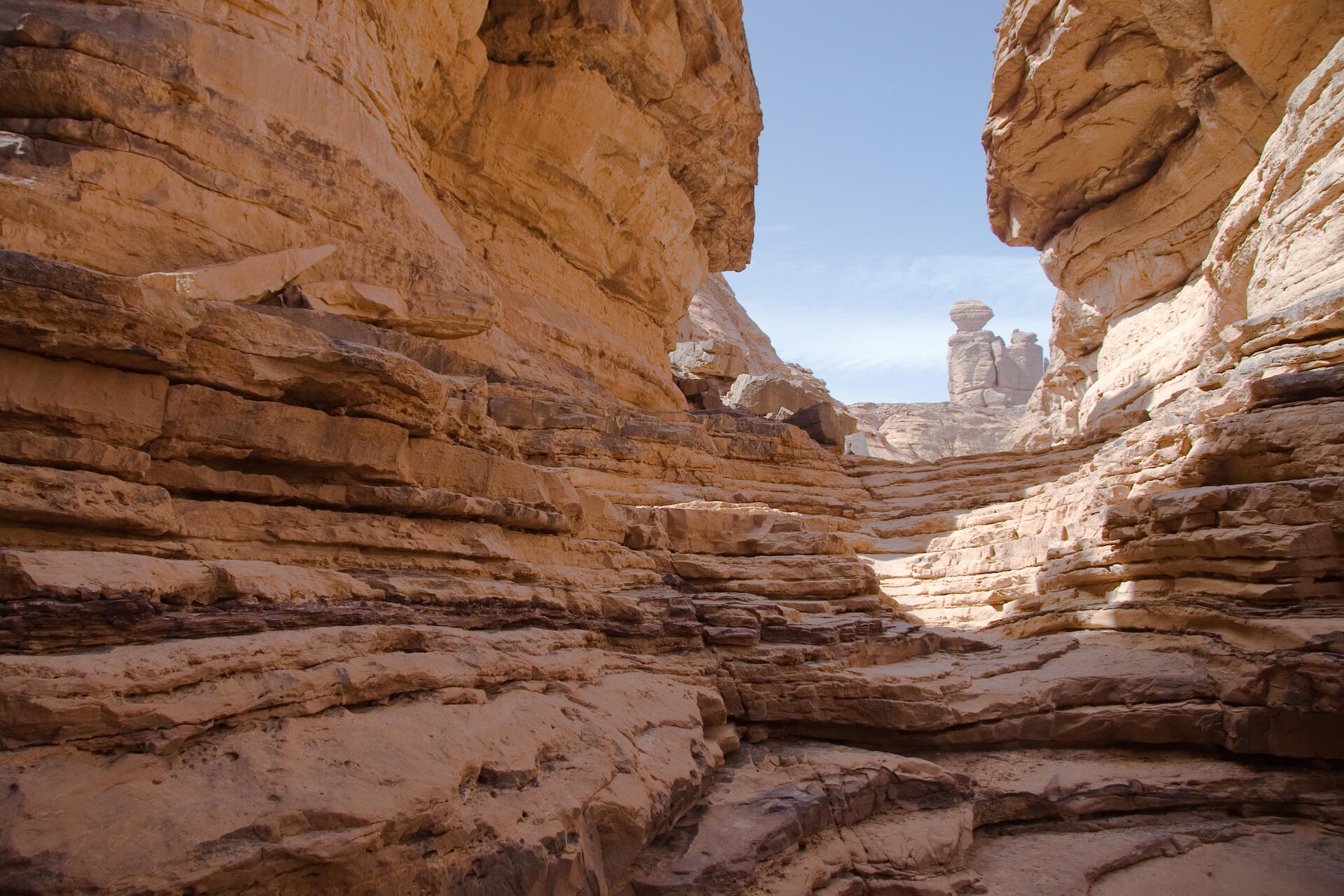
© Luca Galuzzi (Lucag), CC BY-SA 2.5 Resized from original. (This derivative is under the same CC BY-SA license.)
World Heritage Research
Discover scientific research and academic studies that deepen our understanding of Rock-Art Sites of Tadrart Acacus from its history and significance to its conservation, management, and contemporary challenges.
-
Saharan Rock Art: Local Dynamics and Wider Perspectives
Recent analyses of Saharan rock art, particularly within the Tadrart Acacus and Tassili n’Ajer regions, reveal complex local dynamics and broader regional connections. This study highlights how environmental context and social-cultural factors shape artistic expression across different massifs. By integrating analytical and contextual approaches, researchers uncover new perspectives on the chronology, meaning, and relationships between artistic provinces, emphasizing Tadrart Acacus as a pivotal site for understanding Saharan heritage.
Gallinaro, M. (2013). Saharan Rock Art: Local Dynamics and Wider Perspectives. Arts, 2(4), 350–382. https://doi.org/10.3390/arts2040350
View Publication Record | Read Publication -
Writing the desert: the ‘Tifinagh’ rock inscriptions of the Tadrart Acacus (southwestern Libya)
Rock inscriptions in the Tadrart Acacus, a UNESCO World Heritage Site in southwestern Libya, reveal significant insights into Saharan writing systems. The study highlights the potential of 'Tifinagh' inscriptions as tools for interpreting landscape history, integrating them with traditional archaeological approaches. Recent efforts, supported by the British Library's Endangered Archives Programme, have expanded the documentation of these inscriptions, addressing long-standing challenges in dating and decipherment. While preliminary findings underscore their role in reconstructing human activity, future research aims to deepen understanding through refined analytical methods.
Biagetti, S., Kaci, A. A., Mori, L., & di Lernia, S. (2012). Writing the desert: the ‘Tifinagh’ rock inscriptions of the Tadrart Acacus (southwestern Libya). Azania: Archaeological Research in Africa, 47(2), 153–174. https://doi.org/10.1080/0067270x.2012.674323
View Publication Record | Read Publication