World Heritage Identification Number: 1268
World Heritage since: 2013
Category: Cultural Heritage
WHE Type: Historic Cities & Urban Areas
Transboundary Heritage: No
Endangered Heritage: No
Country: 🇳🇪 Niger
Continent: Africa
UNESCO World Region: Africa
Map
The Historic Centre of Agadez: A Gem of Earthen Architecture in the Heart of the Sahara
The Historic Centre of Agadez, located in the heart of the Sahara Desert in Niger, stands as a testament to the rich history, culture, and architectural prowess of its inhabitants. Inscribed as a UNESCO World Heritage Site in 2013, this ancient city serves as a significant crossroads for trade, tradition, and human resilience.
More to come…UNESCO Description of the World Heritage Site
Known as the gateway to the desert, Agadez, on the southern edge of the Sahara desert, developed in the 15th and 16th centuries when the Sultanate of Aïr was established and Touareg tribes were sedentarized in the city, respecting the boundaries of old encampments, which gave rise to a street pattern still in place today. The historic centre of the city, an important crossroads of the caravan trade, is divided into 11 quarters with irregular shapes. They contain numerous earthen dwellings and a well-preserved group of palatial and religious buildings including a 27m high minaret made entirely of mud brick, the highest such structure in the world. The site is marked by ancestral cultural, commercial and handicraft traditions still practiced today and presents exceptional and sophisticated examples of earthen architecture.
UNESCO Justification of the World Heritage Site
Criterion (ii): From the 15th century, Agadez, “the gateway to the desert”, became an exceptional crossroads for the caravan trade. It bears witness to an early historic town, forming a major centre for trans-Saharan cultural interchanges. Its architecture embodies a synthesis of stylistic influences in an original urban ensemble, made entirely of mudbrick and which is specific to the Aïr region.
Criterion (iii): The historic town and its outstanding monumental ensemble, including the Grand Mosque, with its minaret, the tallest ever constructed in mudbrick, and the Sultan’s Palace, bear witness to an exceptional architectural tradition, based on sophisticated use of mudbrick. For more than five centuries, the city has developed a cultural, commercial and handicraft tradition, based on the continuity of the Sultanate of Aïr, up to the present day.
Encyclopedia Record: Historic Centre of Agadez
The Historic Centre of Agadez is the historic district of the city of Agadez in Niger. It was listed as a UNESCO World Heritage Site in 2013.Additional Site Details
Area: 77.6 hectares
Number of Components: 1
(iii) — Unique or exceptional testimony to a cultural tradition
Coordinates: 16.9736111111 , 7.9913888889
Image
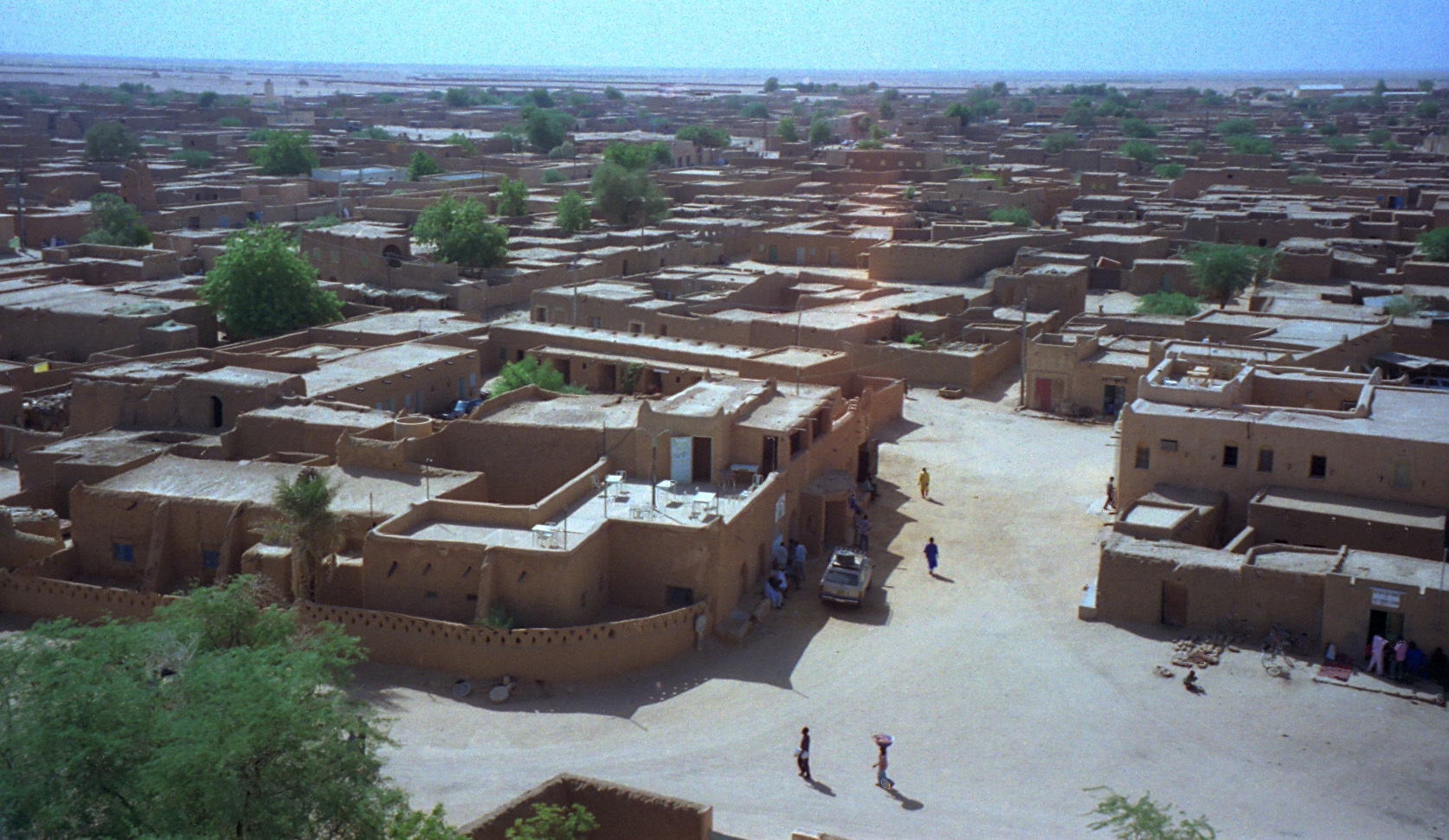
© Dan Lundberg, CC BY-SA 2.0 Resized from original. (This derivative is under the same CC BY-SA license.)
World Heritage Research
Discover scientific research and academic studies that deepen our understanding of Historic Centre of Agadez from its history and significance to its conservation, management, and contemporary challenges.
-
Digital Preservation and Restoration of Historic Buildings in Agadez, Niger
A groundbreaking digital preservation and restoration initiative in Agadez, Niger, has successfully documented and stabilized historic buildings at risk from climate change and conflict. The project, supported by the ALIPH foundation and involving Imane-Atarikh and Iconem, utilized 3D digitization to create detailed models of endangered structures, including the iconic Great Mosque of Agadez. Restoration efforts employed traditional methods while reinforcing structural integrity, with a focus on community collaboration that empowered local women. The initiative also engaged educational programs and received widespread media attention, demonstrating an innovative approach to heritage conservation in vulnerable regions.
Alhassane, M., Barreau, J.-B., Varoutsikos, B., Cissée, A., Coulin, M., Ubelmann, Y., Salifou, A., & Giligny, F. (2025). Digital Preservation and Restoration of Historic Buildings in Agadez, Niger. 3D Research Challenges in Cultural Heritage IV, 97–109. https://doi.org/10.1007/978-3-031-93753-8_7
View Publication Record | Read Publication -
Iklan Aesthetics in Niger: Identity and Adornment from Servility to Self-agency
Contemporary Iklan communities in Niger are redefining their social boundaries and resisting historical marginalization through innovative visual culture, particularly jewelry aesthetics. This study reveals how formerly enslaved groups, historically subjected to Tuareg noble control, now employ tactics such as adopting elite Tuareg styles or incorporating new market goods to assert autonomy. By analyzing two Tamasheq-speaking regions—Tillabéri and Tahoua-Agadez—the research demonstrates the impact of postcolonial economic shifts, NGOs, and societal changes on iklan identity formation. Iklan, once labeled as 'slaves' or 'captives,' are challenging racialized status hierarchies by reinterpreting visual symbols, such as silver jewelry and anklets, to reflect their contemporary agency.
Becker, C. J., & Nowak, B. (2021). Iklan Aesthetics in Niger: Identity and Adornment from Servility to Self-agency. African Arts, 55(3), 10–25. https://doi.org/10.1162/afar_a_00666
View Publication Record | Read Publication