World Heritage Identification Number: 938
World Heritage since: 1999
Category: Cultural Heritage
WHE Type: Cultural Landscapes
Transboundary Heritage: No
Endangered Heritage: No
Country: 🇳🇬 Nigeria
Continent: Africa
UNESCO World Region: Africa
Map
Exploring the Sukur Cultural Landscape: A Unique Blend of Culture, History, and Nature
The Sukur Cultural Landscape, nestled within the Mandara Mountains of Nigeria's Adamawa State, stands as a testament to the harmonious fusion of culture, history, and nature. This remarkable site, inscribed as a UNESCO World Heritage Site in 1999, offers a captivating glimpse into the rich tapestry of African cultural heritage.
More to come…UNESCO Description of the World Heritage Site
The Sukur Cultural Landscape, with the Palace of the Hidi (Chief) on a hill dominating the villages below, the terraced fields and their sacred symbols, and the extensive remains of a former flourishing iron industry, is a remarkably intact physical expression of a society and its spiritual and material culture.
UNESCO Justification of the World Heritage Site
Criterion (iii): Sukur is an exceptional landscape that graphically illustrates a form of land-use that marks a critical stage in human settlement and its relationship with its environment.
Criterion (v): The cultural landscape of Sukur has survived unchanged for many centuries, and continues to do so at a period when this form of traditional human settlement is under threat in many parts of the world.
Criterion (vi): The cultural landscape of Sukur is eloquent testimony to a strong and continuing spiritual and cultural tradition that has endured for many centuries.
Encyclopedia Record: Sukur
Sukur or Sukur Cultural Landscape is a UNESCO World Heritage Site located on a hill above the village of Sukur in the Adamawa State of Nigeria. It is situated in the Mandara Mountains, close to the border with Cameroon. Its UNESCO inscription is based on the cultural heritage, material culture, and the naturally-terraced fields. Sukur is Africa's first cultural landscape to receive World Heritage List inscription.Additional Site Details
Area: 764.4 hectares
Number of Components: 1
(v) — Outstanding example of traditional human settlement
(vi) — Directly associated with events or living traditions
Coordinates: 10.74056 , 13.57194
Image
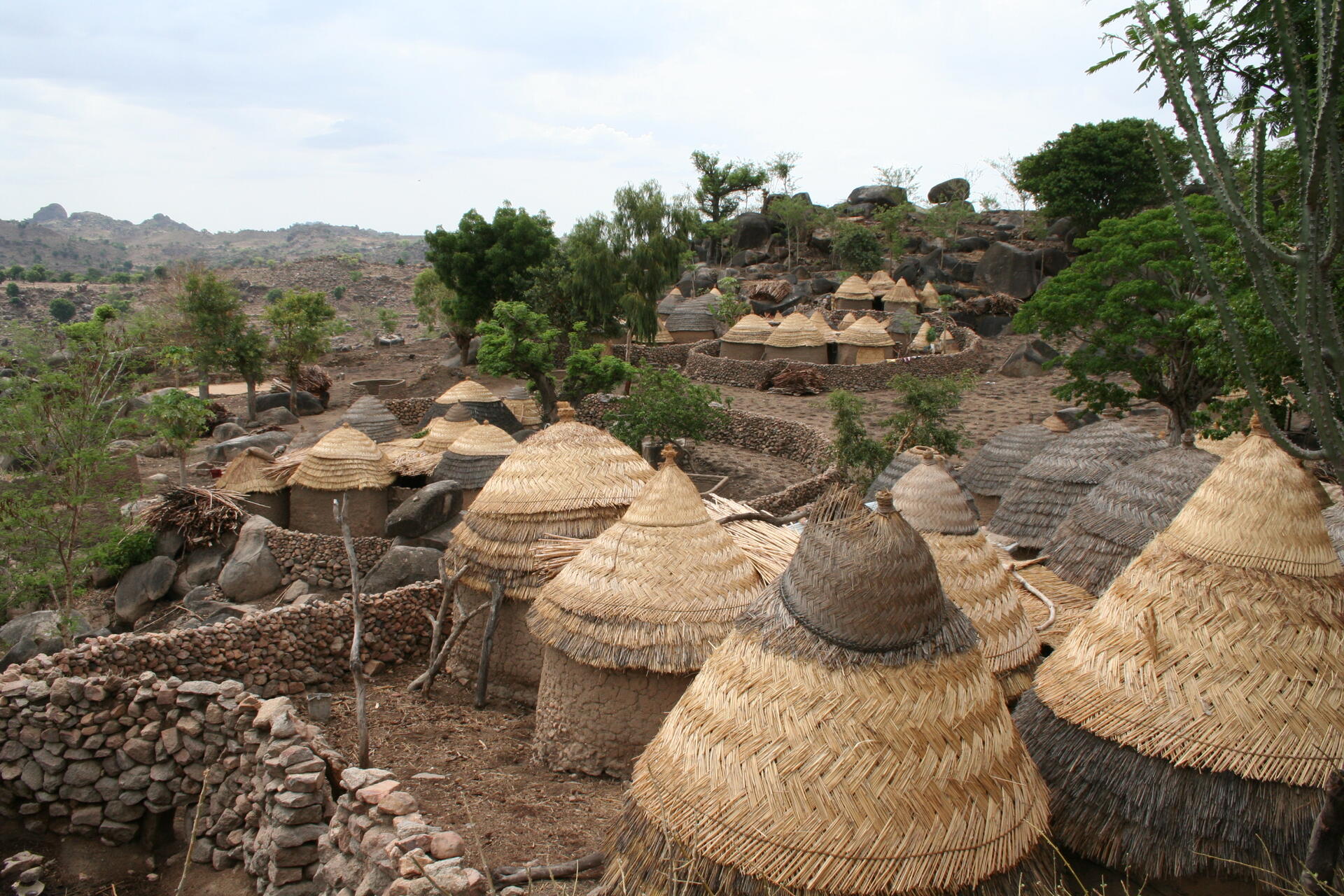
© DipoTayo, CC BY-SA 4.0 Resized from original. (This derivative is under the same CC BY-SA license.)
World Heritage Research
Discover scientific research and academic studies that deepen our understanding of Sukur Cultural Landscape from its history and significance to its conservation, management, and contemporary challenges.
-
Heritage under Siege: Comparative Perspectives on Vandalism, Climate Change and Global Inequality in Nigeria and Iran
Heritage sites, often celebrated for their cultural significance and historical depth, are increasingly under threat from overlapping pressures of climate change, insecurity, vandalism, urban development, and global inequality. A comparative study of the Sukur Cultural Landscape in Nigeria and other heritage sites in Iran reveals that these challenges are not merely environmental or political but also deeply intertwined with issues of memory, power, ownership, and survival. The research, combining qualitative fieldwork, interviews, observations, document analysis, and critical discourse analysis, argues that heritage protection cannot be reduced to technical conservation alone; it requires ecological care, cultural justice, and more democratic participation. Local communities play a crucial role as both witnesses to heritage loss and custodians whose knowledge challenges the limitations of global heritage regimes.
Mba, O. J., & Ghodsi, S. B. (2026). Heritage under Siege: Comparative Perspectives on Vandalism, Climate Change and Global Inequality in Nigeria and Iran. International Journal of Research and Innovation in Social Science, 10(8), 2119–2135. https://doi.org/10.47772/ijriss.2026.100800148
View Publication Record | Read Publication -
Integration of Virtual Reality to Preserve Nigeria’s Cultural Heritage Using Technology Acceptance Model and Constructivism Learning Theory
Virtual Reality (VR) emerges as a transformative tool for preserving Nigeria's cultural heritage, offering immersive and interactive experiences that can counteract threats from urbanization and globalization. This study highlights VR's potential to document and promote both tangible landmarks like the Sukur Cultural Landscape and intangible traditions, such as oral histories and festivals. While global adoption of VR in heritage preservation is growing, its implementation in Nigeria remains limited due to challenges like cost and accessibility. The research emphasizes the need for collaborative efforts among technologists, researchers, and cultural custodians to develop localized VR solutions that enhance cultural awareness, engage younger generations, and boost tourism. By integrating the Technology Acceptance Model and Constructivism Learning Theory, this work provides a roadmap for leveraging VR to safeguard Nigeria's rich cultural legacy while ensuring its continuity across generations.
Esan, O. (2025). Integration of Virtual Reality to Preserve Nigeria’s Cultural Heritage Using Technology Acceptance Model and Constructivism Learning Theory. Fountain of Informatics Journal, 10(1), 11–16. https://doi.org/10.21111/fij.v10i1.13821
View Publication Record | Read Publication -
Sukur Kingdom: The Sleeping Beauty (Popularizing Nigeria’s 1st UNESCO World Heritage Site)
The Sukur Kingdom, Nigeria's first UNESCO World Heritage Site, remains largely unknown despite its significant cultural and historical value. This study identifies the site as a potential key tourist attraction due to its unique terraced fields, ancient iron smelting technology, and rich cultural landscape. By analyzing challenges in its promotion, the research proposes strategies for popularizing the site while ensuring heritage preservation. The approach combines cultural, historical, and geographical analysis to highlight Sukur's global significance and address barriers to its recognition.
Oladimeji, O. M., & Umaru, I. J. (2024). Sukur Kingdom: The Sleeping Beauty (Popularizing Nigeria’s 1st UNESCO World Heritage Site). Kwaghe International Journal of Arts, Humanities and Religious Studies, 1(1), 68–79. https://doi.org/10.58578/kijahrs.v1i1.4077
View Publication Record | Read Publication -
Extension of Sukur Cultural Landscape in Nigeria to incorporate the 16 DGB sites on the Wandala Cultural Landscape in Cameroon as a serial transboundary World Heritage site
A proposed expansion of the Sukur Cultural Landscape in Nigeria to include 16 DGB sites from Cameroon's Wandala Cultural Landscape aims to establish a serial transboundary World Heritage site. This initiative, agreed upon by African World Heritage experts in 2016, seeks to foster international cooperation and bilateral relations between Nigeria and Cameroon, addressing historical disputes such as the Bakasi Peninsula conflict. The proposal highlights the potential for peace and development through cultural heritage collaboration, with a focus on Korup Hill (Cameroon) and Oban Hill (Nigeria). The research emphasizes the importance of transboundary site management in promoting regional stability and shared cultural preservation.
Sham, A. (2023). Extension of Sukur Cultural Landscape in Nigeria to incorporate the 16 DGB sites on the Wandala Cultural Landscape in Cameroon as a serial transboundary World Heritage site. Managing Transnational UNESCO World Heritage Sites in Africa, 157–165. https://doi.org/10.1007/978-3-030-80910-2_14
View Publication Record | Read Publication -
Cultural Heritage and Conflict in Africa
African conflicts, rooted in colonial legacies and exacerbated by Cold War dynamics, have severely impacted cultural heritage, with 13 UNESCO World Heritage Sites on the danger list due to ongoing unrest. While international interventions, such as those in Libya and Mali, have drawn global attention—including legal action against heritage destruction—cases like Nigeria's Sukur Cultural Landscape under Boko Haram attacks remain largely unaddressed by UNESCO or other entities. The study highlights the challenges of applying the 1954 Hague Convention to internal conflicts, which dominate Africa's conflict landscape, and underscores the need for stronger mechanisms to protect vulnerable heritage sites.
Ndoro, W. (2021). Cultural Heritage and Conflict in Africa. Oxford Research Encyclopedia of Anthropology. https://doi.org/10.1093/acrefore/9780190854584.013.270
View Publication Record | Read Publication -
Rural tourism as a factor of sustainable development: a case study of Sukur World Heritage Site in Adamawa State, Northeastern Nigeria
Rural tourism can serve as a significant driver for sustainable development, particularly in regions with rich cultural landscapes. A case study of the Sukur Cultural Landscape, a UNESCO World Heritage Site in Adamawa State, Northeastern Nigeria, demonstrates this potential. The research highlights that community participation and environmental protection are central to leveraging tourism for sustainable growth. It outlines strategies for developing the site while mitigating risks associated with such endeavors. These strategies aim to balance economic benefits with conservation efforts, ensuring long-term sustainability.
Tagowa, W. N. (2010). Rural tourism as a factor of sustainable development: a case study of Sukur World Heritage Site in Adamawa State, Northeastern Nigeria. The Sustainable World, 1, 675–688. https://doi.org/10.2495/sw100611
View Publication Record | Read Publication