World Heritage Identification Number: 1230
World Heritage since: 2009
Category: Cultural Heritage
WHE Type: Religious Sites & Sacred Architecture
Transboundary Heritage: No
Endangered Heritage: No
Country: 🇰🇬 Kyrgyzstan
Continent: Asia
UNESCO World Region: Asia and the Pacific
Map
Exploring the Spiritual Heart of Central Asia: Sulaiman-Too Sacred Mountain
The Sulaiman-Too Sacred Mountain, nestled within the heart of Kyrgyzstan, stands as a testament to the rich cultural and spiritual heritage of Central Asia. This majestic mountain massif, encompassing five distinct peaks, has been a focal point for travelers and pilgrims for over 1,500 years. Inscribed as a UNESCO World Heritage Site in 2009, Sulaiman-Too offers a unique blend of pre-Islamic and Islamic beliefs, making it a remarkable example of religious syncretism.
Rising dramatically above the city of Osh—an important historic crossroads along the Central Asian Silk Roads, Sulaiman-Too serves as a beacon for those traversing this historic network. The mountain's slopes are adorned with numerous ancient places of worship and caves containing intricate petroglyphs depicting humans, animals, and symbolic motifs.
Two historic mosques are of particular note: the Rawat Abdullakhan Mosque, dating back to the 16th century, and the small Babur’s House (or the Takht-i Suleiman Mosque), which sits atop one of the peaks. The Asaf ibn Burhiya Mausoleum, located at the foot of the mountain, further contributes to the site's religious significance.
Within the UNESCO property, 101 sacred sites and features have been identified, including petroglyph locations, caves, shrines, and ritual places. Among these are 17 sites that remain active places of worship today, connected by ancient footpaths across the mountain. These cult sites are traditionally believed to offer healing for ailments such as infertility, headaches, and back pain, as well as blessings of longevity and well-being for pilgrims.
The veneration of Sulaiman-Too transcends individual religious traditions and reflects deeply rooted spiritual practices shared across Central Asia. Although the mountain holds particular importance in Islamic tradition, its sacred status predates the arrival of Islam, with archaeological and historical evidence indicating its role as a major pilgrimage site in pre-Islamic times. This layering and fusion of beliefs has created a unique spiritual landscape that sets Sulaiman-Too apart from other sacred mountains throughout the world.
In terms of its physical characteristics, Sulaiman-Too rises above the fertile Fergana Valley, forming a dramatic backdrop to the city of Osh. The mountain’s peaks and slopes are composed primarily of limestone and other sedimentary rock formations, shaping its distinctive cliffs and caves. Despite the bustling urban environment of Osh, the site supports a range of plant and animal species, providing an important refuge for biodiversity.
Widely regarded as the most complete example of a sacred mountain in Central Asia, the Sulaiman-Too Sacred Mountain embodies centuries of continuous spiritual practice. Its layered history, cultural symbolism, and enduring religious significance make it an essential destination for anyone seeking to explore the heart of Central Asia and gain a deeper understanding of the region's complex and fascinating past.
UNESCO Description of the World Heritage Site
Sulaiman-Too Sacred Mountain Kyrgyzstan dominates the Fergana Valley and forms the backdrop to the city of Osh, at the crossroads of important routes on the Central Asian Silk Roads. For more than one and a half millennia, Sulaiman was a beacon for travellers revered as a sacred mountain. Its five peaks and slopes contain numerous ancient places of worship and caves with petroglyphs as well as two largely reconstructed 16th century mosques. One hundred and one sites with petroglyphs representing humans and animals as well as geometrical forms have been indexed in the property so far. The site numbers 17 places of worship, which are still in use, and many that are not. Dispersed around the mountain peaks they are connected by footpaths. The cult sites are believed to provide cures for barrenness, headaches, and back pain and give the blessing of longevity. Veneration for the mountain blends pre-Islamic and Islamic beliefs. The site is believed to represent the most complete example of a sacred mountain anywhere in Central Asia, worshipped over several millennia.
UNESCO Justification of the World Heritage Site
Criterion (iii): The rich concentration of material evidence for cult practices preserved on Sulaiman-Too mountain from pre- and post-Islamic times, together with its ‘ideal’ form present the most complete picture of a sacred mountain anywhere in Central Asia.
Criterion (vi): Sulaiman-Too presents exceptionally vivid evidence for strong traditions of mountain worship which have spanned several millennia and been absorbed successfully by Islam. It has had a profound effect over a wide part of Central Asia.
Encyclopedia Record: Sulayman Mountain
The Sulayman Mountain is the only World Heritage Site located entirely in the country of Kyrgyzstan. It is located in the city of Osh and was once a major place of pre-Muslim pilgrimage.Additional Site Details
Area: 112 hectares
Number of Components: 1
(vi) — Directly associated with events or living traditions
Coordinates: 40.5311111111 , 72.7827777778
Image
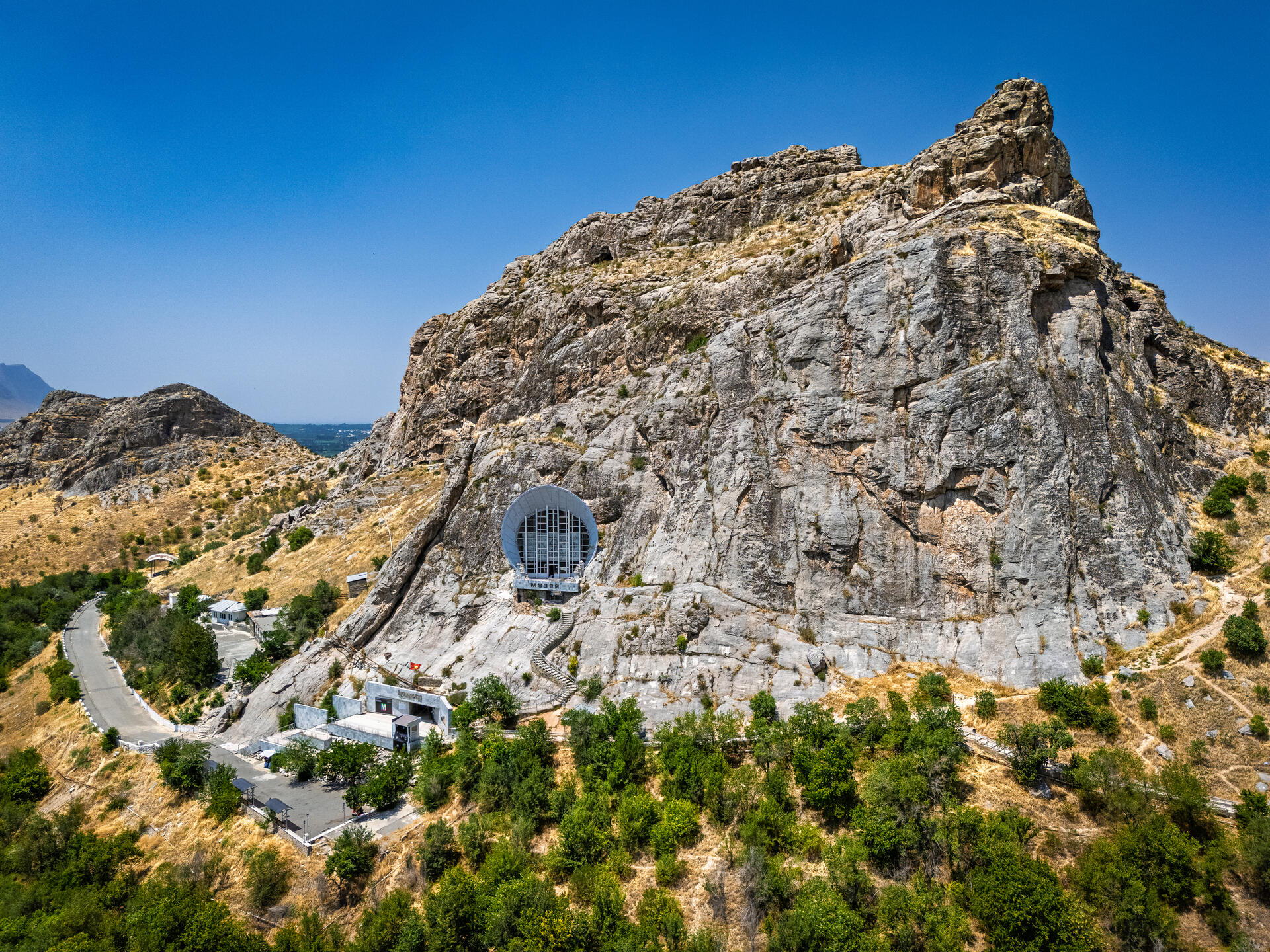
© Nefesh03, CC BY-SA 4.0 Resized from original. (This derivative is under the same CC BY-SA license.)
World Heritage Research
Discover scientific research and academic studies that deepen our understanding of Sulaiman-Too Sacred Mountain from its history and significance to its conservation, management, and contemporary challenges.
-
Research of Functional Aspects of Toponyms in Modern Linguistics
Kyrgyz toponyms serve multiple functional roles, reflecting cultural, historical, and geographical aspects. This study identifies four key functions: nominative-localising (e.g., Ala-Archa, Kyzyl-Asker), artistic (metaphorical or metonymic, e.g., Alamedin, Zhylan-Artyk), chronographic, and cultural memory (e.g., Sulaiman-Too, Asanbai Street). Researchers analyzed toponyms in Bishkek and Osh, revealing how they encode geographical features, historical events, and cultural heritage. The findings highlight the pragmatic significance of toponyms in preserving linguistic and ethnographic identities while illustrating their metaphorical or metonymic motivations.
Isabekov, I., Alymkulov, A., Altaeva, D., & Atazhanova, N. (2026). Research of Functional Aspects of Toponyms in Modern Linguistics. Southern Semiotic Review. https://doi.org/10.33234/ssr.23/13
View Publication Record | Read Publication -
Archaeoseismological Study of Medieval Monuments at the Foot of Sulaiman-Too Mountain (Osh City, Fergana Valley)
A groundbreaking archaeoseismological study of the Ravat Abdullakhan Mosque in Osh, Kyrgyzstan, reveals severe seismic damage likely caused by the 1822 Kokand earthquake. The analysis, using advanced techniques, identified significant structural deformations such as horizontal displacements, tilts, and rotations, suggesting seismic oscillations with a strength of Il = 8–9 on the MSK-64 scale. The mosque, built in the 16th century on older ruins, may have suffered damage from earlier earthquakes in the 12th and 15th centuries, potentially linked to tectonic movements along the adyr faults near Sulaiman-Too Mountain. This research sheds light on the seismic history of the region and the resilience of medieval architectural heritage.
Korzhenkov, A. M., Amanbaeva, B. E., Anarbaev, A., Ibadullaev, H., Korzhenkova, L. A., Pardaev, M., Strelnikov, A. A., Williams, J., & Fortuna, A. B. (2023). Archaeoseismological Study of Medieval Monuments at the Foot of Sulaiman-Too Mountain (Osh City, Fergana Valley). Izvestiya, Atmospheric and Oceanic Physics, 59(7), 838–856. https://doi.org/10.1134/s0001433823070034
View Publication Record | Read Publication -
Concept of regeneration of ethnic quarter “Crafts’ street” in the conservation zone “Sulayman-Too” in the city of Osh
A proposed regeneration concept for the historic 'Crafts’ street' quarter in Osh, Kyrgyzstan, aims to balance cultural preservation with sustainable urban development within the UNESCO World Heritage site Sulaiman-Too. The study highlights the quarter’s pivotal role in maintaining the city’s heritage and boosting its tourist appeal while ensuring adherence to strict conservation protocols. It provides a framework for integrating traditional craftsmanship into modern urban planning, emphasizing the need for regulated use of cultural resources without compromising their authenticity.
Imankulov, D. D., Raid, H., Bektemirova, Z. A., & Moldalieva, I. T. (2022). Concept of regeneration of ethnic quarter “Crafts’ street” in the conservation zone “Sulayman-Too” in the city of Osh. Heritage and Modern Times, 4(4), 453–464. https://doi.org/10.52883/619-0214-2021-4-4-453-464
View Publication Record | Read Publication -
Osh City Revival Concept
A proposed concept for the architectural and planning revival of Osh, Kyrgyzstan, highlights the pivotal role of Sulaiman-Too Sacred Mountain and its historical heritage in driving socio-economic growth and tourism. The study emphasizes the mountain's significance as a cultural and economic asset, advocating for urban reconstruction to preserve and enhance these values. It outlines a program aimed at revitalizing the historic city by integrating modern development with traditional elements, ensuring sustainable urban growth while maintaining cultural integrity.
Moldaliyeva, I. T., & Raid, H. (2022). OSH CITY REVIVAL CONCEPT. The Herald of KSUCTA N a N Isanov, (2-2-2022), 833–839. Internet Archive. https://doi.org/10.35803/1694-5298.2022.2.833-839
View Publication Record | Read Publication