
Summer Palace, an Imperial Garden in Beijing


World Heritage Identification Number: 880

World Heritage since: 1998

Category: Cultural Heritage

WHE Type: Buildings & Architectural Ensembles

Transboundary Heritage: No

Endangered Heritage: No

Country: 🇨🇳 China

Continent: Asia

UNESCO World Region: Asia and the Pacific

Map

The Summer Palace: A Masterpiece of Chinese Landscape Garden Design

The Summer Palace, located in Beijing, China, is a remarkable example of Chinese landscape garden design that has been recognized by UNESCO as a World Heritage Site since 1998. Originally constructed in 1750, this imperial garden underwent significant destruction during the war of 1860 but was meticulously restored on its original foundations in 1886.

More to come…

UNESCO Description of the World Heritage Site

The Summer Palace in Beijing – first built in 1750, largely destroyed in the war of 1860 and restored on its original foundations in 1886 – is a masterpiece of Chinese landscape garden design. The natural landscape of hills and open water is combined with artificial features such as pavilions, halls, palaces, temples and bridges to form a harmonious ensemble of outstanding aesthetic value.

UNESCO Justification of the World Heritage Site

Criterion (i): The Summer Palace in Beijing is an outstanding expression of the creative art of Chinese landscape garden design, incorporating the works of humankind and nature in a harmonious whole.

Criterion (ii): The Summer Palace epitomizes the philosophy and practice of Chinese garden design, which played a key role in the development of this cultural form throughout the east.

Criterion (iii): The Imperial Chinese Garden, illustrated by the Summer Palace, is a potent symbol of one of the major world civilizations.

Encyclopedia Record: Summer Palace

The Summer Palace is a vast ensemble of lakes, gardens and palaces in Beijing. It was an imperial garden during the Qing dynasty. Inside includes Longevity Hill Kunming Lake and Seventeen Hole Bridge. It covers an expanse of 2.9 square kilometres (1.1 sq mi), three-quarters of which is water.

Read more on Wikipedia

Additional Site Details

Area: 297 hectares

Number of Components: 1

UNESCO Criteria: (i) — Masterpiece of human creative genius
(ii) — Significant interchange of human values
(iii) — Unique or exceptional testimony to a cultural tradition

Coordinates: 39.91055556 , 116.1411111
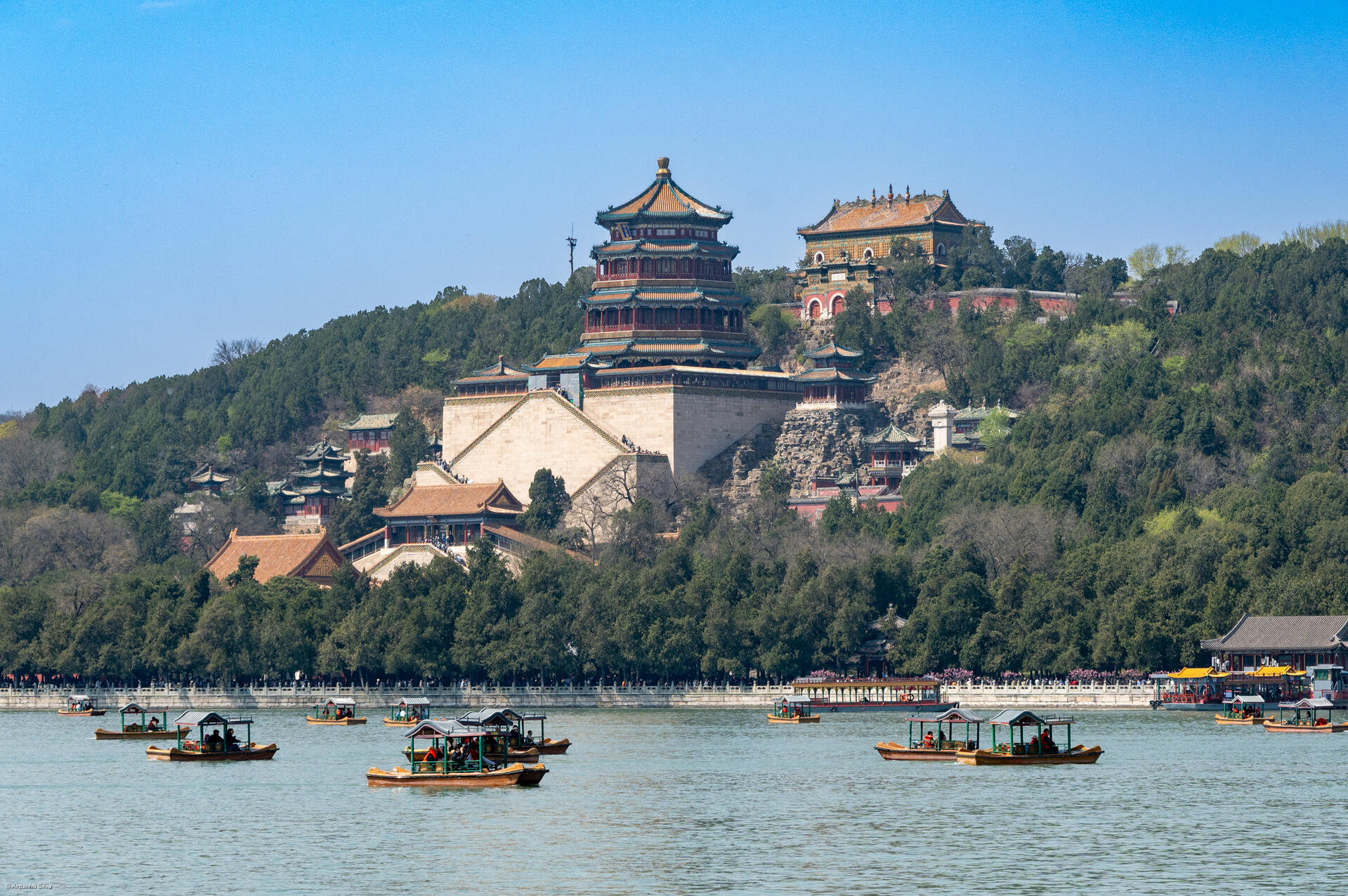
Image

Image of Summer Palace, an Imperial Garden in Beijing

© xiquinhosilva, CC BY 2.0 Resized from original.

World Heritage Research

Discover scientific research and academic studies that deepen our understanding of Summer Palace, an Imperial Garden in Beijing from its history and significance to its conservation, management, and contemporary challenges.

  • Social Value of Urban Green Space Based on Visitors’ Perceptions: The Case of the Summer Palace, Beijing, China

    A study on the Summer Palace, Beijing, reveals that cultural, historical, and aesthetic values are increasingly favored by visitors, with social value hotspots centered around architectural complexes and waters. Using public participation geographic information systems (PPGIS), researchers assessed ecosystem services' social value and its spatial distribution, finding three core hotspot areas. The research also highlights differences in perceptions between anthropocentrists and ecocentrists, with the latter showing higher overall social value indices. This analysis provides insights for urban ecological space planning and management, emphasizing the relationship between environmental landscape features and visitors' perceived social values.

    Huang, R., Liu, Y., Liang, S., Si, J., Di, S., Cai, M., Hu, S., Hao, C., & Zhao, Z. (2023). Social Value of Urban Green Space Based on Visitors’ Perceptions: The Case of the Summer Palace, Beijing, China. Forests, 14(11), 2192. https://doi.org/10.3390/f14112192

    View Publication Record | Read Publication

  • Tourist risk assessment of pollen allergy in tourism attractions: A case study in the Summer Palace, Beijing, China

    A comprehensive risk assessment of pollen allergy for tourists at the Summer Palace, Beijing, identified seven primary allergenic plants, with Platycladus orientalis and Salix babylonica posing the highest risk. The study, using a multidisciplinary approach combining ecology, medicine, phenology, and risk management, revealed that certain spots like the Hall of Serenity and routes such as the Long Corridor and Longevity Hill exhibit high-risk levels for pollen allergy during spring. This research underscores the need for strengthened monitoring and dynamic assessment of pollen-allergy risks to mitigate potential impacts on tourism experiences amidst global warming and urbanization.

    Zhou, Y., Dai, J., Liu, H., & Liu, X. (2022). Tourist risk assessment of pollen allergy in tourism attractions: A case study in the Summer Palace, Beijing, China. Frontiers in Public Health, 10. https://doi.org/10.3389/fpubh.2022.1030066

    View Publication Record | Read Publication
  • Chromatographic, Microscopic, and Spectroscopic Characterization of a Wooden Architectural Painting from the Summer Palace, Beijing, China

    A comprehensive analysis of wooden architectural paintings from the Summer Palace in Beijing reveals the use of blood as a binding medium and identifies emerald green and ultramarine pigments. The study employed advanced techniques, including scanning electron microscopy–energy dispersive spectrometry (SEM-EDS), X-ray fluorescence (XRF), X-ray diffraction (XRD), gas chromatography–mass spectrometry (GC-MS), and morphological microscopy, to systematically characterize the morphology and material composition of these ancient decorative artworks. These findings provide crucial insights into the preparation techniques used in the renowned Summer Palace, offering a scientific basis for restoration efforts and archaeological research.

    Ma, Z., Wang, L., Yan, J., Zhou, W., Pitthard, V., Bayerova, T., & Krist, G. (2019). Chromatographic, Microscopic, and Spectroscopic Characterization of a Wooden Architectural Painting from the Summer Palace, Beijing, China. Analytical Letters, 52(10), 1670–1680. https://doi.org/10.1080/00032719.2018.1561707

    View Publication Record | Read Publication
  • The Old Summer Palace and the Rhetoric of National Treasures

    A critical analysis of the Old Summer Palace reveals how its designation as a national treasure is constructed through rhetorical strategies, shaping its cultural and legal significance. The study examines how narratives surrounding the site's historical value influence its preservation and public perception, highlighting tensions between heritage conservation and political discourse. Gillman employs discourse analysis to dissect official documents, legal texts, and media representations, uncovering the ideological underpinnings of its status as a UNESCO World Heritage Site. This approach underscores the interplay between cultural memory, national identity, and the instrumentalization of heritage for political ends.

    Gillman, D. (2019). The Old Summer Palace and the Rhetoric of National Treasures. Santander Art and Culture Law Review, 5(2), 233–244. https://doi.org/10.4467/2450050xsnr.19.022.11570

    View Publication Record | Read Publication
  • Collecting and Displaying China’s “Summer Palace” in the West

    Over a million objects from the Yuanmingyuan, or Summer Palace—a significant imperial Chinese palace complex—were looted during the Second Opium War and dispersed globally. This study reveals how Western museums, including the Royal Engineers Museum in Kent, the National Museum of Scotland, and the Musee Chinois at Château de Fontainebleau, shaped the display of these artifacts over 150 years, reflecting European cultural, political, and aesthetic biases rather than the original context of the Yuanmingyuan. By analyzing museum practices, the research offers insights into Western representations of China during this period.

    Tythacott, L. (Ed.). (2017). Collecting and Displaying China’s “Summer Palace” in the West. https://doi.org/10.4324/9781315113395

    View Publication Record | Read Publication
  • From the Summer Palace 1860

    A significant portion of objects labeled as originating from the Summer Palace, Beijing, lack verifiable provenance, despite some having clear ties to the 1860 sacking. The study highlights how Western markets in the 19th century often used vague descriptions like 'From the Imperial Summer Palace' for newly acquired items, obscuring their true origins. This practice exacerbated China's political humiliation and cultural loss during colonial-era conflicts. The research examines historical records, sales data, and government responses to trace the movement of artworks, architectural fragments, and manuscripts from Yuanmingyuan (the Old Summer Palace) to Western collections.

    Pearce, N. (2017). From the Summer Palace 1860. Collecting and Displaying China’s “Summer Palace” in the West, 38–50. https://doi.org/10.4324/9781315113395-3

    View Publication Record | Read Publication
  • Monitoring Cultural Heritage Sites with Advanced Multi-Temporal InSAR Technique: The Case Study of the Summer Palace

    A novel Multi-Temporal Interferometric Synthetic Aperture Radar (MTInSAR) technique revealed that the UNESCO World Heritage Site, Summer Palace in Beijing, remains largely stable but faces localized risks. The study identified mm/cm-level instabilities in Longevity Hill's ruins and monuments, likely due to human activities and natural decay. Subsidence near East and South Gates was linked to urbanization, while groundwater variations and over-tourism contributed to instability along Kunming Lakeside. This advanced approach, combining Persistent Scatterers (PSs) and Distributed Scatterers (DSs), offers a high-precision tool for early risk detection and preventive conservation of cultural heritage sites.

    Tang, P., Chen, F., Zhu, X., & Zhou, W. (2016). Monitoring Cultural Heritage Sites with Advanced Multi-Temporal InSAR Technique: The Case Study of the Summer Palace. Remote Sensing, 8(5), 432. https://doi.org/10.3390/rs8050432

    View Publication Record | Read Publication
  • Analysis of the techniques and materials of the coloured paintings in the Renshou Hall in the Summer Palace

    Scientists have uncovered the intricate techniques and materials used in the colored paintings of the Renshou Hall within Beijing's Summer Palace. By employing non-destructive analytical methods, researchers identified the pigments and binding agents that contribute to the enduring vibrancy of these ancient Chinese construction paintings. This study sheds light on the craftsmanship and artistic practices of the Qing Dynasty, offering valuable insights into the preservation and restoration of cultural heritage. The approach utilized integrated techniques to analyze the materials without causing damage, ensuring that the historical integrity of the site remains intact.

    Wang, L., Yang, L., Zhou, W., Yan, J., & Guo, R. (2015). Analysis of the techniques and materials of the coloured paintings in the Renshou Hall in the Summer Palace. Analytical Methods, 7(12), 5334–5337. https://doi.org/10.1039/c5ay00934k

    View Publication Record | Read Publication
  • Discussion of impact of relics activation on protection and utilization approaches-take the old summer palace as an example

    The activation of cultural relics, such as the Old Summer Palace in Beijing, significantly enhances public engagement and understanding while posing challenges to their preservation. This study identifies that effective interpretation of historical and cultural significance can fulfill social service functions without compromising heritage protection. By analyzing resource characteristics, it proposes sustainable approaches for balancing tourism development with relic conservation, offering a model for other UNESCO World Heritage Sites in China.

    Xiaoqi, J. (2015). Discussion of impact of relics activation on protection and utilization approaches-take the old summer palace as an example. ISPRS Annals of the Photogrammetry, Remote Sensing and Spatial Information Sciences, II-5/W3, 351–356. https://doi.org/10.5194/isprsannals-ii-5-w3-351-2015

    View Publication Record | Read Publication
  • Research on digital exhibition Old Summer Palace somatosensory interaction based on Leap Motion

    A novel approach using Leap Motion technology enhances the immersive experience of digital exhibitions at UNESCO World Heritage Sites, particularly for the Old Summer Palace. This somatosensory interaction method allows users to engage with virtual reconstructions through intuitive hand gestures, reducing reliance on traditional input devices like mice or keyboards. The study demonstrates that high-fidelity virtual environments can effectively bridge the gap between real and simulated experiences, offering a non-invasive way to explore cultural heritage without altering original sites. This innovation addresses challenges in digital preservation by enabling detailed scene interactions while preserving historical integrity.

    Liu, D. (2015). Research on digital exhibition Old Summer Palace somatosensory interaction based on Leap Motion. Proceedings of the 2015 International Conference on Electrical, Computer Engineering and Electronics. https://doi.org/10.2991/icecee-15.2015.203

    View Publication Record | Read Publication
  • Trophies of War: Representing ‘Summer Palace’ Loot in Military Museums in the UK

    British and French troops looted and destroyed the Yuanmingyuan (Summer Palace) during the Second Opium War, dispersing over a million imperial artifacts globally. This study reveals that military museums in the UK continue to display these artifacts, framing them as 'trophies of war' rather than acknowledging their cultural significance or the context of their acquisition through conflict. The research analyzes how five UK military museums represent these objects, highlighting the complex narratives constructed around China's imperial heritage in such institutional settings.

    Tythacott, L. (2015). Trophies of War: Representing ‘Summer Palace’ Loot in Military Museums in the UK. Museum and Society, 13(4), 469–488. https://doi.org/10.29311/mas.v13i4.348

    View Publication Record | Read Publication
  • Exploring the Shared Use of World Heritage Sites: Residents and Domestic Tourists' Use and Perceptions of the Summer Palace in Beijing

    Residents and domestic tourists at the Summer Palace, a UNESCO World Heritage Site in Beijing, share similar motivations and experiences despite differing use patterns. The study highlights that while both groups value the site for its cultural significance and aesthetic appeal, their behaviors—such as peak visitation times and preferred areas—can lead to conflicts or interplay. These findings provide actionable insights for heritage management, suggesting strategies to balance shared access while mitigating potential disruptions.

    Su, M. M., & Wall, G. (2014). Exploring the Shared Use of World Heritage Sites: Residents and Domestic Tourists’ Use and Perceptions of the Summer Palace in Beijing. International Journal of Tourism Research, 17(6), 591–601. Portico. https://doi.org/10.1002/jtr.2026

    View Publication Record | Read Publication
  • Residents' use and perceptions of the Summer Palace World Heritage Site in Beijing, China

    Local residents' recreational and social engagement with the Summer Palace, a UNESCO World Heritage Site in Beijing, has been significantly understudied. This research identifies distinct use patterns, motivations, and perceptions among local users, revealing that their interactions with the site extend beyond traditional roles as service providers or impacted stakeholders. Findings highlight how residents utilize the Summer Palace for leisure, social activities, and cultural experiences, offering new insights into the multifaceted dynamics of heritage sites shared by tourists and locals. The study employed qualitative methods to capture residents' experiences and perspectives, providing practical implications for future management strategies that better accommodate diverse user needs.

    Su, M. M., & Wall, G. (2014). Residents’ use and perceptions of the Summer Palace World Heritage Site in Beijing, China. International Journal of Tourism Anthropology, 3(4), 357. https://doi.org/10.1504/ijta.2014.065599

    View Publication Record | Read Publication
  • A Comparative Study of Space Characteristics of Chinese Summer Palace and Korean Changdeokgung Palace Garden from the Aspect of Horizontal Tablet

    Horizontal tablets in the Chinese Summer Palace and Korean Changdeokgung Palace Garden serve as significant cultural and architectural elements, reflecting distinct philosophical and landscape interpretations. In the Summer Palace, these tablets often emphasize natural landscapes and phenomena, deepening spatial meaning through literary expression. Conversely, in Changdeokgung, they strongly reflect Confucian ideals, underscoring moral and spiritual connections inherent to the era's architecture. This comparative study reveals that horizontal tablets not only physically connect architectural elements but also encapsulate the cognitive and cultural nuances of their respective imperial contexts, offering a deeper understanding of these UNESCO World Heritage Sites.

    HAM, K., KONG, M., MITANI, T., & ZHANG, J. (2013). A Comparative Study of Space Characteristics of Chinese Summer Palace and Korean Changdeokgung Palace Garden from the Aspect of Horizontal Tablet. Journal of the Japanese Institute of Landscape Architecture, 76(5), 501–504. https://doi.org/10.5632/jila.76.501

    View Publication Record | Read Publication
  • Fanning the Flames of Popular Nationalism: The Debate in China over the Burning of the Old Summer Palace

    A growing debate in China over the legacy of the Old Summer Palace, destroyed by British and French troops in 1860, reveals deep divisions in national narratives. While the Chinese Communist Party (CCP) has amplified this traumatic event to bolster nationalist legitimacy, linking it to the 'Century of Humiliation,' online critics challenge its official version, accusing it of bias and excessive resource allocation. This study highlights how the CCP's historical framing serves as a tool for political legitimization but also sparks dissent, with some citizens arguing that China remains subordinate to foreign powers despite decades under CCP rule.

    Weatherley, R. D., & Rosen, A. (2013). Fanning the Flames of Popular Nationalism: The Debate in China over the Burning of the Old Summer Palace. Asian Perspective, 37(1), 53–76. https://doi.org/10.1353/apr.2013.0004

    View Publication Record | Read Publication

About World Heritage Explorer

World Heritage Explorer is an independent educational project designed to uncover and share the richness of our world’s cultural and natural heritage. Dive into detailed site profiles, immersive imagery, interactive maps, and tools that help you explore UNESCO World Heritage Sites across the globe. Drawing extensively on open data sources, the project delivers authoritative, well-structured information for learners, educators, travelers, and younger explorers alike.

Learn more about the project

Flag of China

China and the World Heritage Convention

State Party since: December 12, 1985

Status: Ratification

Mandates to the World Heritage Committee: 1991-1997, 1999-2005, 2007-2011, 2017-2021

Total of Mandate Years: 20

Total of Mandates: 4

WHC Electoral Group: IV (Asia/Pacific)

Learn more about China

Weather at the World Heritage Site

Last updated: September 8, 2026

Portions of the page Summer Palace, an Imperial Garden in Beijing are based on data from UNESCO — World Heritage List Dataset and on text from the Wikipedia article Summer Palace, licensed under CC BY-SA 4.0. Changes made. Additional original content by World Heritage Explorer (WHE), licensed under CC BY-SA 4.0. WHE is not affiliated with UNESCO or the World Heritage Committee. Legal Notice. Privacy Policy.

Open Data for an Open World