World Heritage Identification Number: 1714
World Heritage since: 2024
Category: Cultural Heritage
WHE Type: Buildings & Architectural Ensembles
Transboundary Heritage: No
Endangered Heritage: No
Country: 🇨🇳 China
Continent: Asia
UNESCO World Region: Asia and the Pacific
Map
Beijing Central Axis: A Testament to the Evolution of the Chinese Capital
The Beijing Central Axis, inscribed as a UNESCO World Heritage Site in 2024, is a remarkable ensemble of architectural and cultural significance that offers a unique insight into the history, tradition, and urban planning of China. Stretching approximately 7.8 kilometers from the Drum and Bell Towers in the north to the Yongdingmen Gate in the south, this historic axis serves as a testament to the enduring influence of the imperial dynastic system and the ideals outlined in the ancient text, the Kaogongji, or the Book of Diverse Crafts.
More to come…UNESCO Description of the World Heritage Site
Running north to south through the heart of historical Beijing, the Central Axis consists of former imperial palaces and gardens, sacrificial structures, and ceremonial and public buildings. Together they bear testimony to the evolution of the city and exhibits evidence of the imperial dynastic system and urban planning traditions of China. The location, layout, urban pattern, roads and design showcase the ideal capital city as prescribed in the Kaogongji, an ancient text known as the Book of Diverse Crafts. The area, between two parallel rivers, has been settled for about 3,000 years, but the Central Axis itself originated during the Yuan Dynasty (1271-1368) that established its capital, Dadu, in the northern part. The property also features later historical structures built during the Ming Dynasty (1368-1644) and improved during the Qing Dynasty (1636-1912).
Encyclopedia Record: Beijing Central Axis
The Beijing Central Axis, or Central Axis, refers to a stretch of road in Beijing, China. Beijing Central Axis extends 7.8 kilometers from the Drum and Bell Towers in the north to the Yongdingmen Gate in the south.Additional Site Details
Area: 589 hectares
Number of Components: 1
(iv) — Outstanding example of a type of building or landscape
Coordinates: 39.9072222222 , 116.3913888889
Image
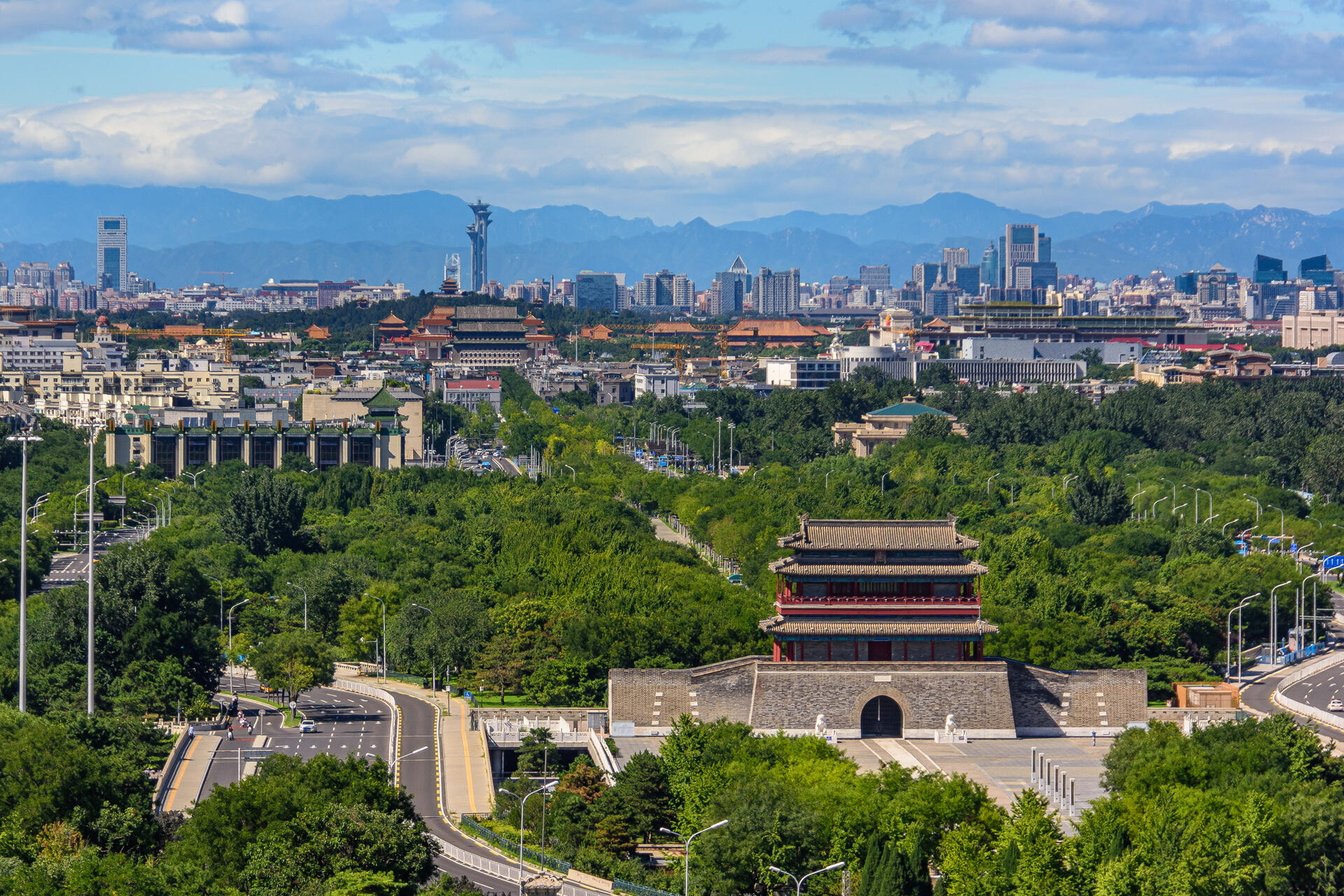
© N509FZ, CC BY-SA 4.0 Resized from original. (This derivative is under the same CC BY-SA license.)