World Heritage Identification Number: 729
World Heritage since: 1996
Category: Cultural Heritage
WHE Type: Buildings & Architectural Ensembles
Transboundary Heritage: No
Endangered Heritage: No
Country: 🇩🇪 Germany
Continent: Europe
UNESCO World Region: Europe and North America
Map
Bauhaus and its Sites in Weimar, Dessau, and Bernau: A Legacy of Classical Modernism
The Bauhaus and its Sites in Weimar, Dessau, and Bernau constitute a significant cultural heritage that has been inscribed on the UNESCO World Heritage List since 1996. These sites represent a revolutionary period in architectural and aesthetic thinking during the 20th century, characterized by the Bauhaus movement's emphasis on a radical renewal of architecture and design.
More to come…UNESCO Description of the World Heritage Site
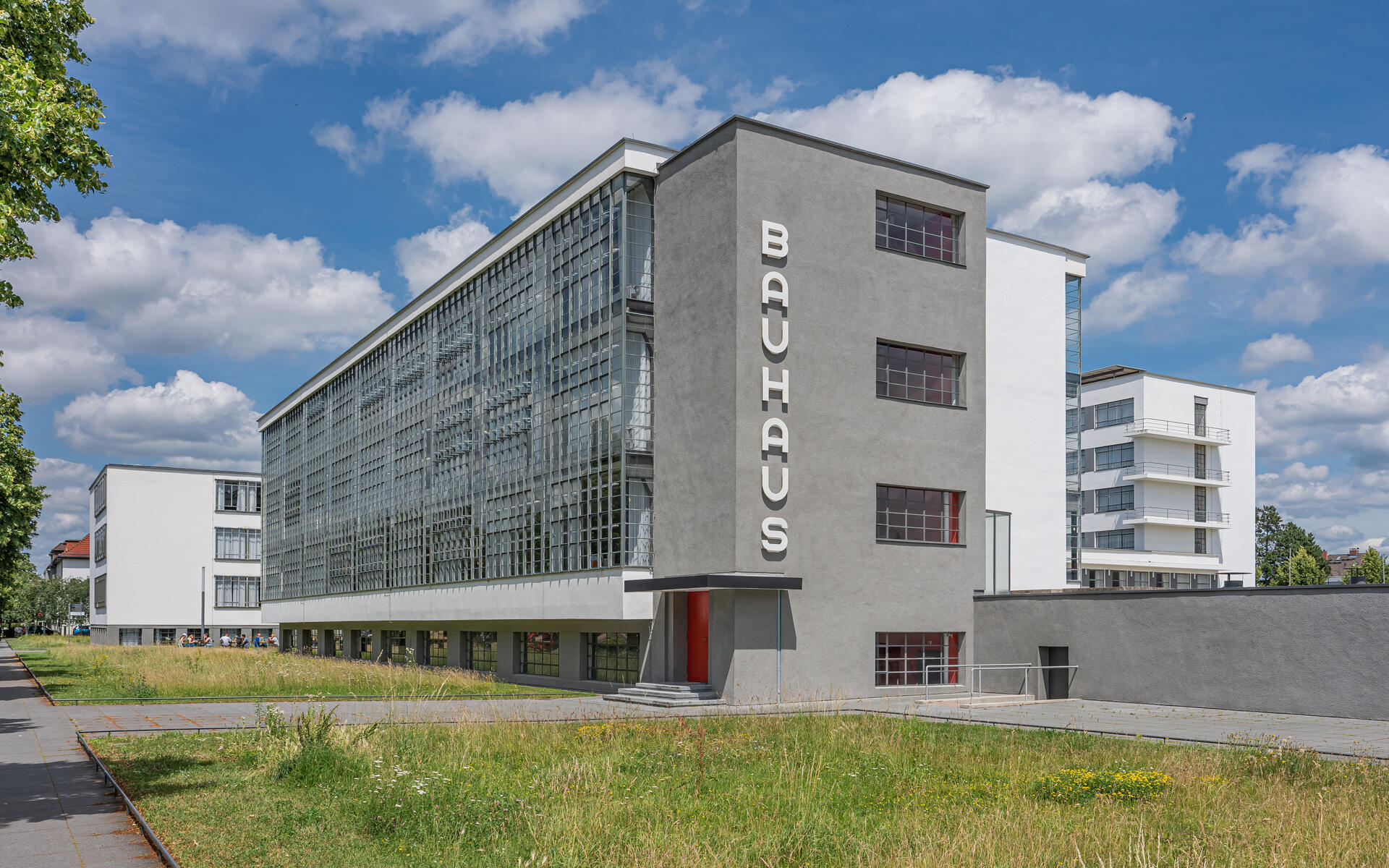
Between 1919 and 1933 the Bauhaus movement revolutionized architectural and aesthetic thinking and practice in the 20th century. The Bauhaus buildings in Weimar, Dessau and Bernau are fundamental representatives of Classical Modernism, directed towards a radical renewal of architecture and design. This property, which was inscribed on the World Heritage List in 1996, originally comprised buildings located in Weimar (Former Art School, the Applied Art School and the Haus Am Horn) and Dessau (Bauhaus Building, the group of seven Masters' Houses). The 2017 extension includes the Houses with Balcony Access in Dessau and the ADGB Trade Union School in Bernau as important contributions to the Bauhaus ideas of austere design, functionalism and social reform.
UNESCO Justification of the World Heritage Site
Criterion (ii): The Bauhaus buildings in Weimar, Dessau and Bernau are central works of European modern art, embodying an avant-garde conception directed towards a radical renewal of architecture and design in a unique and widely influential way. They testify to the cultural blossoming of Modernism, which began here, and has had an effect worldwide.
Criterion (iv): The Bauhaus itself and the other buildings designed by the masters of the Bauhaus are fundamental representatives of Classical Modernism and as such are essential components which represent the 20th century. The Houses with Balcony Access in Dessau and the ADGB Trade Union School are unique products of the Bauhaus’s goal of unity of practice and teaching.
Criterion (vi): The Bauhaus architectural school was the foundation of the Modern Movement which was to revolutionize artistic and architectural thinking and practice in the 20th century.
Encyclopedia Record: Bauhaus and its Sites in Weimar, Dessau and Bernau
Bauhaus and its Sites in Weimar, Dessau and Bernau are World Heritage Sites in Germany, comprising six separate sites which are associated with the Bauhaus art school. It was designated in 1996 with four initial sites, and in 2017 two further sites were added.Additional Site Details
Area: 8.1614 hectares
Number of Components: 11
(iv) — Outstanding example of a type of building or landscape
(vi) — Directly associated with events or living traditions
Coordinates: 50.9747777778 , 11.3295
World Heritage Research
Discover scientific research and academic studies that deepen our understanding of Bauhaus and its Sites in Weimar, Dessau and Bernau from its history and significance to its conservation, management, and contemporary challenges.
-
Das Staatliche Bauhaus Weimar auf dem Weg zur Institution 1919–1921
A groundbreaking analysis reveals the pivotal role of Weimar Bauhaus's predecessor institutions in shaping its revolutionary program between 1919 and 1921. Contrary to prior assumptions, these early structures were not merely obstacles but catalysts for the Bauhaus's self-discovery and institutionalization. The study employs a social science framework to dissect the tensions between assimilation and demarcation, political challenges, and the constant need for justification—highlighting how these conflicts fueled the movement's evolution. By re-evaluating the academic legacy of Weimar's art schools, this research sheds new light on the Bauhaus's emancipation from traditional constraints, offering a nuanced understanding of its formative years.
Ackermann, U. (2025). Das Staatliche Bauhaus Weimar auf dem Weg zur Institution 1919–1921. https://doi.org/10.5771/9783487424569
View Publication Record | Read Publication -
Bauhaus School, Dessau, 1927
The Bauhaus School, established by architect Walter Gropius and relocated to Dessau in 1925, stands as a foundational project of the Modern Movement. By 1927, its first campus building, designed by Gropius himself, embodied the school's revolutionary ethos: the integration of art, architecture, and design through mass production while addressing social needs. This approach challenged traditional boundaries between disciplines, advocating for functional aesthetics that would influence global modernist design. The Dessau site, with its innovative use of materials and spatial organization, exemplifies how Bauhaus principles merged artistic innovation with practical functionality, setting a precedent for 20th-century architecture.
Gropius, W. (2024). Bauhaus School, Dessau, 1927. Great Windows in Modern Architecture, 6–19. https://doi.org/10.4324/9780429341977-2
View Publication Record | Read Publication -
A Short History of the Weimar Republic
A pivotal period in modern European history, the Weimar Republic (1919–1933), is characterized by its dual nature: political and economic instability contrasted with a flourishing cultural renaissance. This revised edition synthesizes original research and existing historiography to highlight the Republic's profound influence on international art, architecture, and science, particularly through Expressionism and the Bauhaus movement. It offers a concise yet comprehensive introduction, addressing key questions about this transformative era while examining its lasting impact on global culture and politics. The study employs a multidisciplinary approach, blending historical analysis with cultural and political context to provide insights into both the challenges and achievements of the Weimar Republic.
Storers, C. (2024). A Short History of the Weimar Republic (, Ed.). Bloomsbury Publishing Plc. https://doi.org/10.5040/9781350175792
View Publication Record | Read Publication -
Symbolic knowledge innovation through bricolage in the periphery: the Bauhaus movement
Symbolic knowledge innovation, which involves recombining aesthetic ideas to foster growth, is shown to emerge through bricolage—creative reuse of diverse resources—in peripheral regions. This study highlights the Bauhaus movement as a case where micro-level actors, despite operating in the periphery of Weimar and Dessau, drove symbolic knowledge innovation across three phases: idea generation, artifact development, and commercial success. By examining actor agency and multi-level interactions (macro, meso, micro), the research demonstrates how bricolage enables new path creation in peripheral contexts, challenging conventional views that focus on macro or meso aggregates like policy or industrial R&D.
Kesidou, E., Plakoyiannaki, E., & Tardios, J. A. (2024). Symbolic knowledge innovation through bricolage in the periphery: the Bauhaus movement. Journal of Economic Geography, 24(4), 567–594. https://doi.org/10.1093/jeg/lbae010
View Publication Record | Read Publication -
Unbekanntes Bauhaus
A comprehensive exploration of the Bauhaus movement's lesser-known aspects, 'Unbekanntes Bauhaus' delves into its architectural and cultural impact across Weimar, Dessau, and Bernau. The publication provides a detailed account of Bauhaus's evolution, highlighting its experimental approaches to design, education, and urban planning. Through meticulous research, it examines the movement's influence on modern architecture while offering insights into its historical context. The book combines archival materials, interviews, and analyses to present a nuanced perspective on Bauhaus's legacy. Published by Bauhaus-Archiv Berlin, Stiftung Bauhaus Dessau, and Klassik Stiftung Weimar, this work serves as both an academic resource and a travel guide, bridging the gap between scholarly study and public engagement with Bauhaus heritage.
Bienert, M., & Eisold, N. (2024). Unbekanntes Bauhaus. Literaturblatt Für Baden-Württemberg, (4), 21. https://doi.org/10.53458/litbw.vi4.12906
View Publication Record | Read Publication -
“Design nature”: A color interpretation of Bauhaus school building in Dessau and its conceptual origins
Bauhaus architecture redefined the role of color in design, shifting from subjective to objective methods rooted in natural laws. The study reveals that Walter Gropius used color to convey a 'natural perspective,' embedding deeper connotations into architectural expression. By analyzing the Bauhaus school building in Dessau, researchers traced the evolution of color cognition through historical investigation and theoretical research, dissecting its conceptual framework and perceptual methods. This approach not only highlights the scientific design behind Bauhaus color but also underscores its enduring value as a spatial experience tool.
Meng, Y., & Liu, W. (2025). “Design nature”: A color interpretation of Bauhaus school building in Dessau and its conceptual origins. Frontiers of Architectural Research, 14(1), 32–61. https://doi.org/10.1016/j.foar.2024.06.012
View Publication Record | Read Publication -
Bauhaus Okulunda Renk Teorileri
Bauhaus, established in Weimar, Germany, in 1919 by architect Walter Gropius, emerged as a revolutionary educational institution during post-World War I socio-political and economic turmoil. It challenged traditional boundaries between fine arts and applied arts, aiming to integrate technology with humanistic values while fostering creativity through apprenticeship models. Unlike conventional art schools, Bauhaus sought to dissolve disciplinary silos, positioning itself as an industrial education hub where art served functional purposes beyond museums—such as in architecture and design. Its color theory and pedagogical innovations reflected a broader vision of merging artistic expression with mass production, emphasizing the artist's responsibility in shaping a more humane society.
Alp Doğan Erciş, M., & Özpolat, K. (2023). Bauhaus Okulunda Renk Teorileri. Social Sciences Studies Journal, 111(111), 6830–6839. https://doi.org/10.29228/sssj.69193
View Publication Record | Read Publication