World Heritage Identification Number: 846
World Heritage since: 1998
Category: Cultural Heritage
WHE Type: Buildings & Architectural Ensembles
Transboundary Heritage: No
Endangered Heritage: No
Country: 🇩🇪 Germany
Continent: Europe
UNESCO World Region: Europe and North America
Map
Classical Weimar: A Cultural Hub of the Enlightenment Era
Classical Weimar, inscribed as a UNESCO World Heritage Site in 1998, is a testament to the profound cultural bloom that took place in the small Thuringian town of Weimar, Germany, during the late 18th and early 19th centuries. This designation recognizes the significant impact of Weimar as a center of the Enlightenment, a period marked by reason, science, and skepticism, which contrasted with the religious and political upheavals of the time.
More to come…UNESCO Description of the World Heritage Site
In the late 18th and early 19th centuries the small Thuringian town of Weimar witnessed a remarkable cultural flowering, attracting many writers and scholars, notably Goethe and Schiller. This development is reflected in the high quality of many of the buildings and of the parks in the surrounding area.
UNESCO Justification of the World Heritage Site
Criterion (iii): The high artistic quality of the public and private buildings and parks in and around the town testify to the remarkable cultural flowering of the Weimar Classical Period.
Criterion (vi): Enlightened ducal patronage attracted many of the leading writers and thinkers in Germany, such as Goethe, Schiller, and Herder to Weimar in the late 18th and early 19th century, making it the cultural centre of the Europe of the day.
Encyclopedia Record: Classical Weimar (World Heritage Site)
Classical Weimar is a UNESCO World Heritage Site consisting of 11 sites located in and around the city of Weimar, Germany. The site was inscribed on 2 December 1998. The properties all bear testimony to the influence of Weimar as a cultural centre of the Enlightenment during the eighteenth and early nineteenth centuries. A number of notable writers and philosophers lived in Weimar between 1772 and 1805, including Johann Wolfgang von Goethe, Johann Gottfried Herder, Friedrich Schiller, and Christoph Martin Wieland. These figures ushered in and participated in the Weimar Classicism movement, and the architecture of the sites across the city reflects the rapid cultural development of the Classical Weimar era.Additional Site Details
Area: Not available
Number of Components: 1
(vi) — Directly associated with events or living traditions
Coordinates: 50.9775 , 11.32861
Image
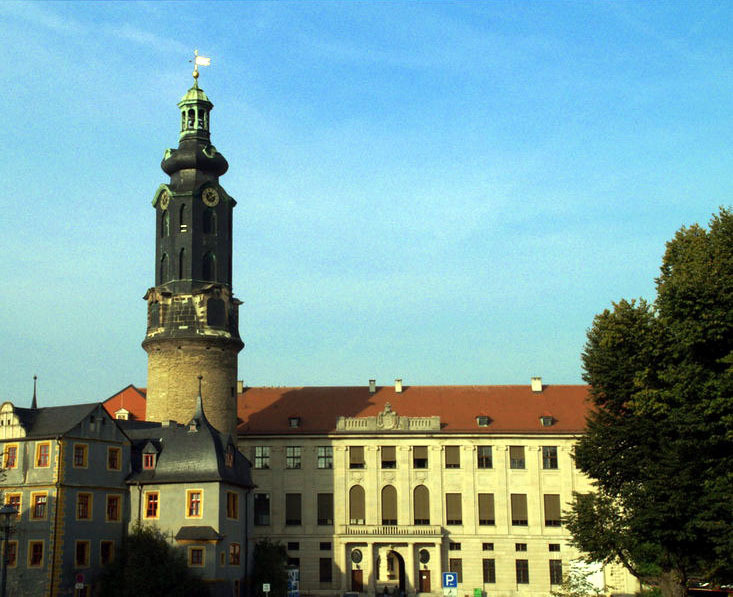
© Dundak, CC BY-SA 2.5 Resized from original. (This derivative is under the same CC BY-SA license.)
World Heritage Research
Discover scientific research and academic studies that deepen our understanding of Classical Weimar from its history and significance to its conservation, management, and contemporary challenges.
-
Classical Weimar and Bauhaus in Weimar
Classical Weimar and Bauhaus in Weimar represent pivotal cultural and architectural movements that shaped Thuringia's heritage. The study highlights the use of durable Weimar Travertine for building bases, alongside Bad Berka and Tonndorf sandstones for more intricate masonry, and Lehesten Roof Slate since 1780. The Bauhaus School (1919–1933), with its innovative fusion of art and craftsmanship, revolutionized aesthetic and architectural practices, exemplified by Henry van de Velde's design of the Bauhaus University Weimar. This research underscores the significance of these movements in preserving cultural identity through material and architectural innovation.
Katzschmann, L. (2021). Classical Weimar and Bauhaus in Weimar. Natural Stone and World Heritage, 31–35. https://doi.org/10.1201/9780367823061-7
View Publication Record | Read Publication -
Stadtgeschichten: Rumor, Gossip, and the Making of Classical Weimar
Rumor and gossip played a pivotal role in shaping Classical Weimar's cultural significance, acting as instrumental forces rather than obstacles. This study reveals how urban limitations in 18th-century Weimar facilitated the circulation of rumors and gossip, which helped negotiate tensions between the court and the town, elevating Weimar to national prominence. By linking these social phenomena to the built environment, the research demonstrates that persistent rumors were crucial in transcending material restrictions and establishing Classical Weimar's iconic status in German cultural history.
Tautz, B. (2013). Stadtgeschichten: Rumor, Gossip, and the Making of Classical Weimar. German Studies Review, 36(3), 497–514. https://doi.org/10.1353/gsr.2013.0138
View Publication Record | Read Publication