World Heritage Identification Number: 813
World Heritage since: 1997
Category: Cultural Heritage
WHE Type: Agriculture Landscapes, Parks & Gardens
Transboundary Heritage: No
Endangered Heritage: No
Country: 🇨🇳 China
Continent: Asia
UNESCO World Region: Asia and the Pacific
Map
Masterpieces of Chinese Landscape Architecture: The Classical Gardens of Suzhou
The Classical Gardens of Suzhou, located in the historical city of Suzhou, Jiangsu Province, China, are a remarkable collection of nine gardens that have earned a place on the UNESCO World Heritage List. These gardens serve as a testament to the enduring tradition of classical Chinese landscape architecture, where the pursuit of replicating natural landscapes in miniature forms a central theme.
More to come…UNESCO Description of the World Heritage Site
Classical Chinese garden design, which seeks to recreate natural landscapes in miniature, is nowhere better illustrated than in the nine gardens in the historic city of Suzhou. They are generally acknowledged to be masterpieces of the genre. Dating from the 11th-19th century, the gardens reflect the profound metaphysical importance of natural beauty in Chinese culture in their meticulous design.
UNESCO Justification of the World Heritage Site
Criterion (i): The classical gardens of Suzhou that have been influenced by the traditional Chinese craftsmanship and artistry first introduced by the freehand brushwork of traditional Chinese paintings, embody the refined sophistication of traditional Chinese culture. This embodiment of artistic perfection has won them a reputation as the most creative gardening masterpieces of ancient China.
Criterion (ii): Within a time span of over 2,000 years, a unique but systematic form of landscaping for these particular types of gardens was formed. Its planning, design, construction techniques, as well as artistic effect have had a significant impact on the development of landscaping in China as well as the world.
Criterion (iii): The classical gardens of Suzhou first originated from the ancient Chinese intellectuals' desire to harmonize with nature while cultivating their temperament. They are the finest remnants of the wisdom and tradition of ancient Chinese intellectuals.
Criterion (iv): The classical gardens of Suzhou are the most vivid specimens of the culture expressed in landscape garden design from the East Yangtze Delta region in the 11th to 19th centuries. The underlying philosophy, literature, art, and craftsmanship shown in the architecture, gardening as well as the handcrafts reflect the monumental achievements of the social, cultural, scientific, and technological developments of this period.
Criterion (v): These classical Suzhou gardens are outstanding examples of the harmonious relationship achieved between traditional Chinese residences and artfully contrived nature. They showcase the life style, etiquette and customs of the East Yangtze Delta region during the 11th to 19th centuries.
Encyclopedia Record: Classical Gardens of Suzhou
The Classical Gardens of Suzhou are a group of gardens in the city of Suzhou, in Jiangsu, China, that have been added to the UNESCO World Heritage List.Additional Site Details
Area: 11.922 hectares
Number of Components: 9
(ii) — Significant interchange of human values
(iii) — Unique or exceptional testimony to a cultural tradition
(iv) — Outstanding example of a type of building or landscape
(v) — Outstanding example of traditional human settlement
Coordinates: 31.31666667 , 120.45
Image
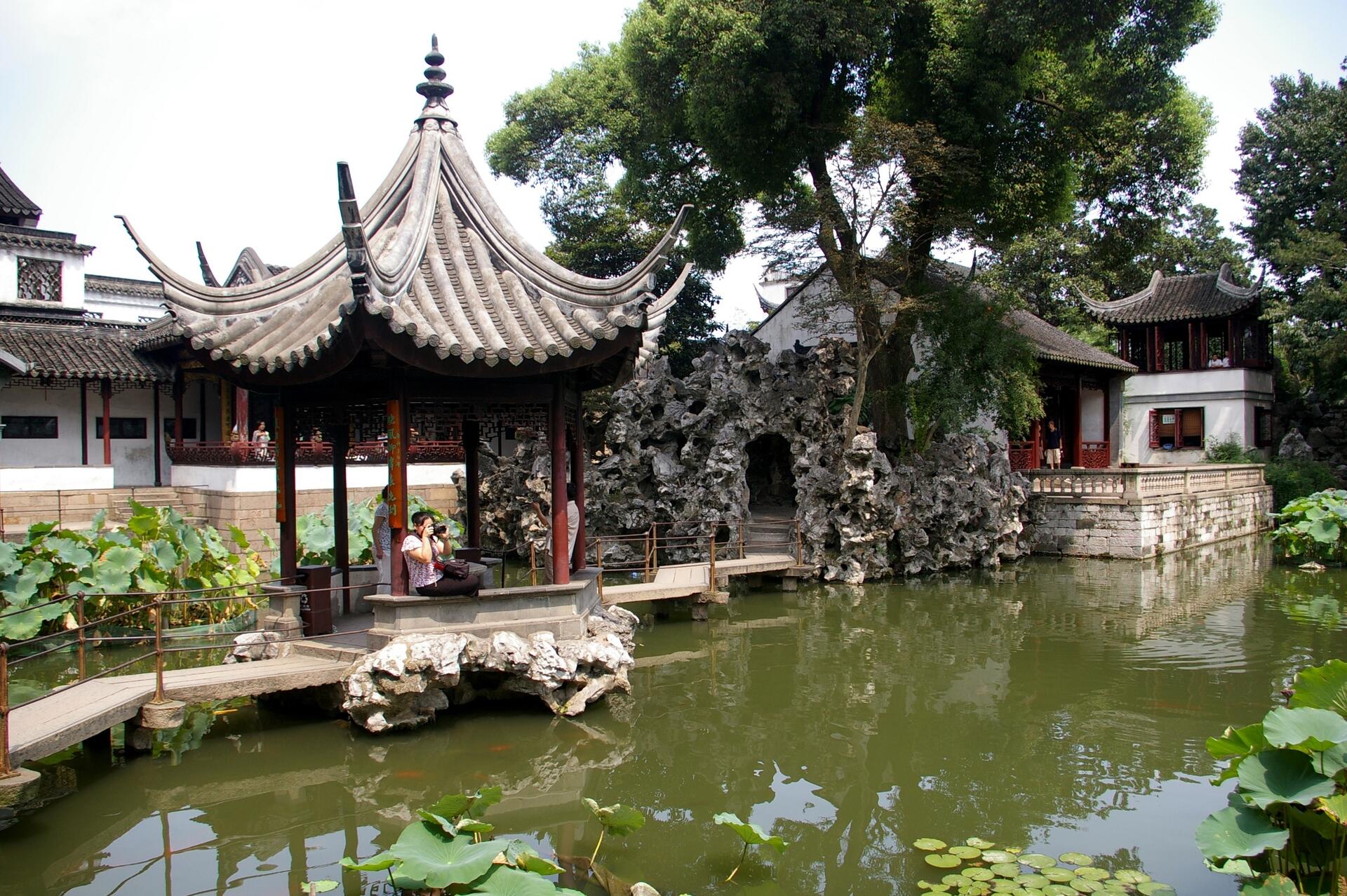
© Jakub Hałun, CC BY-SA 4.0 Resized from original. (This derivative is under the same CC BY-SA license.)
World Heritage Research
Discover scientific research and academic studies that deepen our understanding of Classical Gardens of Suzhou from its history and significance to its conservation, management, and contemporary challenges.
-
Digital heritage integration of Kunqu opera and Suzhou classical gardens
Research demonstrates that integrating Kunqu opera performances with Suzhou classical gardens through 'living documentation' significantly enhances cultural understanding and audience engagement. By combining multi-camera arrays and Gaussian Splatting, the study creates an Integrated Digital Theater that provides photorealistic, site-specific reenactments, linking intangible cultural heritage (ICH) to its material context. User studies reveal improved spatiality, realism, and cultural wholeness compared to traditional VR methods, fostering simultaneous interest in both Kunqu opera and the gardens. This approach addresses the gap in current 3D digitization efforts by embedding performance data within tangible heritage environments.
Tian, F., Lu, Y., Tu, M., Zhu, Q., & Li, Y. (2026). Digital heritage integration of Kunqu opera and Suzhou classical gardens. Npj Heritage Science, 14(1). https://doi.org/10.1038/s40494-026-02353-6
View Publication Record | Read Publication -
VI Development Using the Cultural Elements of Suzhou Classical garden in Jiangsu Province
A groundbreaking approach to integrating the cultural and aesthetic elements of Suzhou Classical Gardens into modern design demonstrates significant potential for preserving traditional Chinese garden culture while fostering contemporary creativity. This study reveals that by reinterpreting iconic features such as patterns, windows, and landscape architecture through a modern lens, designers can achieve a seamless blend of historical and contemporary aesthetics. The research involved a systematic analysis of Suzhou gardens' symbolic elements, spatial principles, and color systems, followed by digital reconstruction to explore innovative design applications. Findings suggest that this method not only maintains the philosophical essence of classical garden design but also enhances its relevance in modern cultural products, offering a model for other heritage sites seeking to bridge tradition and innovation.
Yin, H., & Chung, W. (2026). VI Development Using the Cultural Elements of Suzhou Classical garden in Jiangsu Province. Journal of Communication Design, 94(0), 226–242. https://doi.org/10.25111/jcd.2026.94.16
View Publication Record | Read Publication -
Pre-Heritagisation and the Cultural Sustainability of Classical Suzhou Gardens During China’s Modern Transformation: A Study of Periodical Discourse, 1870–1948
A dual discursive process during China's modern transformation (1870–1948) laid the socio-cultural foundation for the later recognition of Suzhou's classical gardens as heritage sites. This study reveals how periodical discourse simultaneously portrayed the gardens as multifunctional civic spaces and reinforced their classical value through historical memory, creating broader public intelligibility and cultural legitimacy before formal designation. Analyzing 699 historical texts using mixed-methods approaches, including quantitative content analysis and Critical Discourse Analysis (CDA), the research demonstrates that pre-heritagisation is not merely an administrative process but a complex discursive mechanism that materially refunctioned and symbolically re-anchored these cultural landscapes under modern conditions.
Guo, Z., Tang, Z., Sun, J., Zhou, H., & Chen, Y. (2026). Pre-Heritagisation and the Cultural Sustainability of Classical Suzhou Gardens During China’s Modern Transformation: A Study of Periodical Discourse, 1870–1948. Sustainability, 18(9), 4282. https://doi.org/10.3390/su18094282
View Publication Record | Read Publication -
Empirical Study on Emotional Perception and Restorative Effects of Suzhou Garden Landscapes: Text Mining and Statistical Analysis
Suzhou classical gardens, renowned for their tranquil and serene landscapes, significantly impact visitors' mental well-being. A study combining text mining of online reviews with questionnaire data revealed that these gardens evoke strong positive emotions, with terms like 'tranquil,' 'quiet,' and 'serene' frequently mentioned. Analysis using ROST CM6 software highlighted differences in emotional and cognitive responses across gardens, linking these to spatial factors such as landscape diversity, visual scale, and greenery types. The findings suggest that specific design elements play a crucial role in enhancing psychological comfort, offering valuable insights for modern urban green space planning. This research bridges theory and practice, emphasizing the integration of functionality with aesthetics to address contemporary societal needs.
Zhang, Z., Wang, X., & Jiang, M. (2025). Empirical Study on Emotional Perception and Restorative Effects of Suzhou Garden Landscapes: Text Mining and Statistical Analysis. Land, 14(1), 122. https://doi.org/10.3390/land14010122
View Publication Record | Read Publication -
Visualization microclimate scenarios of Classical Chinese Garden in Suzhou, China
Classical Chinese gardens in Suzhou, China, demonstrate significant microclimate regulation effects through their design elements. Water bodies and lush vegetation effectively reduce air temperature and increase humidity, while architectural structures and rocks influence heat distribution and retention. This study, using Geographic Information System (GIS) technology and the Inverse Distance Weighted (IDW) spatial interpolation method, analyzed three representative gardens: the Humble Administrator's Garden, the Lingering Garden, and the Canglang Pavilion. The findings highlight the role of traditional garden design principles in climate adaptability, providing valuable insights for modern urban park design and sustainable urban planning. This research underscores GIS-based spatial interpolation as a powerful tool for visualizing thermal comfort and optimizing urban green spaces.
Tang, J., & Ibrahim, W. Y. B. W. (2025). Visualization microclimate scenarios of Classical Chinese Garden in Suzhou, China. Journal of Infrastructure Policy and Development, 9(1), 10772. https://doi.org/10.24294/jipd10772
View Publication Record | Read Publication -
Introducing cultural schema into heritage tourism map design: the case of ‘Suzhou Classical Gardens’ Narrative Map, China
A novel theoretical framework for heritage tourism map design, integrating cultural schema theory, has been developed to better represent local cultures and narratives. The study demonstrates its effectiveness through the 'Suzhou Classical Gardens' Narrative Map in China, highlighting how traditional cartographic paradigms can be enhanced by incorporating storytelling elements. Five key cartographic design guidelines are proposed, offering a fresh perspective for future research in this field.
Xiang, J., Li, Q., Zhang, J., Weng, M., Kang, M., & Su, S. (2025). Introducing cultural schema into heritage tourism map design: the case of ‘Suzhou Classical Gardens’ Narrative Map, China. Journal of Maps, 21(1). https://doi.org/10.1080/17445647.2025.2495782
View Publication Record | Read Publication -
Machine Learning in the Design Decision-Making of Traditional Garden Space Renewal: A Case Study of the Classical Gardens of Jiangnan
A machine learning approach using conditional generative adversarial networks (CGAN) achieves high accuracy in generating traditional garden space schemes, with a 91.08% success rate in capturing key elements of Suzhou Gardens. This method offers an efficient alternative to human-experience-based design, enabling rapid generation and evaluation of multiple renewal plans for spaces ranging from 200 to 1000 square meters. The study demonstrates the potential of AI-driven tools to support decision-making in urban renewal projects by providing data-backed comparisons and feasibility analyses.
Yan, L., Zheng, L., Jia, X., Zhang, Y., & Chen, Y. (2025). Machine Learning in the Design Decision-Making of Traditional Garden Space Renewal: A Case Study of the Classical Gardens of Jiangnan. Buildings, 15(14), 2401. https://doi.org/10.3390/buildings15142401
View Publication Record | Read Publication