World Heritage Identification Number: 1334
World Heritage since: 2011
Category: Cultural Heritage
WHE Type: Cultural Landscapes
Transboundary Heritage: No
Endangered Heritage: No
Country: 🇨🇳 China
Continent: Asia
UNESCO World Region: Asia and the Pacific
Map
The Enchanting West Lake Cultural Landscape of Hangzhou: A UNESCO World Heritage Site
The West Lake Cultural Landscape of Hangzhou, inscribed as a UNESCO World Heritage Site in 2011, offers a captivating blend of human ingenuity and natural beauty that has inspired generations of poets, scholars, and artists for over a millennium. This enchanting landscape, situated to the west of the historic city of Hangzhou, lies south of the Yangtze River.
More to come…UNESCO Description of the World Heritage Site
The West Lake Cultural Landscape of Hangzhou, comprising the West Lake and the hills surrounding its three sides, has inspired famous poets, scholars and artists since the 9th century. It comprises numerous temples, pagodas, pavilions, gardens and ornamental trees, as well as causeways and artificial islands. These additions have been made to improve the landscape west of the city of Hangzhou to the south of the Yangtze river.
The West Lake has influenced garden design in the rest of China as well as Japan and Korea over the centuries and bears an exceptional testimony to the cultural tradition of improving landscapes to create a series of vistas reflecting an idealised fusion between humans and nature.
UNESCO Justification of the World Heritage Site
Criterion (ii): The improved landscape of West Lake can be seen to reflect Buddhist ideals imported into China from India such as 'Buddhist peacefulness' and 'nature as paintings', and in turn it had a major influence on landscape design in East Asia. Its causeways, islands, bridges, temples, pagodas and well defined views, were widely copied over China, notably in the summer Palace at Beijing and in Japan. The notion of ten poetically named scenic places persisted for seven centuries all over China and also spread to the Korean peninsula after the 16th century, when Korean intellectuals made visits to the West Lake.
Criterion (iii): The West Lake landscape is an exceptional testimony to the very specific cultural tradition of improving landscapes to create a series of 'pictures' that reflect what was seen as a perfect fusion between people and nature, a tradition that evolved in the Tang and Song Dynasties and has continued its relevance to the present day. The 'improved' West Lake, with its exceptional array of man-made causeways, islands, bridges, gardens, pagodas and temples, against a backdrop of the wooded hills, can be seen as an entity that manifests this tradition in an outstanding way.
Criterion (vi): The Tang and Song culture of demonstrating harmony between man and nature by improving the landscape to create pictures of great beauty, captured by artists and given names by poets, is highly visible in the West Lake Landscape, with its islands, causeways, temples, pagodas and ornamental planting. The value of that tradition has persisted for seven centuries in West Lake and has spread across China and into Japan and Korea, turning it into a tradition of outstanding significance.
Encyclopedia Record: West Lake
West Lake, also known as Xihu and by other names, is a freshwater lake in Hangzhou, China. Situated to the west of Hangzhou's former walled city, the lake has a surface area of 6.39 km2 (2.47 sq mi), stretching 3.2 km (2.0 mi) from north to south and 2.8 km (1.7 mi) from east to west. In the lake are four causeways, three artificial islands, and Gushan, the only natural island. Gentle hills surround the lake on its north, west, and south sides, with the Leifeng and Baochu pagodas standing in pair on the south and north banks. Several famous temples are nestled in the mountains west of the lake, including Lingyin and Jingci Temples.Additional Site Details
Area: 3,322.88 hectares
Number of Components: 1
(iii) — Unique or exceptional testimony to a cultural tradition
(vi) — Directly associated with events or living traditions
Coordinates: 30.2375 , 120.1408333333
Image
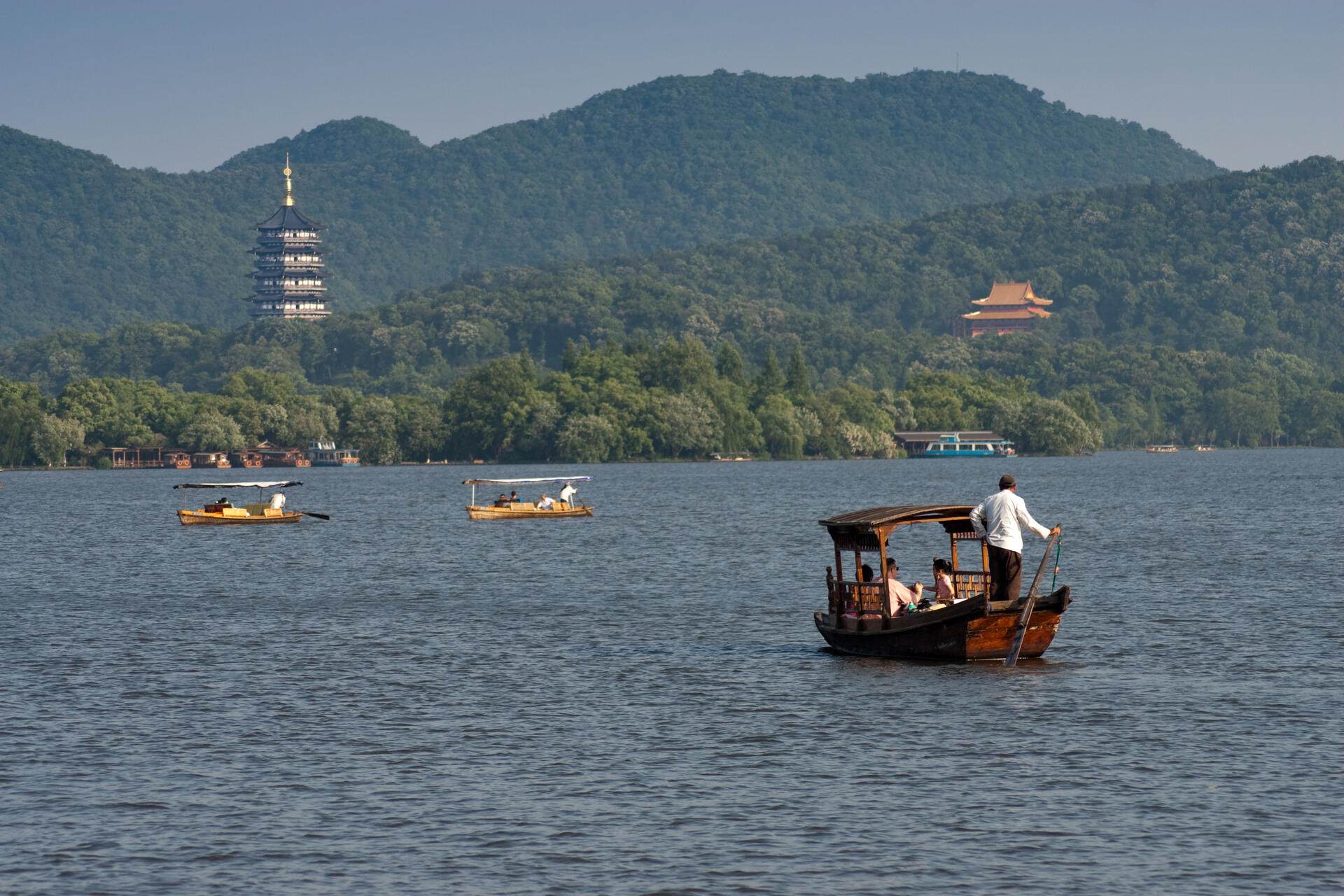
© Louisa Salazar, CC BY-SA 3.0 Resized from original. (This derivative is under the same CC BY-SA license.)
World Heritage Research
Discover scientific research and academic studies that deepen our understanding of West Lake Cultural Landscape of Hangzhou from its history and significance to its conservation, management, and contemporary challenges.
-
Visual Impact Assessment Method for Cultural Heritage: West Lake Cultural Landscape in Hangzhou, China
A new Visual Impact Assessment (VIA) framework for cultural heritage demonstrates that the Shangri-La Hotel East Building project significantly alters the visual attributes of Hangzhou's West Lake. This study overcomes limitations in traditional VIA methods by integrating objective visual sensitivity assessments with subjective public perception evaluations using the Analytic Hierarchy Process (AHP) and questionnaires. The framework, grounded in heritage value attributes, provides a more comprehensive and generalizable approach to predicting visual impacts on cultural landscapes. It highlights the importance of Heritage Impact Assessment as a preliminary tool for evaluating development projects, balancing objectivity and subjectivity while emphasizing public participation.
Kou, H., Zhang, L., & Zhang, S. (2024). Visual Impact Assessment Method for Cultural Heritage: West Lake Cultural Landscape in Hangzhou, China. Land, 13(10), 1596. https://doi.org/10.3390/land13101596
View Publication Record | Read Publication -
Exploring 1800 years of ecosystem services from West Lake, Hangzhou, China
West Lake, a UNESCO World Heritage Site in Hangzhou, China, has provided varying ecosystem services over 1800 years, with cultural services like recreation and tourism becoming dominant today. The study uses cultural and political ecology perspectives to analyze historical data, revealing how national, regional, and local policies have shaped these services. It highlights the significance of management strategies in sustaining long-term ecological functions and visual integrity, offering insights for future conservation efforts.
Wang, X., Wu, H., Gorenflo, L. J., & Wu, C. (2023). Exploring 1800 years of ecosystem services from West Lake, Hangzhou, China. Studies in the History of Gardens & Designed Landscapes, 43(4), 279–297. https://doi.org/10.1080/14601176.2023.2267375
View Publication Record | Read Publication -
The synergic impacts of salt mixture and frost damage on rock decay: implications for the deterioration of rock-hewn heritages
Rock-hewn heritages, such as those found in the West Lake Cultural Landscape of Hangzhou (WLCL), are vulnerable to combined salt weathering and freeze–thaw cycles, leading to significant deterioration. A study revealed that stones with moderate porosity (~5%) and a higher proportion of micropores, like flint, were particularly susceptible to these synergistic effects, exhibiting surface deformation and strength decline. Porous tuff developed a hard crust and pore fill, while compact carbonate rock showed minimal damage. The research used laboratory ageing tests on five stone types from the WLCL area, simulating 25 cycles of salt impregnation (Na₂SO₄–MgSO₄ mixture), freezing-thaw, and evaporation. Findings indicate that inherent rock properties significantly influence vulnerability to weathering, emphasizing their role in developing preventive conservation strategies for UNESCO World Heritage Sites.
Wang, Y., & Zhang, H. (2023). The synergic impacts of salt mixture and frost damage on rock decay: implications for the deterioration of rock-hewn heritages. Heritage Science, 11(1). https://doi.org/10.1186/s40494-023-01054-8
View Publication Record | Read Publication -
West Lake cultural landscape of Hangzhou
The West Lake Cultural Landscape of Hangzhou stands as a testament to the enduring influence of traditional Chinese landscape design principles, blending 'harmony between humans and nature' with poetic and artistic inspiration from literature and poetry. This 700-year-old tradition, rooted in the ninth century, has not only persisted but also spread across China and into neighboring countries like Japan and Korea. The landscape's core value lies in its integration of six creation elements that reflect Chinese cultural aesthetics, where culture dominates nature, creating a unique and significant heritage site. This study underscores the historical and cultural significance of West Lake as an outstanding example of how landscape design can embody and perpetuate cultural values over centuries.
Zhang, R. (2023). West Lake cultural landscape of Hangzhou. Routledge Handbook of Cultural Landscape Practice, 362–368. https://doi.org/10.4324/9781315203119-41
View Publication Record | Read Publication -
Comparing landscape values and heritage stakeholders: a case study of West Lake Cultural Landscape of Hangzhou, China
A comparative analysis of perspectives on the West Lake Cultural Landscape of Hangzhou reveals significant discrepancies between international experts and local stakeholders, including Chinese heritage professionals, residents, and tourists. International experts often overlooked the nuanced cultural values articulated by Chinese authorities due to differences in historical, philosophical, and heritage value systems. Meanwhile, tourists and locals linked traditional and contemporary Chinese cultural values to personal emotions and experiences, enriching the discourse on social heritage value. This study underscores the importance of integrating diverse stakeholder knowledge in UNESCO World Heritage nomination processes to ensure comprehensive and culturally sensitive evaluations.
Zhang, R., & Brown, S. (2022). Comparing landscape values and heritage stakeholders: a case study of West Lake Cultural Landscape of Hangzhou, China. International Journal of Cultural Policy, 29(2), 184–201. https://doi.org/10.1080/10286632.2022.2038142
View Publication Record | Read Publication -
A Study on the Coordinative Green Development of Tourist Experience and Commercialization of Tourism at Cultural Heritage Sites
Tourists at China’s cultural heritage sites prioritize coordinative green development and high-quality tourist experiences over commercialization, with overall satisfaction at three key sites—West Lake Cultural Landscape of Hangzhou, Ancient City of Pingyao, and Confucius Temple in Nanjing. This study introduces an indicator system for assessing such development (CGDTECT) and applies fuzzy comprehensive evaluation alongside importance-performance analysis to gauge tourist perceptions. Findings suggest that while tourists value green development and experience, they are generally satisfied with current conditions, supporting the adoption of continuous improvement strategies. The research offers actionable insights for balancing tourism growth with cultural preservation, aiding sustainable heritage management.
Tang, C., Zheng, Q., & Ng, P. (2019). A Study on the Coordinative Green Development of Tourist Experience and Commercialization of Tourism at Cultural Heritage Sites. Sustainability, 11(17), 4732. https://doi.org/10.3390/su11174732
View Publication Record | Read Publication -
Cultural landscape meanings. The case of West Lake, Hangzhou, China
The West Lake Cultural Landscape of Hangzhou reflects complex cultural meanings that diverge between international heritage agencies and Chinese perspectives. While Western conservation approaches often prioritize universal values, the study reveals that Chinese interpretations emphasize local identity, historical continuity, and emotional connections to the landscape. International bodies like UNESCO and ICOMOS, alongside Chinese stakeholders involved in its 2011 nomination process, may underestimate these nuanced meanings. Meanwhile, Chinese tourists perceive the site not just as a tourist attraction but as a symbol of national pride and cultural heritage, highlighting the need for conservation strategies that bridge global and local understandings.
Zhang, R., & Taylor, K. (2019). Cultural landscape meanings. The case of West Lake, Hangzhou, China. Landscape Research, 45(2), 164–178. https://doi.org/10.1080/01426397.2019.1589438
View Publication Record | Read Publication -
World Heritage listing and changes of political values: a case study in West Lake Cultural Landscape in Hongzhou, China
This study reveals that Chinese governments, while pursuing World Heritage listing for the West Lake Cultural Landscape of Hangzhou, strategically adapt to Eurocentric UNESCO criteria by omitting values incompatible with Western heritage discourses. Through extensive fieldwork in Beijing, Shanghai, and Hangzhou, researchers mapped tensions between local governmental perceptions of heritage value and UNESCO/ICOMOS standards. The findings demonstrate a cynical approach where Chinese authorities recognize the 'rules' of World Heritage listing but selectively conform to them, prioritizing international legitimacy over indigenous cultural narratives. This adaptation, driven by the desire for global recognition, reshapes site management while perpetuating a disconnect between local heritage values and UNESCO's 'outstanding universal value' framework.
Zhang, R. (2016). World Heritage listing and changes of political values: a case study in West Lake Cultural Landscape in Hongzhou, China. International Journal of Heritage Studies, 23(3), 215–233. https://doi.org/10.1080/13527258.2016.1255989
View Publication Record | Read Publication -
Soundscape of the West Lake Scenic Area with profound cultural background—a case study of Evening Bell Ringing in Jingci Temple, China
Research on the soundscape of Hangzhou's West Lake Cultural Landscape reveals that natural, cultural, and historic sounds significantly influence people's subjective experiences. The study, focusing on the Evening Bell Ringing at Jingci Temple, analyzed objective physical indices in winter and spring, combined with subjective evaluations from participants. Findings demonstrate a strong correlation between the soundscape and the local environment, history, and culture, emphasizing the importance of integrating these elements for a cohesive and meaningful auditory experience. This insight underscores the interplay between natural and cultural factors in shaping the perception of scenic areas.
Ge, J., Guo, M., & Yue, M. (2013). Soundscape of the West Lake Scenic Area with profound cultural background—a case study of Evening Bell Ringing in Jingci Temple, China. Journal of Zhejiang University SCIENCE A, 14(3), 219–229. https://doi.org/10.1631/jzus.a1200159
View Publication Record | Read Publication