World Heritage Identification Number: 1508
World Heritage since: 2016
Category: Cultural Heritage
WHE Type: Archaeological Sites
Transboundary Heritage: No
Endangered Heritage: No
Country: 🇨🇳 China
Continent: Asia
UNESCO World Region: Asia and the Pacific
Map
Exploring the Zuojiang Huashan Rock Art Cultural Landscape: A Window into Ancient Chinese Culture
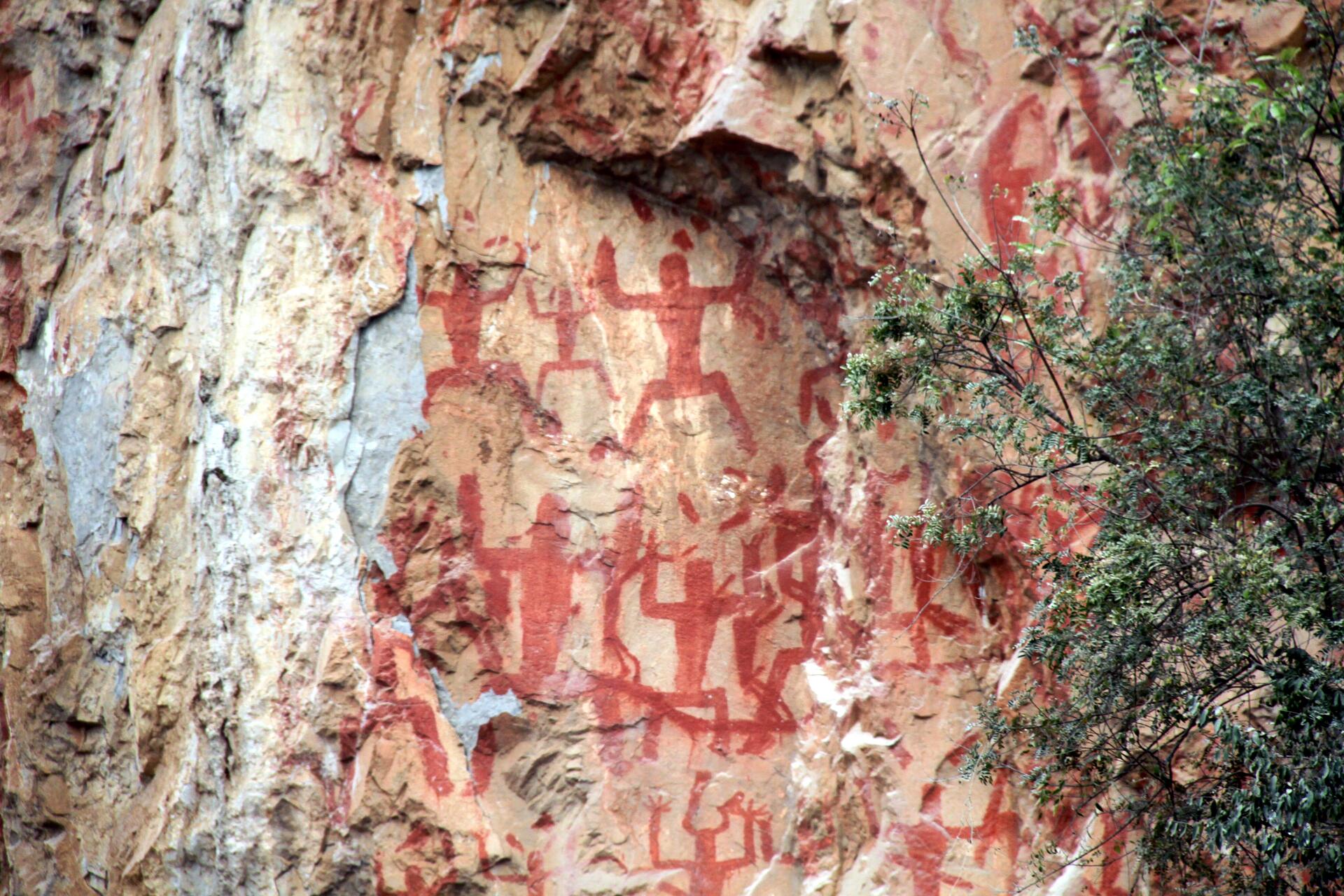
The Zuojiang Huashan Rock Art Cultural Landscape, inscribed as a UNESCO World Heritage Site in 2016, offers a unique glimpse into the rich cultural history of ancient China. Situated along the steep cliffs bordering southwestern China, this site consists of 38 locations adorned with rock art that dates back to the 5th century BCE and extends up to the 2nd century CE. These remarkable paintings provide valuable insights into the lives, rituals, and beliefs of the Luoyue people, who were once prevalent across southern China.
More to come…UNESCO Description of the World Heritage Site
Located on the steep cliffs in the border regions of southwest China, these 38 sites of rock art illustrate the life and rituals of the Luoyue people. They date from the period around the 5th century BCE to the 2nd century CE. In a surrounding landscape of karst, rivers and plateaux, they depict ceremonies that have been interpreted as portraying the bronze drum culture once prevalent across southern China. This cultural landscape is the only remains of this culture today.
UNESCO Justification of the World Heritage Site
Criterion (iii): The Zuojiang Huashan Rock Art Cultural Landscape, with its special combination of landscape and rock art, vividly conveys the vigorous spiritual and social life of the Luoyue people who lived along the Zuojiang River from the 5th century BCE to the 2nd century CE. It is now the only witness to the tradition.
Criterion (vi): The images of Zuojiang Huashan depicting drums and related elements are symbolic records directly associated with the bronze drum culture once widespread in the region. Today bronze drums are still respected as symbols of power in southern China.
Encyclopedia Record: Zuojiang Huashan Rock Art
The Zuojiang Huashan Rock Art Cultural Landscape is an extensive assembly of historical rock art that was painted on limestone cliff faces in Guangxi, southern China. The paintings are located on the west bank of the Ming River which is a tributary of the Zuo River. The area of the paintings is part of the Nonggang Nature Reserve and belongs to Ningming County. On July 15, 2016, Zuojiang Huashan Rock Art Cultural Landscape was listed as the 49th UNESCO World Heritage Site in China.Additional Site Details
Area: 6,621.6 hectares
Number of Components: 3
(vi) — Directly associated with events or living traditions
Coordinates: 22.2555555556 , 107.0230555556
World Heritage Research
Discover scientific research and academic studies that deepen our understanding of Zuojiang Huashan Rock Art Cultural Landscape from its history and significance to its conservation, management, and contemporary challenges.
-
A gated-attention multi-prior injection diffusion model for Huashan rock art image restoration
A novel gated-attention multi-prior injection diffusion model significantly advances the restoration of weathered rock art at Zuojiang Huashan, achieving superior performance metrics (MSE: 0.021, MAE: 0.093, PSNR: 26.73, SSIM: 0.892) compared to baseline methods. The model's dual-branch prior extraction and gate attention fusion modules effectively reconstruct structural contours and texture details in degraded regions, with statistically significant improvements verified through ablation studies. This approach offers a promising solution for preserving cultural heritage by addressing fading, loss, and texture degradation caused by environmental factors and human disturbances.
Zhao, T., Huang, L., Qi, X., & Deng, P. (2026). A gated-attention multi-prior injection diffusion model for Huashan rock art image restoration. Scientific Reports, 16(1). https://doi.org/10.1038/s41598-026-41226-7
View Publication Record | Read Publication -
Resilience Assessment of Traditional Villages Based on Cultural Ecosystem Services—An Empirical Study of the Zuojiang Huashan Rock Art World Heritage Area in China
Cultural ecosystem services are the cornerstone of social–ecological resilience in traditional villages, with their diversity and reinforcement directly shaping village resilience. A study of Zuojiang Huashan Rock Art World Heritage Area revealed that high-resilience villages benefit from robust cultural services and community rules, while low-resilience ones suffer service loss and weakened social ties. The research applied resilience theory, field investigations, interviews, questionnaires, and Delphi surveys to assess spatial variations in resilience. This work enriches resilience theory with cultural dimensions, offering a practical tool for heritage practitioners to transition from static preservation to dynamic, vibrant protection systems.
Lu, Y., Hasnan, L., & Teh, B. T. (2026). Resilience Assessment of Traditional Villages Based on Cultural Ecosystem Services—An Empirical Study of the Zuojiang Huashan Rock Art World Heritage Area in China. Sustainability, 18(6), 2845. https://doi.org/10.3390/su18062845
View Publication Record | Read Publication -
From regional symbols to educational spaces: Spatial design pathways for Zuojiang Huashan rock art heritage
A systematic spatial design framework is proposed to transform the regional symbols of Zuojiang Huashan Rock Art Cultural Landscape into dynamic educational resources. This approach addresses current limitations, such as shallow symbolic translation and insufficient experiential design, by integrating symbol extraction, narrative translation, layered educational spaces, immersive participation, and coordinated protection-communication-activation. The framework enhances public learning within the context of Luoyue cultural transmission, linking symbolic interpretation with spatial narratives and interdisciplinary education. The study combines literature analysis, cultural interpretation, and semantic analysis to identify key dimensions supporting historical cognition, aesthetic education, and cultural identity formation.
Li, Z., & Sikka, S. (2026). From regional symbols to educational spaces: Spatial design pathways for Zuojiang Huashan rock art heritage. Net Journals. https://doi.org/10.5281/ZENODO.20086177
View Publication Record | Read Publication -
Multimodal metaphors in Zuojiang Huashan rock art cultural landscape
Research on the Zuojiang Huashan Rock Art Cultural Landscape reveals that folk art serves as a complex system of multimodal metaphors, where visuals, materials, and genre collectively convey abstract meanings. The study applies Conceptual Metaphor Theory (CMT) to demonstrate that these modalities are both complementary and mutually exclusive, with each mode uniquely interpreting the target domain without substitution. This interplay enhances comprehension of the multi-layered cultural significance embedded in Huashan Rock Art, positioning it beyond mere artistic expression. By integrating cognitive linguistics and anthropology, the research provides insight into the motivations behind its creation, offering a novel framework for understanding folk art's symbolic depth.
Zhang, S. (2025). Multimodal metaphors in Zuojiang Huashan rock art cultural landscape. Review of Cognitive Linguistics. https://doi.org/10.1075/rcl.00216.zha
View Publication Record | Read Publication -
Corpus-based Translation Study of Cultural Heritage International Publicity--A Case Study of Zuojiang Huashan Rock Art
A corpus-based translation study of the Zuojiang Huashan Rock Art Cultural Landscape reveals that strategic international publicity through Chinese-English translation can significantly enhance its global recognition, research value, and economic potential. The analysis highlights the importance of government-led initiatives in improving translation quality and training specialized talent to support cultural heritage promotion. Effective translation not only preserves the rich diversity of world cultures but also fosters cross-border collaboration, strengthens diplomatic ties, and boosts China's cultural tourism industry. This study provides a model for other UNESCO World Heritage Sites seeking similar international visibility through corpus-based translation research.
Li, Z., & Lei, L. (2022). Corpus-based Translation Study of Cultural Heritage International Publicity--A Case Study of Zuojiang Huashan Rock Art. International Journal of Applied Linguistics and Translation, 8(1), 10. https://doi.org/10.11648/j.ijalt.20220801.12
View Publication Record | Read Publication -
Late-Holocene vegetation change reveals the environment of ancient people and the origin of Huashan cliff paintings in Guangxi, southwestern China
A pollen record from the Zuojiang Huashan Rock Art Cultural Landscape reveals that mixed broad-leaf and conifer forests dominated the region during the period of cliff painting creation (2370–2115 cal. yr BP), providing key materials for ancient artworks. The study suggests that a humid climate facilitated human activities, while short-term droughts may have triggered social instability, including warfare. This research highlights the interplay between environmental conditions and human civilization in southwestern China, emphasizing the need to integrate natural and socio-political analyses to understand ancient cultural practices.
Li, K., Zhang, Y., Liao, M., Ni, J., & Chen, Y. (2020). Late-Holocene vegetation change reveals the environment of ancient people and the origin of Huashan cliff paintings in Guangxi, southwestern China. The Holocene, 30(9), 1296–1309. https://doi.org/10.1177/0959683620919980
View Publication Record | Read Publication -
Social Values and Rock Art Tourism: An Ethnographic Study of the Huashan Rock Art Area (China)
Rock art tourism, while reinforcing social values tied to heritage sites, can also diminish local communities' emotional attachment due to undesired consequences of World Heritage designation efforts. A study focusing on the Zuojiang Huashan Rock Art Cultural Landscape in China—China's first rock art site inscribed on the UNESCO World Heritage List in 2016—reveals that tourism promotion initiatives, driven by authorities, have paradoxically both strengthened and weakened local social values. The research, employing ethnographic methods, highlights the need for a critical reassessment of global and Chinese rock art heritage management strategies to balance preservation, cultural significance, and community impact.
Gao, Q. (2017). Social Values and Rock Art Tourism: An Ethnographic Study of the Huashan Rock Art Area (China). Conservation and Management of Archaeological Sites, 19(1), 82–95. https://doi.org/10.1080/13505033.2016.1290477
View Publication Record | Read Publication