World Heritage Identification Number: 1328
World Heritage since: 2010
Category: Cultural Heritage
WHE Type: Buildings & Architectural Ensembles
Transboundary Heritage: No
Endangered Heritage: No
Country: 🇻🇳 Viet Nam
Continent: Asia
UNESCO World Region: Asia and the Pacific
Map
The Central Sector of the Imperial Citadel of Thang Long – A Historical Testimony in Hanoi, Vietnam
The Central Sector of the Imperial Citadel of Thang Long, situated in the heart of Hanoi, Vietnam, stands as a significant historical artifact that bears witness to the rich cultural heritage and political evolution of the region. Inscribed as a UNESCO World Heritage Site in 2010, this architectural ensemble offers valuable insights into the development of Southeast Asian cultures and the interplay of influences from neighboring regions.
More to come…UNESCO Description of the World Heritage Site
The Thang Long Imperial Citadel was built in the 11th century by the Ly Viet Dynasty, marking the independence of the Dai Viet. It was constructed on the remains of a Chinese fortress dating from the 7th century, on drained land reclaimed from the Red River Delta in Hanoi. It was the centre of regional political power for almost 13 centuries without interruption. The Imperial Citadel buildings and the remains in the 18 Hoang Dieu Archaeological Site reflect a unique South-East Asian culture specific to the lower Red River Valley, at the crossroads between influences coming from China in the north and the ancient Kingdom of Champa in the south.
UNESCO Justification of the World Heritage Site
Criterion (ii): The Central Sector of the Imperial Citadel of Thang Long - Hanoi bears witness to the meeting of influences coming mainly from China in the north and the Kingdom of Champa in the south. It expresses a set of intercultural exchanges which shaped a unique culture in the lower Red River Valley.
Criterion (iii): The Central Sector of the Imperial Citadel of Thang Long bears witness to the long cultural tradition of the Viêt populations established in the Delta and the lower Red River Valley. It was a continuous seat of power from the 7th century through to the present day.
Criterion (vi): The Imperial Citadel of Thang Long at Hanoi, with its political function and symbolic role, is directly associated with numerous and important cultural and historical events, and leading artistic expressions and moral, philosophical, and religious ideas. The succession of these events marks the formative and development process of an independent nation over more than a thousand years, including the colonial period and the two contemporary Wars of Independence and reunification of Viet Nam.
Encyclopedia Record: Imperial Citadel of Thăng Long
The Imperial Citadel of Thăng Long is a complex of historic buildings associated with the history of Vietnam located in the centre of Hanoi, Vietnam. Its construction began in 1010 and was completed in early 1011 under the reign of Emperor Lý Thái Tổ of the Lý dynasty. Most of the existing structure is dated to the extensive reconstruction of the old Imperial Citadel ordered by Gia Long in 1805, but the Citadel was largely demolished by the French to allow more land for offices and barracks.Additional Site Details
Area: 18.395 hectares
Number of Components: 1
(iii) — Unique or exceptional testimony to a cultural tradition
(vi) — Directly associated with events or living traditions
Coordinates: 21.03752 , 105.838623
Image
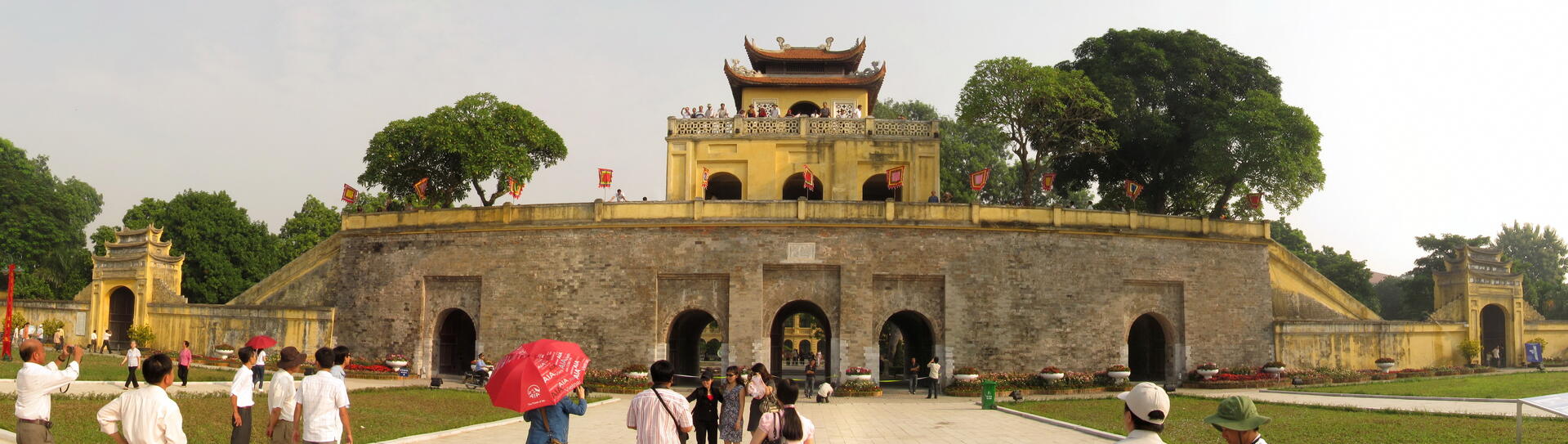
© Grenouille vert, CC BY-SA 3.0 Resized from original. (This derivative is under the same CC BY-SA license.)
World Heritage Research
Discover scientific research and academic studies that deepen our understanding of Central Sector of the Imperial Citadel of Thang Long - Hanoi from its history and significance to its conservation, management, and contemporary challenges.
-
Researching Heritage in the Education of Traditional Culture for University Students in Vietnam: A Case Study of the Historical Relic of the Central Sector of the Imperial Citadel of Thang Long - Hanoi
A UNESCO-listed site, the Central Sector of the Imperial Citadel of Thang Long - Hanoi, plays a significant role in educating university students about Vietnam's traditional culture. This study reveals that heritage sites effectively shape students' awareness, knowledge, and behavior regarding cultural values, fostering a sense of responsibility for preservation. By employing both qualitative and quantitative methods, researchers analyzed how the citadel influences students' appreciation and promotion of Vietnam's World Cultural Heritage. The findings underscore the potential of such sites to bridge traditional culture education with global heritage conservation efforts, offering actionable insights for enhancing student engagement in cultural preservation.
Loan, N. T. T., & Phuong, D. T. (2024). O Ensino do Patrimônio Cultural na Educação de Cultura Tradicional para Universitários no Vietnã: Estudo de Caso do Setor Central da Cidadela Imperial de Thang Long - Hanói. Cadernos de Educação Tecnologia E Sociedade, 17(se5), 157–172. https://doi.org/10.14571/brajets.v17.nse5.157-172
View Publication Record | Read Publication -
Commodification and Politicization of Heritage: Implications for Heritage Tourism at the Imperial Citadel of Thang Long, Hanoi (Vietnam)
Heritage commodification is inherently intertwined with politicization, particularly for sites of national and international significance. Using the UNESCO-listed Central Sector of the Imperial Citadel of Thang Long in Hanoi as a case study, this research reveals that political priorities often overshadow commercial utilization, such as tourism, leading to issues like heritage dissonance. The study analyzes how heritage resources are selected, interpreted, and targeted for diverse audiences, highlighting the complexities of balancing preservation with development. This finding underscores the need for strategies that address both cultural significance and economic potential without compromising heritage integrity.
Bui, H. T., & Lee, T. J. (2015). Commodification and Politicization of Heritage: Implications for Heritage Tourism at the Imperial Citadel of Thang Long, Hanoi (Vietnam). Austrian Journal of South-East Asian Studies, Vol 8 No 2 (2015): Tourism and Development. https://doi.org/10.14764/10.ASEAS-2015.2-5
View Publication Record | Read Publication