World Heritage Identification Number: 766
World Heritage since: 2001
Category: Natural Heritage
WHE Type: Protected Areas & National Parks
Transboundary Heritage: No
Endangered Heritage: No
Country: 🇷🇺 Russian Federation
Continent: Europe
UNESCO World Region: Europe and North America
Map
Central Sikhote-Alin: A Unique Temperate Forest Haven
The Central Sikhote-Alin, a sprawling mountain range in the easternmost part of Russia, stretches approximately 900 kilometers (560 miles) northeast of the Pacific seaport city of Vladivostok. This vast expanse of land, which serves as a natural boundary between the Primorsky and Khabarovsk Kraies, boasts a rich and diverse ecosystem that has earned it recognition as a UNESCO World Heritage Site since 2001.
More to come…UNESCO Description of the World Heritage Site
The Sikhote-Alin mountain range contains one of the richest and most unusual temperate forests of the world. In this mixed zone between taiga and subtropics, southern species such as the tiger and Himalayan bear cohabit with northern species such as the brown bear and lynx. After its extension in 2018, the property includes the Bikin River Valley, located about 100 km to the north of the existing site. It encompasses the South-Okhotsk dark coniferous forests and the East-Asian coniferous broadleaf forests. The fauna includes species of the taiga alongside southern Manchurian species. It includes notable mammals such as the Amur Tiger, Siberian Musk Deer, Wolverine and Sable.
UNESCO Justification of the World Heritage Site
Criterion (x): Despite ongoing large-scale logging in the region, much of the Sikhote-Alin Range continues to be covered in natural vegetation with large remnants of intact forests in its less accessible reaches. The property boasts intact representations of one of the world’s most diverse temperate forest landscapes on both the eastern and western slopes of the central Sikhote-Alin Mountains. Forest types vary according to aspect and along the altitudinal gradient from sea level to almost 2,000 m.a.s.l., transitioning into tundra vegetation in the highest elevations. The combination of glacial history, location, climate and relief has permitted the evolution of highly diverse temperate forests with unique species assemblages showing boreal, temperate and subtropical faunal and floral elements, recognized as a global “Centre of Plant Diversity”. The recorded 1,200 species of vascular plant species, including some 180 trees and shrubs, is extraordinarily high for a temperate forest and comprises numerous endemics. The more than 400 documented vertebrate species include an impressive 65 mammal species. For several of these, the mountain range is either the southernmost distribution limit, for example for Wolverine, or the northernmost, such as for the majestic Amur Tiger. For the latter, and many other species, Central Sikhote-Alin is of critical conservation importance. Further notable and charismatic species include the long-tailed Goral Goat, Siberian Musk Deer, both Himalayan Black Bear and Brown Bear, Lynx, as well as spectacular, endangered birds like the Blakiston’s Fish-Owl, the world’s largest owl, the scaly-sided Merganser and the red-crowned Crane.
Encyclopedia Record: Sikhote-Alin
The Sikhote-Alin is a mountain range in Primorsky and Khabarovsk Krais in Russia, extending about 900 kilometres (560 mi) to the northeast of the Russian seaport of Vladivostok on the Pacific Ocean. The highest summits are Tordoki Yani at 2,077 metres (6,814 ft) above sea level, Ko Mountain in Khabarovsk Krai and Anik Mountain in Primorsky Krai.Additional Site Details
Area: 1,566,818 hectares
Number of Components: 3
Coordinates: 46.6833333333 , 136.6611111111
IUCN World Heritage Outlook
The 2025 Conservation Outlook on Central Sikhote-Alin reports the following assessment:
Source: International Union for Conservation of Nature (IUCN) · View assessment
Image
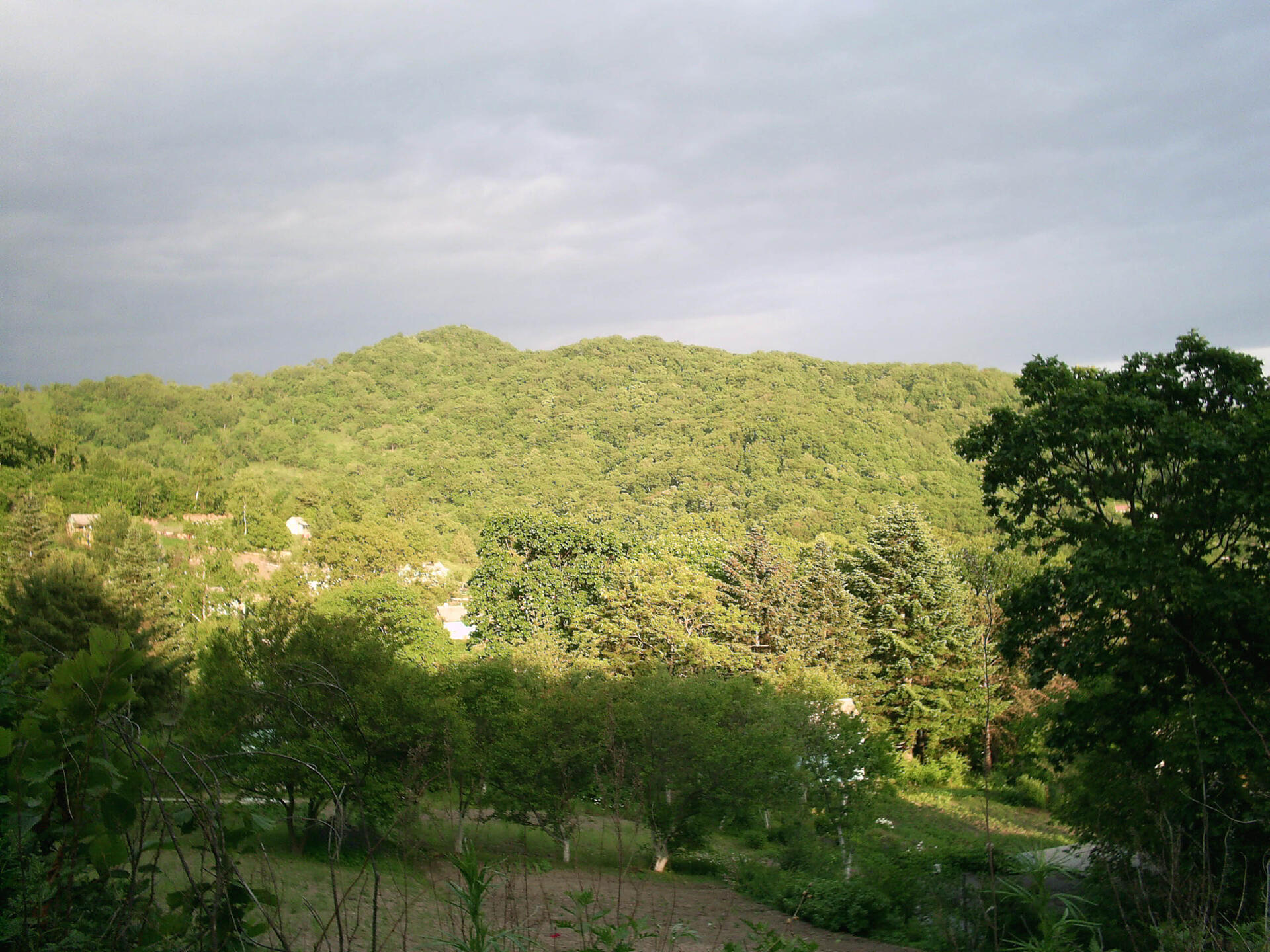
© pauk aka Ruslan V Albitsky, CC BY-SA 3.0 Resized from original. (This derivative is under the same CC BY-SA license.)
World Heritage Research
Discover scientific research and academic studies that deepen our understanding of Central Sikhote-Alin from its history and significance to its conservation, management, and contemporary challenges.
-
Impact of Windblow on the Structure and Phytomass of Siberian Pine and Birch Forests of the Central Sikhote-Alin
A catastrophic windblow event in 2016, unprecedented in the history of the Sikhote-Alin Reserve, led to significant reductions in phytomass and structural integrity of Siberian pine (cedar) and birch forests. The study found that the windblow decreased the average stock of stone pine forests by 46% (from 552 to 298 m³ ha⁻¹) and birch forests by 35% (from 253 to 163 m³ ha⁻¹). Biomass stocks for cedar and birch forests dropped by 44% and 35%, respectively, with a maximum carbon capacity of 150 t C ha⁻¹ identified for stone pine forests. The research analyzed data from permanent test plots (PTPs) before and after the windblow, spanning 8–18 years, using regional allometric equations to determine aboveground phytomass. Spruce, fir, and cedar were found to be less resistant to windblow, while maples, Amur linden, and larch exhibited higher resilience.
Ivanov, A. V., Salo, M. A., Bondarchuk, S. N., Zamolodchikov, D. G., Mogileva, A. V., & Kochkarina, N. A. (2022). Impact of Windblow on the Structure and Phytomass of Siberian Pine and Birch Forests of the Central Sikhote-Alin. Contemporary Problems of Ecology, 15(7), 831–839. https://doi.org/10.1134/s1995425522070101
View Publication Record | Read Publication -
Development of Solontsovskie Lakes as indicator of humidity within Central Sikhote-Alin in the Late Holocene
A detailed reconstruction of humidity changes in the Central Sikhote-Alin during the Late Holocene reveals that precipitation variations, rather than temperature shifts, primarily drove hydrological fluctuations. Using sediment analysis from Solontsovskie Lakes—particularly Nizhnee Lake—researchers identified rapid transitions between wet and dry phases, with frequent changes in diatom assemblages and peat-forming plants indicating unstable hydroclimatic conditions. While cooling periods generally coincided with decreased moisture, the Little Ice Age was notably wet due to increased precipitation. The study leveraged radiocarbon dating (with a temporal resolution of 30–60 years) and comparative analysis of two lakes to trace trophic shifts and organogenic sedimentation rates (up to 1.9 mm/year). These findings correlate local paleoclimatic events with global data, offering new insights into the region's climate sensitivity.
Razjigaeva, N. G., Ganzey, L. A., Grebennikova, T. A., Kopoteva, T. A., Klimin, M. A., Lyashchevskaya, M. S., Panichev, A. M., Arslanov, Kh. A., Maksimov, F. E., Petrov, A. Yu.,. (2021). Development of Solontsovskie Lakes as indicator of humidity within Central Sikhote-Alin in the Late Holocene. Geosystems of Transition Zones, 5(3), 287–304. https://doi.org/10.30730/gtrz.2021.5.3.287-304
View Publication Record | Read Publication -
Experience of Complex Microseismic and Magnetotelluric Sounding on the Northern Part of the Central Sikhote-Alin Fault
A study of the Central Sikhote-Alin Fault (CSAF) reveals that its fault zone is impermeable, characterized by a narrow subvertical high-resistivity region between contrasting crustal blocks. Researchers used microseismic sounding (MSS) and magnetotelluric sounding (MTS) to map relative P-wave velocities and geoelectric structures up to 9 km deep along a 42 km transect. The findings show that the CSAF's structure aligns with another fault zone 6 km northwest, extending deeper than initially observed. This dual-method approach demonstrates promise for unraveling crustal dynamics in tectonically active regions.
Pupatenko, V. V., Ryabinkin, K. S., Bronnikov, A. K., Verkhoturov, A. L.,. (2021). EXPERIENCE OF COMPLEX MICROSEISMIC AND MAGNETOTELLURIC SOUNDING ON THE NORTHERN PART OF THE CENTRAL SIKHOTE-ALIN FAULT. Bulletin of Kamchatka Regional Association «Educational-Scientific Center». Earth Sciences, (2(50)), 84–94. https://doi.org/10.31431/1816-5524-2021-2-50-84-94
View Publication Record | Read Publication -
The Sikhote-Alin Fold System. General Structural Features and Certain Aspects of Control of Gold Mineralization: A Case Study for Central Sikhote-Alin, Russia (Part One)
A structural analysis of the Sikhote-Alin fold system in Central Russia reveals that its gold-sulfide mineralization is closely linked to Cretaceous-era folding characterized by northeast-southwest (50-60°) orientation, formed under conditions of crustal shortening and left-lateral shear. The study identifies type-morphic features indicating this folding resulted from longitudinal bending with flow during a period of tectonomagmatic activity spanning the Aptian to late Cretaceous. The research employs structural-kinematic correlation to elucidate the relationship between folding dynamics and gold mineralization, offering insights into the geological processes controlling ore formation in this region.
Nevolin, P. L., Mitrokhin, A. N., Utkin, V. P.,. (2018). THE SIKHOTE-ALIN FOLD SYSTEM. GENERAL STRUCTURAL FEATURES AND CERTAIN ASPECTS OF CONTROL OF GOLD MINERALIZATION: A CASE STUDY FOR CENTRAL SIKHOTE-ALIN, RUSSIA (Part One). Bulletin of Kamchatka Regional Association «Educational-Scientific Center». Earth Sciences, (2(38)), 84–101. https://doi.org/10.31431/1816-5524-2018-2-38-84-101
View Publication Record | Read Publication -
Post-fire Successions of Vegetation and Pinus koraiensis Ectomycorrhizal Communities in Korean Pine–Broadleaf Forests of the Central Sikhote-Alin
In the Central Sikhote-Alin, Korean pine (Pinus koraiensis) seedlings thrive best during late-successional stages (90–100 years and 230–250 years), where balanced ectomycorrhizal fungal communities and thick soil layers foster successful mycorrhization. Early post-fire stages (fresh burns) promote competitive mycorrhization by stress-adapted fungi, while mid-successional stages (50–60 years) show the least successful mycorrhiza formation. The study analyzed four successional phases, linking vegetation structure to Korean pine seedling survival and fungal community dynamics, revealing critical insights into forest regeneration after disturbances.
Pimenova, E. A., Gromyko, M. N., Bondarchuk, S. N., Malysheva, V. F., Malysheva, E. F., & Kovalenko, A. E. (2016). Post-fire Successions of Vegetation and Pinus koraiensis Ectomycorrhizal Communities in Korean Pine–Broadleaf Forests of the Central Sikhote-Alin. Achievements in the Life Sciences, 10(1), 48–56. https://doi.org/10.1016/j.als.2016.05.004
View Publication Record | Read Publication