World Heritage Identification Number: 1017
World Heritage since: 2000
Category: Natural Heritage
WHE Type: Protected Areas & National Parks
Transboundary Heritage: No
Endangered Heritage: No
Country: 🇸🇷 Suriname
Continent: Americas
UNESCO World Region: Latin America and the Caribbean
Map
Exploring the Biodiversity Haven: Central Suriname Nature Reserve
The Central Suriname Nature Reserve (CSNR) stands as a testament to the richness and resilience of the Earth's natural wonders, nestled within the heart of Suriname. Established in 2000, this expansive nature reserve spans over 1.6 million hectares, making it one of the largest protected areas in South America.
More to come…UNESCO Description of the World Heritage Site
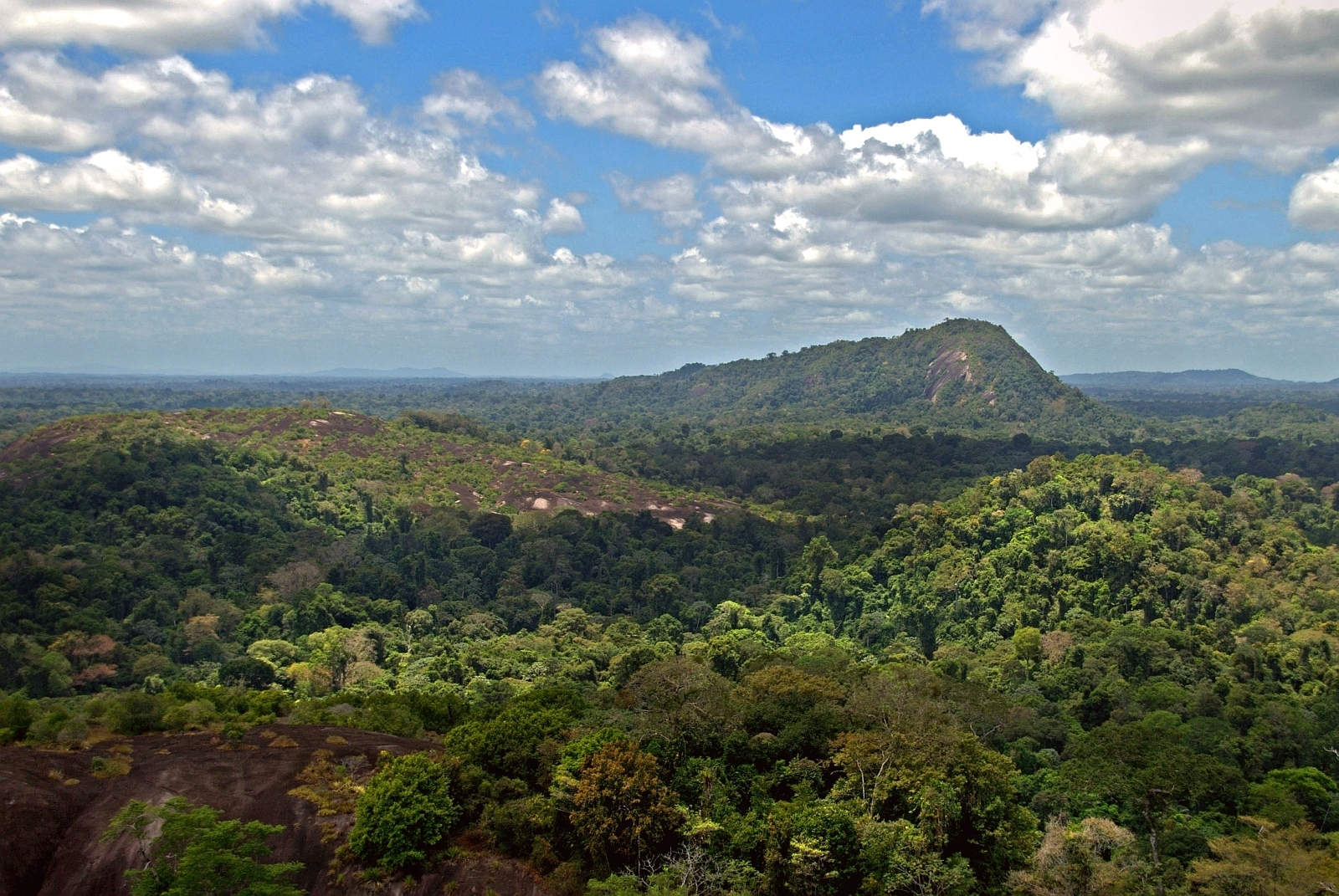
The Central Suriname Nature Reserve comprises 1.6 million ha of primary tropical forest of west-central Suriname. It protects the upper watershed of the Coppename River and the headwaters of the Lucie, Oost, Zuid, Saramaccz, and Gran Rio rivers and covers a range of topography and ecosystems of notable conservation value due to its pristine state. Its montane and lowland forests contain a high diversity of plant life with more than 5,000 vascular plant species collected to date. The Reserve's animals are typical of the region and include the jaguar, giant armadillo, giant river otter, tapir, sloths, eight species of primates and 400 bird species such as harpy eagle, Guiana cock-of-the-rock, and scarlet macaw.
UNESCO Justification of the World Heritage Site
Criterion (ix): The property encompasses significantly diverse topography and soils. The altitudinal gradient, ranging from 25 m.a.s.l. to Suriname's highest elevation at 1,230 m.a.s.l, spans almost the entire possible range. These conditions have resulted in an extraordinary variety of ecosystems, habitats and ecological niches of global conservation importance. Besides vast tracts of dense tropical lowland forest there are swamp forests, rare rocky savannas, and visually stunning granite inselbergs, all harbouring specialised communities of flora and fauna. To this day, this ecosystem variation has been allowing organisms to move in response to disturbance, adapt to change and maintain gene flow between populations in one of the few remaining areas of vast and undisturbed forests in the wider Amazonian region, practically free of direct human impacts. Viable populations of large top predators indicate a nearly pristine state, rendering the property into an invaluable scientific reference to better understand the natural dynamics of the undisturbed forest ecosystems.
Criterion (x): The site contains a stunning diversity of plant and animal species, many of which are endemic to the Guiana Shield and globally vulnerable, threatened or endangered. Due to its location on the Eastern edge of the Precambrian Guiana Shield the property contains a distinct assemblage of species compared to the rest of the Guiana Shield region. Some 6,000 plant species have been recorded in yet incomplete inventories. Of the 1,890 known species of vertebrates in Suriname, at least 65 are endemic to the country and likely occur within the property. Many of the species are endemic to the property or even small areas within the property, such as the ecologically and geologically remarkable individual granite inselbergs. The large and undisturbed property is of major importance for viable populations of several rare species such as Guianan Cock-of-the-Rock and Giant River Otter. Research expeditions routinely reveal species of fauna and flora previously unknown to science.
Encyclopedia Record: Central Suriname Nature Reserve
The Central Suriname Nature Reserve is a conservation unit in Suriname. It preserves an area of tropical rainforest. The reserve is in pristine condition.Additional Site Details
Area: 1,600,000 hectares
Number of Components: 1
(x) — Contains most important habitats for biodiversity
Coordinates: 4 , -56.5
IUCN World Heritage Outlook
The 2025 Conservation Outlook on Central Suriname Nature Reserve reports the following assessment:
Source: International Union for Conservation of Nature (IUCN) · View assessment
World Heritage Research
Discover scientific research and academic studies that deepen our understanding of Central Suriname Nature Reserve from its history and significance to its conservation, management, and contemporary challenges.
-
Prey Composition of Harpy Eagles (Harpia harpyja) in Raleighvallen, Suriname
A new study reveals that Harpy Eagles (Harpia harpyja), the largest eagles on Earth, have a diverse diet in primary forests of the Central Suriname Nature Reserve, including nine previously unrecorded prey species. These apex predators, known for their ecological significance, frequently target game animals such as large primates and birds alongside sloths, which were traditionally considered their staple prey. The research, combining field observations with a review of existing literature, identifies 102 prey species in total, providing critical insights into the autecology of Harpy Eagles in Neotropical forests. This information underscores the ecological role of apex predators and highlights the importance of preserving primary forest habitats to sustain their populations.
Miranda, E. B. P. (2018). Prey Composition of Harpy Eagles ( Harpia harpyja ) in Raleighvallen, Suriname. Tropical Conservation Science, 11. https://doi.org/10.1177/1940082918800789
View Publication Record | Read Publication -
Gaps and opportunities for the World Heritage Convention to contribute to global wilderness conservation
Only about 1.8% of the world's wilderness is protected under UNESCO World Heritage Sites (WHS), with notable exceptions like the Okavango Delta and Central Suriname Nature Reserve. A global analysis identified significant gaps in wilderness representation across 22 terrestrial biorealms, despite WHS containing some excellent examples. The study used a 'last-of-the-wild' method to map remaining wilderness areas and assessed their coverage under existing protected designations. It also pinpointed 840 large protected areas—predominantly wilderness—that could serve as candidates for future WHS designation, addressing critical biodiversity gaps. The research underscores the urgent need for the World Heritage Convention to prioritize ecological integrity in preserving these irreplaceable landscapes.
Allan, J. R., Kormos, C., Jaeger, T., Venter, O., Bertzky, B., Shi, Y., Mackey, B., van Merm, R., Osipova, E., & Watson, J. E. M. (2017). Gaps and opportunities for the World Heritage Convention to contribute to global wilderness conservation. Conservation Biology, 32(1), 116–126. Portico. https://doi.org/10.1111/cobi.12976
View Publication Record | Read Publication -
A new species of suckermouth armored catfish, Pseudancistrus kwinti (Siluriformes: Loricariidae) from the Coppename River drainage, Central Suriname Nature Reserve, Suriname
Researchers have discovered a new species of suckermouth armored catfish, Pseudancistrus kwinti, in the Coppename River drainage within Suriname's Central Suriname Nature Reserve (CSNR). This unique species is distinguished by several key traits: the absence of dentary papillae, a complete mid-dorsal plate row, mottled or barred coloration, hypertrophied odontodes along the snout edge, and weakly evertible cheek plates. The discovery highlights the rich biodiversity of the CSNR, a UNESCO World Heritage Site renowned for its pristine environment. However, the region faces growing threats from mining, increased fishing pressure, and tourism, which could significantly alter this delicate ecosystem.
WILLINK, P. W., MOL, J. H., & CHERNOFF, B. (2010). A new species of suckermouth armored catfish, Pseudancistrus kwinti (Siluriformes: Loricariidae) from the Coppename River drainage, Central Suriname Nature Reserve, Suriname. Zootaxa, 2332(1). https://doi.org/10.11646/zootaxa.2332.1.3
View Publication Record | Read Publication