World Heritage Identification Number: 1250
World Heritage since: 2007
Category: Cultural Heritage
WHE Type: Historic Cities & Urban Areas
Transboundary Heritage: No
Endangered Heritage: No
Country: 🇲🇽 Mexico
Continent: Americas
UNESCO World Region: Latin America and the Caribbean
Map
A Modernist Icon: The Central University City Campus of the Universidad Nacional Autónoma de México (UNAM)
The Central University City Campus of the Universidad Nacional Autónoma de México (UNAM), located in the Coyoacán borough of Mexico City, stands as a testament to mid-20th century modernist architecture and urban planning. Inscribed as a UNESCO World Heritage Site in 2007, this expansive complex serves as the primary campus for Mexico's national university, offering a unique blend of modern design principles and references to Mexico's rich pre-Hispanic heritage.
More to come…UNESCO Description of the World Heritage Site
The ensemble of buildings, sports facilities and open spaces of the Central University City Campus of the Universidad Nacional Autónoma de México (UNAM), was built from 1949 to 1952 by more than 60 architects, engineers and artists who were involved in the project. As a result, the campus constitutes a unique example of 20th-century modernism integrating urbanism, architecture, engineering, landscape design and fine arts with references to local traditions, especially to Mexico’s pre-Hispanic past. The ensemble embodies social and cultural values of universal significance and is one of the most significant icons of modernity in Latin America.
UNESCO Justification of the World Heritage Site
Criterion (i): The Central University City Campus of UNAM constitutes a unique example in the 20th century where more than sixty professionals worked together, in the framework of a master plan, to create an urban architectural ensemble that bears testimony to social and cultural values of universal significance.
Criterion (ii): The most important trends of architectural thinking from the 20th century converge in the Central University City Campus of UNAM: modern architecture, historicist regionalism, and plastic integration; the last two of Mexican origin.
Criterion (iv): The Central University City Campus of UNAM is one of the few models around the world where the principles proposed by Modern Architecture and Urbanism were totally applied; the ultimate purpose of which was to offer man a notable improvement in the quality of life.
Encyclopedia Record: Ciudad Universitaria, Mexico City
Ciudad Universitaria is the main campus of the National Autonomous University of Mexico (UNAM), located in Coyoacán borough in the southern part of Mexico City. Designed by architects Mario Pani and Enrique del Moral, it encloses the Olympic Stadium, about 40 faculties and institutes, the Cultural Center, an ecological reserve, the Central Library, the National Library of Mexico and a few museums. It was built during the 1950s on an ancient solidified lava bed in Coyoacán called "El Pedregal" to replace the scattered buildings in downtown Mexico City where classes were given. It was completed in 1954 at a cost of approximately $25 million. It was declared a World Heritage Site by UNESCO in 2007.Additional Site Details
Area: 176.5 hectares
Number of Components: 1
(ii) — Significant interchange of human values
(iv) — Outstanding example of a type of building or landscape
Coordinates: 19.3322222222 , -99.1880555555
Image
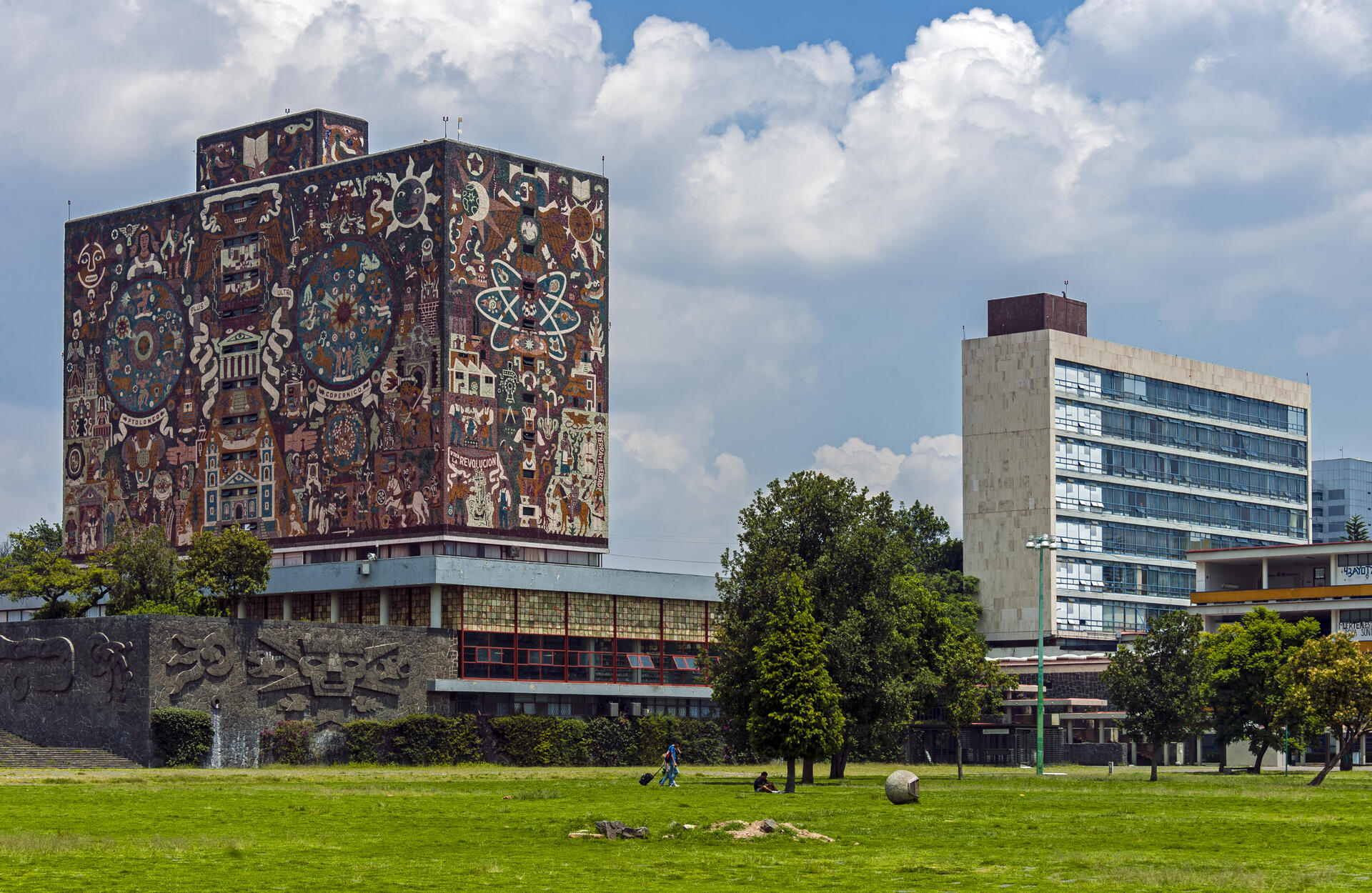
© Daniel Case, CC BY-SA 3.0 Resized from original. (This derivative is under the same CC BY-SA license.)