World Heritage Identification Number: 702
World Heritage since: 1994
Category: Cultural Heritage
WHE Type: Religious Sites & Sacred Architecture
Transboundary Heritage: No
Endangered Heritage: No
Country: 🇲🇽 Mexico
Continent: Americas
UNESCO World Region: Latin America and the Caribbean
Map
Early Christian Architecture in Colonial Mexico: The Earliest 16th-Century Monasteries on the Slopes of Popocatepetl
The Earliest 16th-Century Monasteries on the Slopes of Popocatepetl, a UNESCO World Heritage Site since 1994, offer a unique glimpse into the early Christian architecture that shaped colonial Mexico. Located in the states of Morelos, Puebla, and Tlaxcala, these 15 monasteries were built by the Augustinians, Franciscans, and Dominicans to evangelize the regions south and east of the Popocatépetl volcano.
More to come…UNESCO Description of the World Heritage Site
The Earliest 16th-Century Monasteries on the Slopes of Popocatepetl is a serial property with 15 component parts located in the states of Morelos, Puebla and Tlaxcala in Mexico, built as part of the evangelisation and colonisation of the northern territories of Mexico. They are in an excellent state of conservation and are good examples of the architectural style adopted by the first missionaries – Franciscans, Dominicans and Augustinians – who converted the indigenous populations to Christianity in the early 16th century. They also represent an example of a new architectural concept in which open spaces, including wide atria and posa chapels, are of renewed importance. The influence of this style is felt throughout the Mexican territory and even beyond its borders.
UNESCO Justification of the World Heritage Site
Criterion (ii): The considerable influence exercised by the architectural model of the Earliest 16th-Century Monasteries on the Slopes of Popocatepetl, which spread over a very wide area, is incontestable. They operated not only in the second half of the 16th century in the centre and south-east of Mexico, but continued with the expansion of colonisation and evangelisation of the lands to the north in the 18th century, reaching the present-day United States of America from the Atlantic to the Pacific coasts, in the form of a large number of smaller establishments known as “missions” rather than monasteries.
Criterion (iv): The Earliest 16th-Century Monasteries on the Slopes of Popocatepetl is a group of monasteries selected as being representative of a large total. They bear characteristic witness to a certain type of structure, architectural as well as urban, which served as the centre of new human establishments for the reorganization of an enormous territory and for the introduction of new social and cultural elements.
Encyclopedia Record: Monasteries on the slopes of Popocatépetl
The Earliest Monasteries on the Slopes of Popocatepetl are sixteen earliest 16th-century monasteries which were built by the Augustinians, the Franciscans and the Dominicans in order to evangelize the areas south and east of the Popocatépetl volcano in central Mexico. These monasteries were recognized by the UNESCO as World Heritage Sites in 1994, because they served as the model for the early monastery and church buildings as well as evangelization efforts in New Spain and some points beyond in Latin America. These monasteries almost uniformly feature a very large atrium in front of a single nave church with a capilla abierta or open chapel. The atrium functioned as the meeting point between the indigenous peoples and the missionary friars, with mass for the newly converted held outdoors instead of within the church. This arrangement can be found repeated in other areas of Mexico as these friars continued to branch out over New Spain.Additional Site Details
Area: 24.33 hectares
Number of Components: 15
(iv) — Outstanding example of a type of building or landscape
Coordinates: 18.9347222222 , -98.8977777778
Image
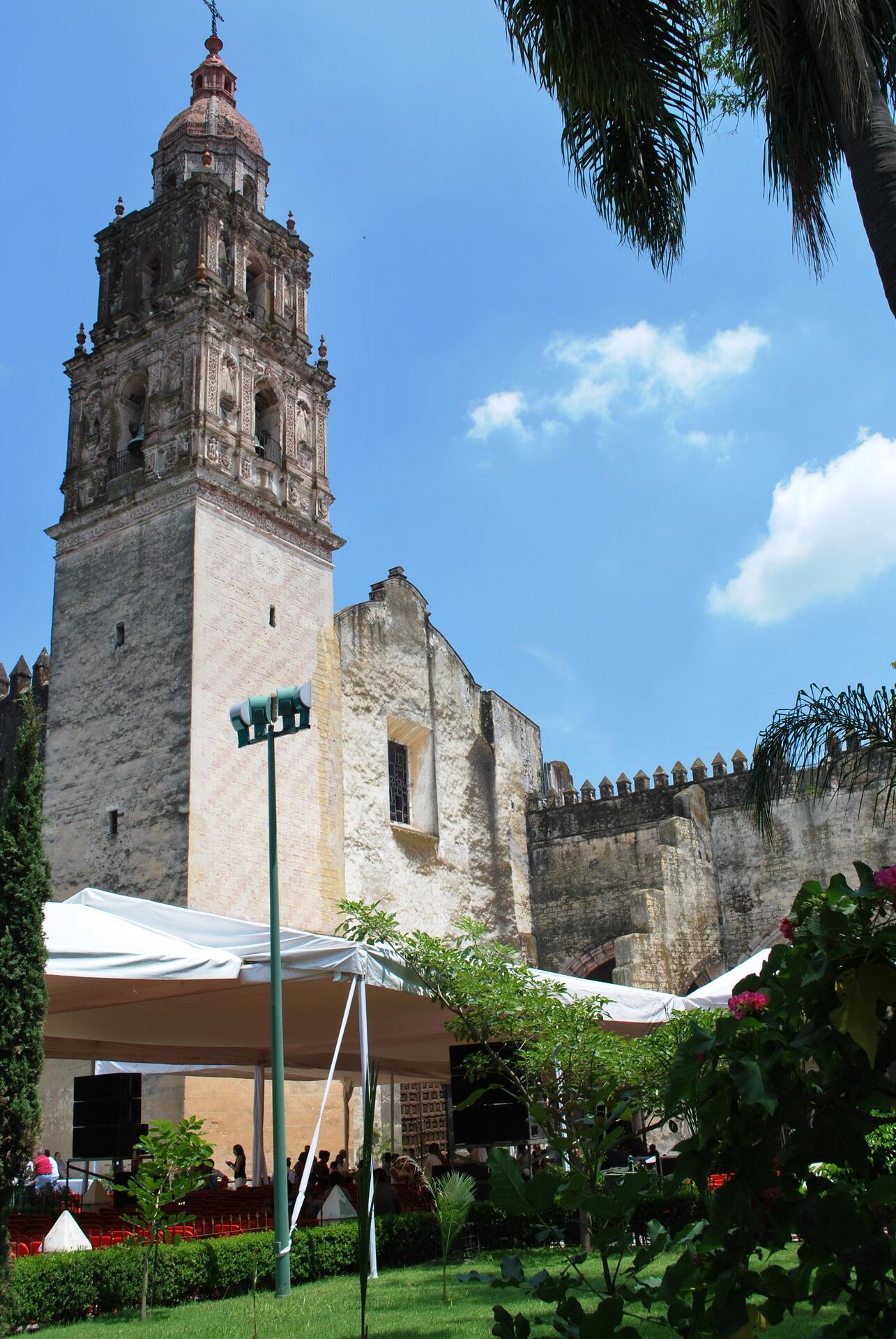
© Thelmadatter, CC BY-SA 3.0 Resized from original. (This derivative is under the same CC BY-SA license.)