World Heritage Identification Number: 788
World Heritage since: 1996
Category: Cultural Heritage
WHE Type: Buildings & Architectural Ensembles
Transboundary Heritage: No
Endangered Heritage: No
Country: 🇮🇹 Italy
Continent: Europe
UNESCO World Region: Europe and North America
Map
The Early Christian Monuments of Ravenna: A Unique Collection of Artistic Masterpieces
The Early Christian Monuments of Ravenna, inscribed as a UNESCO World Heritage Site in 1996, represent a remarkable testament to the blending of diverse artistic influences during the formative years of Christianity. Located in the heart of the Emilia-Romagna region in Northern Italy, these eight architectural wonders serve as a time capsule, offering a glimpse into the rich history and cultural evolution of the city that once served as the capital of the Western Roman Empire.
More to come…UNESCO Description of the World Heritage Site
Ravenna was the seat of the Roman Empire in the 5th century and then of Byzantine Italy until the 8th century. It has a unique collection of early Christian mosaics and monuments. All eight buildings – the Mausoleum of Galla Placidia, the Neonian Baptistery, the Basilica of Sant'Apollinare Nuovo, the Arian Baptistery, the Archiepiscopal Chapel, the Mausoleum of Theodoric, the Church of San Vitale and the Basilica of Sant'Apollinare in Classe – were constructed in the 5th and 6th centuries. They show great artistic skill, including a wonderful blend of Graeco-Roman tradition, Christian iconography and oriental and Western styles.
UNESCO Justification of the World Heritage Site
Criterion (i): The Early Christian Monuments of Ravenna are of outstanding significance by virtue of the supreme artistry of the mosaic art they contain.
Criterion (ii): The Early Christian Monuments of Ravenna are without parallel because of the crucial evidence they provide of artistic and religious relationships and contacts at an important period of European cultural history. The mosaics are among the best surviving examples of this form of art in Europe and have an increased significance due to the blending of western and eastern motifs and techniques
Criterion (iii): The Early Christian Monuments of Ravenna show great artistic skill, including a wonderful blend of Greco-Roman tradition, Christian iconography and oriental and western styles typifying the culture of the later Roman Empire.
Criterion (iv): The property constitutes an epitome of religious and funerary art and architecture during the 6th century AD.
Encyclopedia Record: Ravenna
Ravenna is the capital city of the Province of Ravenna, in the Emilia-Romagna region of Northern Italy. It was the capital city of the Western Roman Empire during the fifth century A.D. until its collapse in 476, after which it served as the capital of the Ostrogothic Kingdom and then the Byzantine Exarchate of Ravenna. With a population of 156,475 inhabitants as of 2026, it is the 24th-largest city in Italy. Ravenna is also the second largest city in Italy by area with 653.82 km2.Additional Site Details
Area: 1.32 hectares
Number of Components: 8
(ii) — Significant interchange of human values
(iii) — Unique or exceptional testimony to a cultural tradition
(iv) — Outstanding example of a type of building or landscape
Coordinates: 44.42041667 , 12.19625
Image
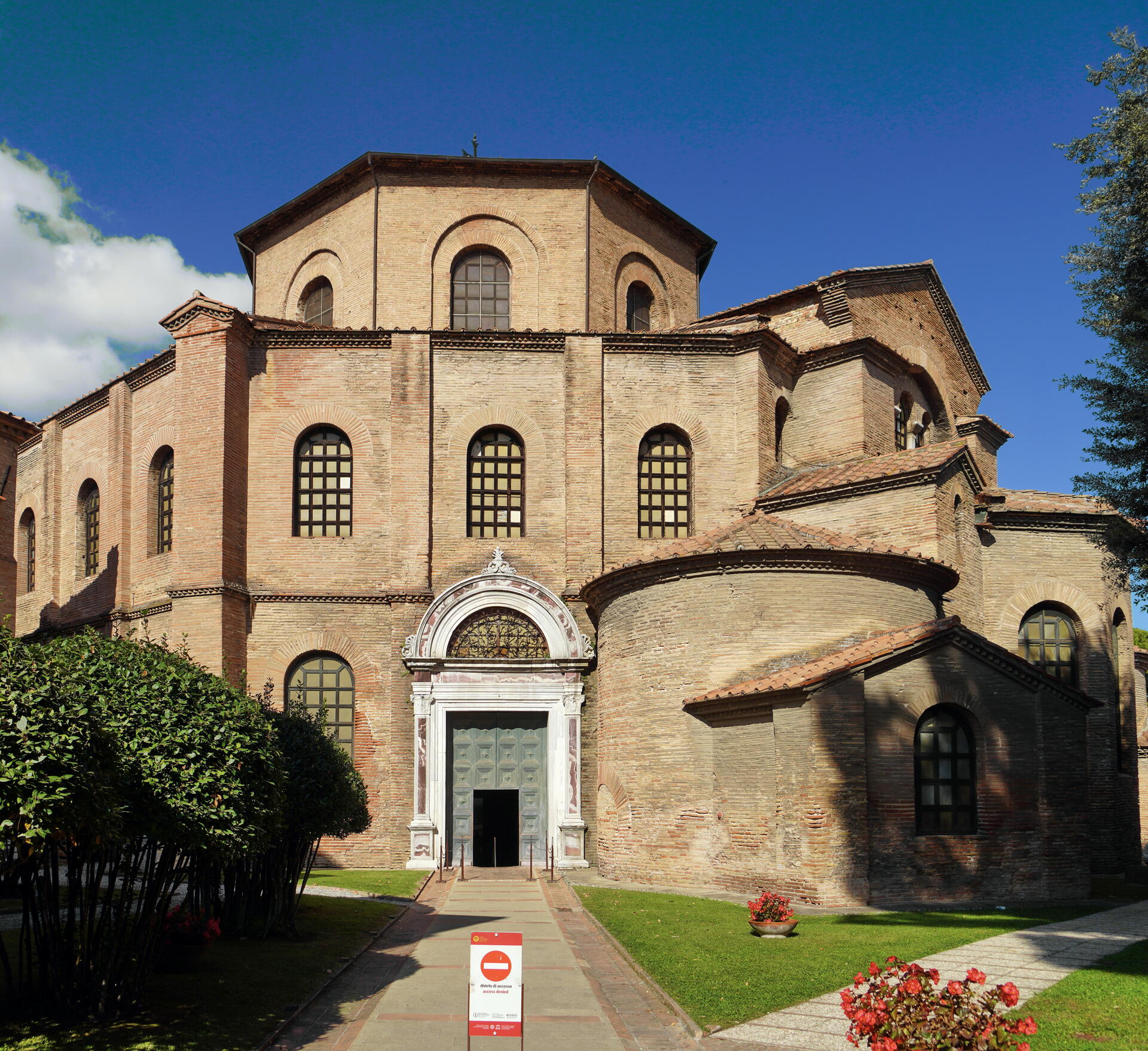
© Commonists, CC BY-SA 4.0 Resized from original. (This derivative is under the same CC BY-SA license.)
World Heritage Research
Discover scientific research and academic studies that deepen our understanding of Early Christian Monuments of Ravenna from its history and significance to its conservation, management, and contemporary challenges.
-
Building the Knowledge Base for Cultural Heritage Risk Assessment: The Case of the Arian Baptistry, Ravenna (Italy)
Effective cultural heritage risk assessment demands integration of technical, social, and governance factors. This study demonstrates that disaster risk assessment (DRA) for the Arian Baptistery in Ravenna—part of UNESCO’s Early Christian Monuments—requires harmonization across disciplines to address conceptual inconsistencies. By combining ICCROM’s ABC Method with IPCC/UNDRR models and QuiskScan, researchers developed a five-step framework: context analysis, stakeholder mapping, value assessment, terminological alignment, and risk systematization. A key innovation is the hybrid hazard framework, which expands 'dissociation' to include governance failures and socio-political risks, bridging ICCROM’s Ten Agents of Deterioration with UNDRR 2025 hazards. The Arian Baptistery serves as a methodological laboratory, offering a replicable model for knowledge organization and terminology harmonization in heritage risk management.
Fiorentino, S., Casarotto, A., Falbo, I., & Vandini, M. (2026). Building the Knowledge Base for Cultural Heritage Risk Assessment: The Case of the Arian Baptistry, Ravenna (Italy). Heritage, 9(3), 111. https://doi.org/10.3390/heritage9030111
View Publication Record | Read Publication -
Sustaining the past, shaping the future
Balancing heritage conservation with sustainable tourism development is critical for Mediterranean World Heritage Sites (WHS), yet current management models often fall short. A comparative study of the Episcopal Complex of the Euphrasian Basilica in Poreč, Croatia, and Ravenna’s Early Christian Monuments reveals key strengths and weaknesses in governance structures, stakeholder engagement, and conservation strategies. Innovative practices identified—such as integrating local community input through surveys—offer actionable lessons for improving WHS management across the region. By analyzing qualitative data from management plans and expert interviews, this research highlights the need to reassess traditional approaches to ensure long-term sustainability without compromising cultural integrity.
Legović, M., & Urošević, N. (2026). Sustaining the past, shaping the future. Cultural Challenges of a Changing Europe, 322–351. https://doi.org/10.4000/16q3m
View Publication Record | Read Publication -
According to Byzantine Designs: Syrian Merchants in the West and Early Christian Architecture
Syrian merchant communities in post-Roman Europe played a significant role in transmitting Eastern Mediterranean architectural and liturgical traditions to the West, likely influencing early Christian architecture from Ravenna to Ireland. The study identifies octagonal baptisteries and cathedrals—such as those in Milan and Ravenna—as hallmarks of Antiochian architectural influence, suggesting direct imitation or involvement of Syrian craftsmen. Archaeological and historical evidence supports the presence of these communities, with parallels drawn to better-documented merchant groups, like Greek traders in Ukraine. The research highlights how even small, resourceful migrant groups can leave a lasting cultural imprint.
Morozova, D. (2025). According to Byzantine Designs: Syrian Merchants in the West and Early Christian Architecture. NaUKMA Research Papers. History and Theory of Culture, 8, 81–91. https://doi.org/10.18523/2617-8907.2025.8.81-91
View Publication Record | Read Publication -
Endangered historic sites: the case study of Santa Croce in Ravenna (Italie)
Santa Croce in Ravenna, part of the UNESCO-listed Early Christian Monuments, faces significant hydrogeological threats due to climate change-induced flooding and subsidence. A recent geotechnical study, combining piezometric monitoring with 3D modeling via laser scanning and photogrammetry, revealed critical vulnerabilities in the site's drainage system and subsoil structure. These findings highlight the urgent need for adaptive preservation strategies to mitigate long-term stability risks, offering a model for protecting other endangered historic sites.
Marchi, M., Bertolini, I., & Gottardi, G. (2024). Endangered historic sites: the case study of Santa Croce in Ravenna (Italie). Geotechnical Engineering Challenges to Meet Current and Emerging Needs of Society, 1209–1213. https://doi.org/10.1201/9781003431749-217
View Publication Record | Read Publication -
Images of the Garden of Eden in the Ornamental Decoration of the Church of San Vitale in Ravenna: On the Question of Influences and Models
A comparative analysis of the ornamental mosaic decoration in Ravenna's Church of San Vitale reveals significant iconographic and stylistic parallels with early Christian monuments from Aquileia and Sicily. These findings challenge existing assumptions about the influences shaping monumental church decorations, suggesting a more complex interplay between regional art centers than previously understood. The study employed detailed visual analysis to identify shared motifs and techniques, particularly focusing on depictions of the Garden of Eden in the presbytery. This approach enriches our understanding of artistic transmission and cultural exchange during this period.
Khripkova, E. A. (2023). IMAGES OF THE GARDEN OF EDEN IN THE ORNAMENTAL DECORATION OF THE CHURCH OF SAN VITALE IN RAVENNA: ON THE QUESTION OF INFLUENCES AND MODELS. Studia Religiosa Rossica: Russian Journal of Religion, (3), 18–37. https://doi.org/10.28995/2658-4158-2023-3-18-37
View Publication Record | Read Publication -
Through a Glass Darkly
A mosaic in the basilica of Sant'Apollinare in Ravenna depicts a procession of wise virgins, including three men dressed in Phrygian caps—a symbol often associated with Mithraism. This finding challenges the prevailing silence of early medieval Christian polemicists regarding pagan influences, suggesting a more nuanced relationship between Christianity and earlier traditions. The study examines the Welsh bard Taliesin as a potential 'initiate,' linking him to underground Mithraism in the sixth century. While classical revivals during the Renaissance drew inspiration from various sources, Mithras remained peripheral, with no significant artistic works emerging from Mithraic monuments. The research sheds light on the subtle persistence of pagan elements in Christian art and thought.
Fear, A. (2022). Through a Glass Darkly. Mithras, 189–204. https://doi.org/10.4324/9780429491467-14
View Publication Record | Read Publication -
La représentation conjointe des évêques et des autorités politiques sur les mosaïques de Ravenne (
v e-vii e siècles)A notable shift in the representation of bishops and political authorities in Ravenna's mosaics, spanning the 5th to 7th centuries, is documented. This study reveals that by the mid-6th century, ecclesiastical leaders began appearing alongside sovereigns as collaborators, a change attributed to the aftermath of the Gothic War. Analyzing both written sources, such as Andreas Agnellus' Liber Pontificalis Rauennatis from the 9th century, and mosaics from sites like San Vitale, this research highlights how Ravenna's early Christian monuments reflect evolving power dynamics during Italy's transition into the Byzantine period.
Zhou, Z. (2022). La représentation conjointe des évêques et des autorités politiques sur les mosaïques de Ravenne (
View Publication Record | Read Publicationv e-vii e siècles). Giornale Italiano Di Filologia, 74, 259–339. https://doi.org/10.1484/j.gif.5.130821