World Heritage Identification Number: 828
World Heritage since: 1998
Category: Cultural Heritage
WHE Type: Historic Cities & Urban Areas
Transboundary Heritage: No
Endangered Heritage: No
Country: 🇮🇹 Italy
Continent: Europe
UNESCO World Region: Europe and North America
Map
The Historic Centre of Urbino: A Renaissance Gem in the Marche Region
The Historic Centre of Urbino, nestled in the picturesque Marche region of Italy, stands as a testament to the rich cultural heritage and artistic flourishing that marked the Renaissance period. Inscribed as a UNESCO World Heritage Site in 1998, this small hill town offers visitors a unique opportunity to immerse themselves in the remnants of an era that left indelible marks on European history and art.
More to come…UNESCO Description of the World Heritage Site
The small hill town of Urbino, in the Marche, experienced a great cultural flowering in the 15th century, attracting artists and scholars from all over Italy and beyond, and influencing cultural developments elsewhere in Europe. Owing to its economic and cultural stagnation from the 16th century onwards, it has preserved its Renaissance appearance to a remarkable extent.
UNESCO Justification of the World Heritage Site
Criterion (ii): During its short cultural pre-eminence, Urbino attracted some of the most outstanding humanist scholars and artists of the Renaissance, who created there an exceptional urban complex of remarkable homogeneity, the influence of which was carried far into the rest of Europe.
Criterion (iv): Urbino represents a pinnacle of Renaissance art and architecture, harmoniously adapted to its physical site and to its medieval precursor in an exceptional manner.
Encyclopedia Record: Urbino
Urbino is a comune (municipality) in the Italian region of Marche, southwest of Pesaro. It is a World Heritage Site notable for a remarkable historical legacy of independent Renaissance culture, especially under the patronage of Federico da Montefeltro, duke of Urbino from 1444 to 1482.Additional Site Details
Area: 29.23 hectares
Number of Components: 1
(iv) — Outstanding example of a type of building or landscape
Coordinates: 43.725 , 12.63333
Image
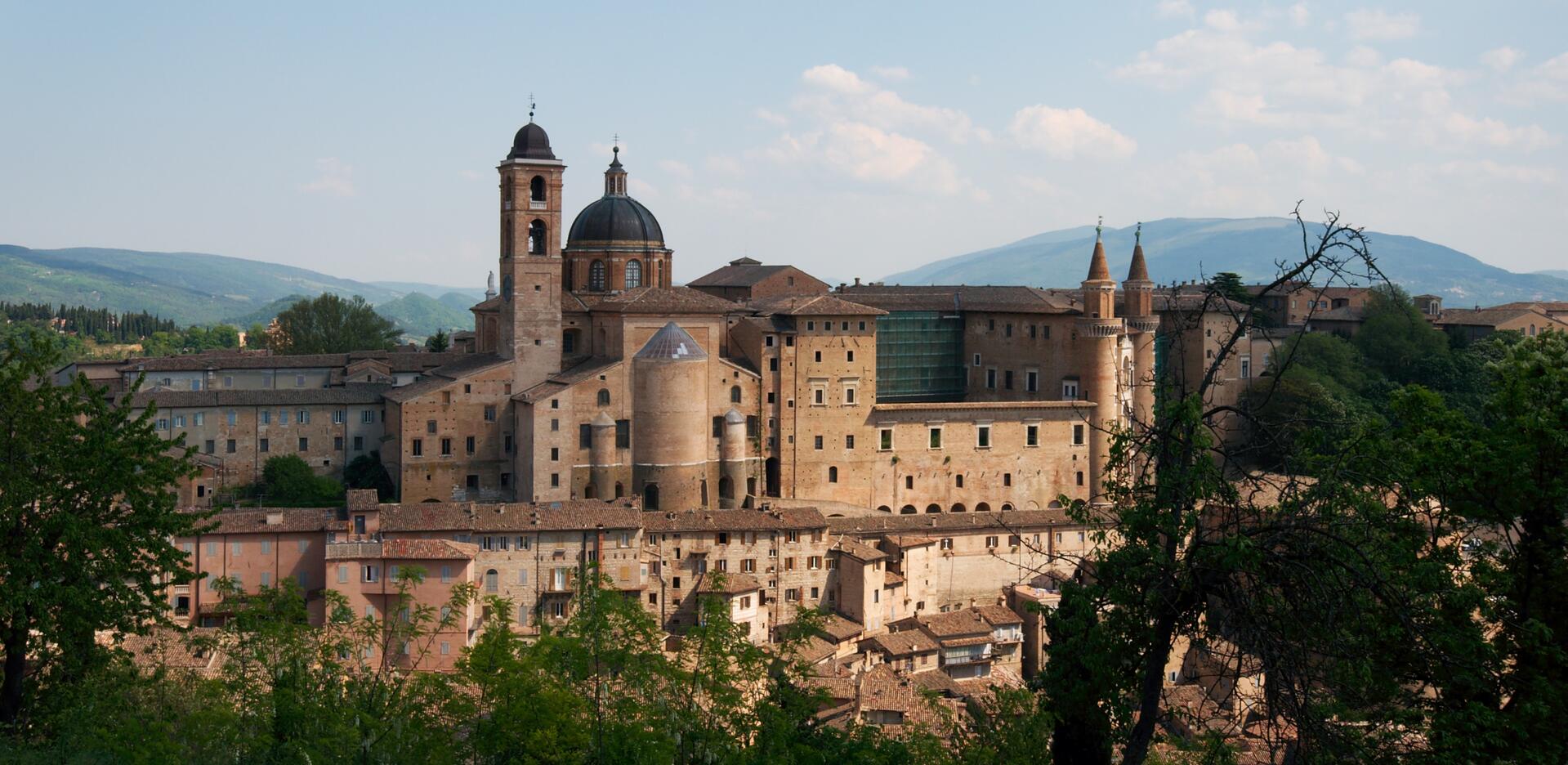
© Il conte di Luna, CC BY-SA 2.0 Resized from original. (This derivative is under the same CC BY-SA license.)
World Heritage Research
Discover scientific research and academic studies that deepen our understanding of Historic Centre of Urbino from its history and significance to its conservation, management, and contemporary challenges.
-
The brick material culture of Urbino (UNESCO World Heritage, Central Italy) as inferred from a multidisciplinary archaeometric study on the historic architecture
A multidisciplinary archaeometric study on the brick material culture of Urbino, Italy, reveals that the city's historic architecture, from Roman to Modern times, relied consistently on raw materials sourced from nearby deposits. Thermoluminescence (TL) dating confirms the prolonged construction periods of key structures, including the Cathedral, which spanned over three centuries. The study highlights a progressive improvement in brick quality and preparation techniques, with firing temperatures reaching at least 850–900°C, though incomplete calcite breakdown due to inconsistent pyrotechnological processes. Uniaxial Compressive Strength of historic bricks aligns with modern standards, underscoring the enduring significance of Urbino's brick material culture, which continued seamlessly until the mid-20th century.
Santi, P., Veneri, F., Tonelli, G., Tramontana, M., Panzeri, L., Galli, A., & Renzulli, A. (2025). The brick material culture of Urbino (UNESCO World Heritage, Central Italy) as inferred from a multidisciplinary archaeometric study on the historic architecture. Built Heritage, 9(1). https://doi.org/10.1186/s43238-025-00233-9
View Publication Record | Read Publication -
Ampliare un World Heritage Site verso il passato recente. L’opera di Giancarlo De Carlo a Urbino
A proposal to expand the boundaries of UNESCO World Heritage Sites (WHS) to include 20th-century heritage, exemplified by Giancarlo De Carlo's work in Urbino, offers a novel approach to preserving modern architectural contributions. The study highlights that De Carlo's master plan for Urbino created a harmonious blend between modern architecture and historic preservation, enriching the site's cultural values beyond its original Renaissance focus. While the 1988 inscription of the Historic Centre of Urbino as an outstanding example of a Renaissance capital did not acknowledge De Carlo's work, the site's management plan (2012-14) suggests including modern buildings in the buffer zone. This raises questions about how to systematically integrate recent heritage into WHS frameworks, with potential implications for global heritage conservation practices.
Borgarino, M. P., & Del Curto, D. (2023). Ampliare un World Heritage Site verso il passato recente. L’opera di Giancarlo De Carlo a Urbino. Restauro Archeologico, 30(1). https://doi.org/10.36253/rar-14267
View Publication Record | Read Publication -
Urbino città Patrimonio UNESCO: un piano per la conservazione, valorizzazione e gestione del patrimonio storico – artistico dell’Ateneo
A groundbreaking pilot project at Palazzo Albani, part of the UNESCO-listed Historic Centre of Urbino, introduces innovative protocols for conserving and communicating architectural heritage. The study, conducted by researchers from the University of Urbino, focuses on integrating historical archival analysis with direct investigation to identify optimal interventions. This approach emphasizes technical-constructive aspects while addressing the unique challenges of preserving non-renewable resources like Palazzo Albani, recognized for its irreplaceable value. The work aims to set a precedent for managing and enhancing the artistic and architectural heritage of Urbino's historic center, contributing to broader strategies for UNESCO World Heritage Sites.
Baratin, L., Cattaneo, A., Gasparetto, F., & Tronconi, V. (2023). Urbino città Patrimonio UNESCO: un piano per la conservazione, valorizzazione e gestione del patrimonio storico – artistico dell’Ateneo. Restauro Archeologico, 30(1). https://doi.org/10.36253/rar-14287
View Publication Record | Read Publication -
The Historic Centre of Urbino, UNESCO World Heritage (Marche Region, Italy): an Urban-Geological Itinerary Across the Building and Ornamental Stones
A detailed geological and petrographic study of the Historic Centre of Urbino, Italyreveals that its building stones primarily originate from local sedimentary formations, particularly limestones within the Umbria–Marche–Romagna Succession. While these materials were historically favored due to their availability in the Northern Marche Apennines, some high-status ornamental stones used in monuments and decorations were sourced from extra-regional Italian areas (e.g., the Alps) and foreign countries like France and Egypt. The research highlights how stone selection was influenced not only by geological factors but also by historical periods, artistic styles, economic importance, and associations with notable figures such as Pope Clemente XI. An open-air stone itinerary featuring 10 key stops is proposed to enhance the appreciation of Urbino’s geological and cultural heritage, supporting geotourism development. The study relied on autoptic observations and historical documentation, avoiding sample collection due to conservation constraints.
Santi, P., Tramontana, M., Tonelli, G., Renzulli, A., & Veneri, F. (2021). The Historic Centre of Urbino, UNESCO World Heritage (Marche Region, Italy): an Urban-Geological Itinerary Across the Building and Ornamental Stones. Geoheritage, 13(4). https://doi.org/10.1007/s12371-021-00606-3
View Publication Record | Read Publication -
Porta Valbona a Urbino: la sua rappresentazione tra storia e restauro
Porta Valbona, Urbino's most significant historic gate, stands as an exceptional urban palimpsest, preserving layers of historical evolution despite centuries of restorations. Built in 1621 for a royal wedding, its monumental facade and limestone eagles (18th-century additions) exemplify the city's architectural heritage. A multidisciplinary study—integrating urban, historical, geometric, material, and structural analyses—revealed Porta Valbona’s enduring testimonial, constructive, and architectural values. Leveraging GIS systems, researchers mapped its shape and resilience, identifying strengths, weaknesses, opportunities, and threats to inform conservation strategies. This approach offers a model for studying and preserving complex monumental heritage sites.
Baratin, L., Cattaneo, A., & Moretti, E. (2020). Porta Valbona a Urbino: la sua rappresentazione tra storia e restauro. X, 1045–1052. https://doi.org/10.4995/fortmed2020.2020.11401
View Publication Record | Read Publication -
The Fortification System of the City of Urbino: The Case Study of Valbona Gate from 3D Surveys to GIS Applications for Dynamic Maps
Advanced integration of 3D surveys and GIS technologies provides a comprehensive, dynamic mapping tool for analyzing the architectural evolution and deterioration of Urbino's historic fortifications. Focusing on Valbona Gate, this study reveals the layered history—from protohistoric roots to Renaissance adaptations—and offers precise diagnostic capabilities for conservation planning. By combining geometric and morphological data with tri-dimensional GIS systems, researchers can assess pathologies, visualize past states, and enable statistical evaluations critical for maintaining UNESCO-listed sites like Urbino's walled city.
Bertozzi, S., Baratin, L., & Moretti, E. (2016). The Fortification System of the City of Urbino: The Case Study of Valbona Gate from 3D Surveys to GIS Applications for Dynamic Maps. Digital Heritage. Progress in Cultural Heritage: Documentation, Preservation, and Protection, 645–656. https://doi.org/10.1007/978-3-319-48496-9_51
View Publication Record | Read Publication -
GIS intelligence for a cutting-edge management of 3D cities
A groundbreaking approach to urban management using GIS technology has been developed, offering a dynamic and upgradeable 3D modeling system for UNESCO World Heritage Sites. This methodology, applied to Urbino's historic center, integrates geomorphological and historical data to provide comprehensive spatial analysis of the city's evolution from Roman settlements to its current state. The system focuses on managing urban elements' composition, geometric characteristics, conservation status, and monitoring interventions, all within a geodatabase environment that supports real-time updates. This innovative framework enhances urban area enjoyment while also supporting decision-making and planning processes.
Baratin, L., Bertozzi, S., & Moretti, E. (2015). GIS intelligence for a cutting-edge management of 3D cities. 2015 Digital Heritage, 93–96. https://doi.org/10.1109/digitalheritage.2015.7419460
View Publication Record | Read Publication