World Heritage Identification Number: 853
World Heritage since: 2000
Category: Cultural Heritage
WHE Type: Archaeological Sites
Transboundary Heritage: No
Endangered Heritage: No
Country: 🇭🇺 Hungary
Continent: Europe
UNESCO World Region: Europe and North America
Map
The Early Christian Necropolis of Pécs (Sopianae): A Testament to the Spread of Christianity in the Late Roman Empire
The Early Christian Necropolis of Pécs, located in the southwestern part of Hungary, offers a unique glimpse into the history of Christianity during the Late Roman Empire. This archaeological site, inscribed on the UNESCO World Heritage List in 2000, is a remarkable testament to the spread of Christianity beyond the Italian peninsula.
More to come…UNESCO Description of the World Heritage Site
In the 4th century, a remarkable series of decorated tombs were constructed in the cemetery of the Roman provincial town of Sopianae (modern Pécs). These are important both structurally and architecturally, since they were built as underground burial chambers with memorial chapels above the ground. The tombs are important also in artistic terms, since they are richly decorated with murals of outstanding quality depicting Christian themes.
UNESCO Justification of the World Heritage Site
Criterion (iii): The burial chambers and memorial chapels of the Sopianae cemetery bear outstanding testimony to the strength and faith of the Christian communities of the Late Roman Empire.
Criterion (iv): The unique Early Christian sepulchral art and architecture of the northern and western Roman provinces is exceptionally well and fully illustrated by the Sopianae cemetery at Pécs.
Encyclopedia Record: Early Christian Necropolis of Pécs
The Early Christian Necropolis of Pécs is a Roman cemetery and archeological site in Pécs, Hungary. Dating from the 4th century AD, the necropolis contains many decorated tombs, mausoleums, and burial chapels from the Early Christian period. It is one of the most significant Roman cemeteries outside of Italy. Because of its size, unique architecture, artistry, and testimony to the spread of Christianity in the Late Roman Empire, the necropolis was added to the UNESCO World Heritage List in 2000.Additional Site Details
Area: 3.76 hectares
Number of Components: 1
(iv) — Outstanding example of a type of building or landscape
Coordinates: 46.07444 , 18.22778
Image
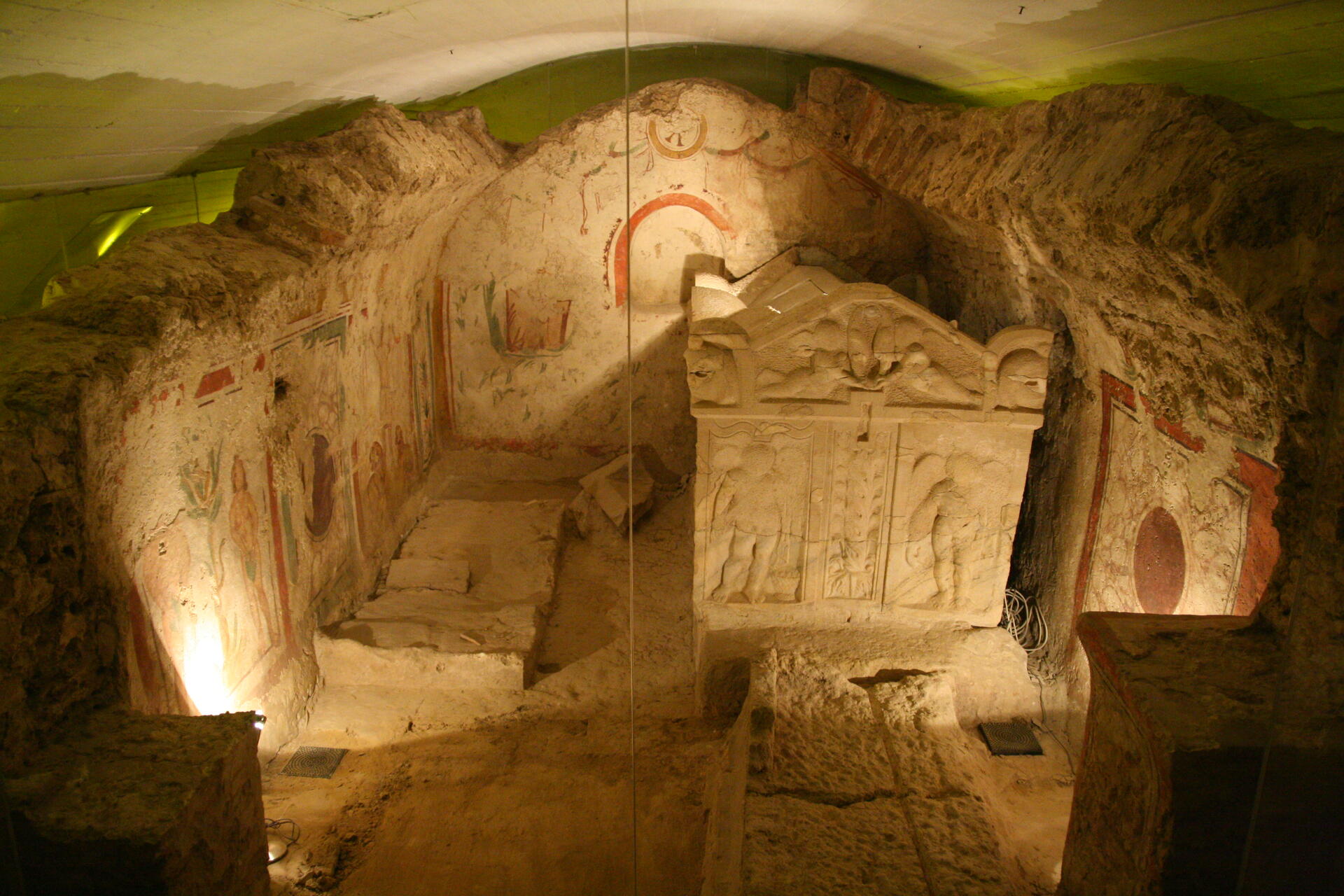
© Lestat (Jan Mehlich), CC BY-SA 3.0 Resized from original. (This derivative is under the same CC BY-SA license.)