World Heritage Identification Number: 931
World Heritage since: 1999
Category: Cultural Heritage
WHE Type: Historic Cities & Urban Areas
Transboundary Heritage: No
Endangered Heritage: No
Country: 🇦🇹 Austria
Continent: Europe
UNESCO World Region: Europe and North America
Map
City of Graz – Historic Centre and Schloss Eggenberg: A Harmonious Blend of Architectural Styles and Cultural Influences
The City of Graz – Historic Centre and Schloss Eggenberg, inscribed as a UNESCO World Heritage Site in 1999, offers a unique insight into the rich cultural and architectural history of Central Europe. Situated in the southeastern part of Austria, Graz serves as the capital of the state of Styria and is the second largest city in the country, with a population of approximately 306,068 as of 2025.
More to come…UNESCO Description of the World Heritage Site
The City of Graz – Historic Centre and Schloss Eggenberg bear witness to an exemplary model of the living heritage of a central European urban complex influenced by the secular presence of the Habsburgs and the cultural and artistic role played by the main aristocratic families. They are a harmonious blend of the architectural styles and artistic movements that have succeeded each other from the Middle Ages until the 18th century, from the many neighbouring regions of Central and Mediterranean Europe. They embody a diversified and highly comprehensive ensemble of architectural, decorative and landscape examples of these interchanges of influence.
UNESCO Justification of the World Heritage Site
Criterion (ii): The City of Graz – Historic Centre and Schloss Eggenberg reflects artistic and architectural movements originating from the Germanic region, the Balkans and the Mediterranean, for which it served as a crossroads for centuries. The greatest architects and artists of these different regions expressed themselves forcefully here and thus created a brilliant syntheses.
Criterion (iv): The urban complex forming the City of Graz – Historic Centre and Schloss Eggenberg is an exceptional example of a harmonious integration of architectural styles from successive periods. Each age is represented by typical buildings, which are often masterpieces. The physiognomy of the city and of the castle faithfully tells the story of their common historic and cultural development.
Encyclopedia Record: Graz
Graz is the capital of the Austrian state of Styria and the second-largest city in Austria, after Vienna. On 1 January 2026, Graz had a population of 307,912, or 345,391 including residents with a secondary residence. In 2023, the population of the Graz functional urban area was 660,238. The city is an important centre of higher education, with four universities and four other higher education institutions; together, they had more than 63,000 students as of 10 June 2023. Its historic centre (Altstadt) is considered one of the best-preserved urban centres in Central Europe.Additional Site Details
Area: 91.094 hectares
Number of Components: 2
(iv) — Outstanding example of a type of building or landscape
Coordinates: 47.0730555556 , 15.4386111111
Image
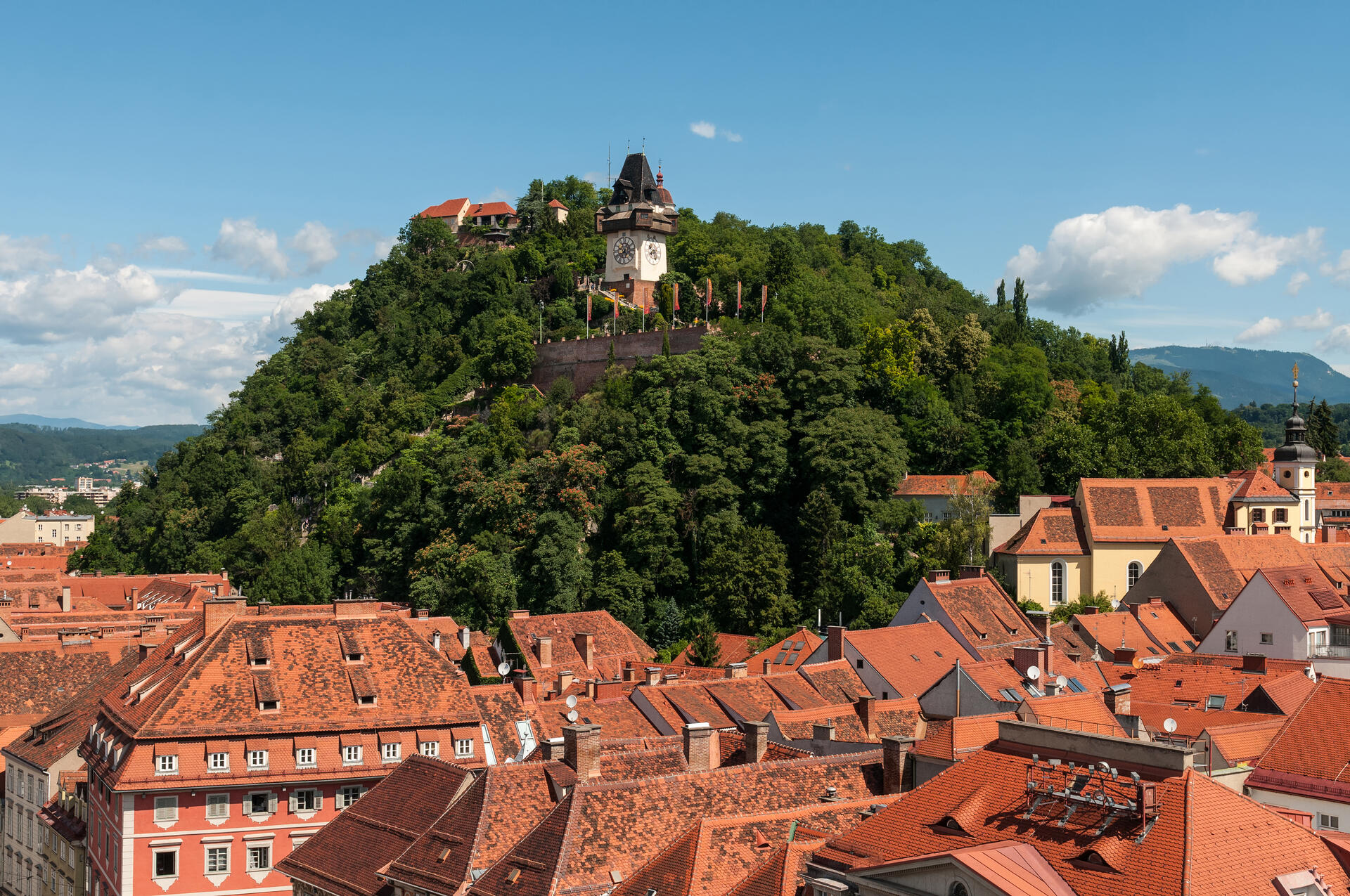
© Ralf Roletschek, CC BY-SA 3.0 at Resized from original. (This derivative is under the same CC BY-SA license.)
World Heritage Research
Discover scientific research and academic studies that deepen our understanding of City of Graz – Historic Centre and Schloss Eggenberg from its history and significance to its conservation, management, and contemporary challenges.
-
The Development of Urban Rural Relationship at the Example of the City of Graz Austria
A dynamic urban-rural relationship has emerged around Graz, Austria, characterized by growing cooperation and competition between the city and its surrounding municipalities. This study quantifies changes over time using data from 1978, building on Wilhelm Leitner's 'Interaktionsraum Graz' framework. It reveals a strong development of an 'urban region,' where functional linkages based on mobility, infrastructure, and economic exchange have intensified. The findings highlight the potential for sustainable regional development through collaboration while also noting increased competition, particularly in southern Graz. This research underscores the importance of recognizing interdependence between urban and rural areas to achieve balanced growth and preserve natural resources.
Fischer, W., Flor, M., & Außerlechner, C. (2026). THE DEVELOPMENT OF URBAN RURAL RELATIONSHIP AT THE EXAMPLE OF THE CITY OF GRAZ AUSTRIA. Proceedings 2026, 137–155. https://doi.org/10.18509/gbp26137f
View Publication Record | Read Publication -
From geology to site decision: Potential for underground heat storage in Graz
A promising solution for long-term thermal energy storage, cavern thermal energy storage (CTES), has been identified as feasible for Graz, Austria. This study highlights the potential of CTES systems to store excess heat from industrial processes, thereby contributing to CO2 emission reduction. Geological analyses pinpointed solid rock formations, particularly carbonates and crystalline rocks in the western and north-western areas of Graz, as suitable storage sites. Among these, the Karolinensteinbruch site was recommended due to its favorable geological conditions despite challenges such as distance to district heating networks and risks associated with karst phenomena. The conceptual designs proposed modular and expandable geometries to adapt to Graz's fluctuating urban energy demand. While the study confirms CTES as a viable option for Graz, it emphasizes the need for further detailed investigations into geotechnical and geological properties to ensure successful implementation.
Kaml, G., Schreilechner, M. G., & Marcher, T. (2025). From geology to site decision: Potential for underground heat storage in Graz. Geomechanics and Tunnelling, 18(1), 57–63. Portico. https://doi.org/10.1002/geot.202400080
View Publication Record | Read Publication -
An Example of the Transition to Sustainable Mobility in the Austrian City of Graz
Graz, Austria, stands out as a replicable model for sustainable mobility within the EU, demonstrating significant reductions in greenhouse gas emissions through its 'eco-transformation' strategy. The city's focus on 'soft mobility'—walking, cycling, and public transit—has proven effective, with quantitative analysis showing that environmental and temporal variables influence cycling behavior. This study highlights Graz as a leading example of how urban areas can transition to sustainable transportation, aligning with broader EU climate goals and offering insights for other cities aiming to mitigate the ecological impacts of fossil-fueled mobility.
Šobot, A., & Gričar, S. (2025). An Example of the Transition to Sustainable Mobility in the Austrian City of Graz. Sustainability, 17(10), 4324. https://doi.org/10.3390/su17104324
View Publication Record | Read Publication -
Installation of hot boxes for conservation in the last nursery roost of Greater Horseshoe Bats Rhinolophus ferrumequinum in Austria
A novel conservation strategy involving the installation of hot boxes has been successfully implemented to support the critically endangered Greater Horseshoe Bat (Rhinolophus ferrumequinum) population in Austria. This intervention, the first of its kind in the country, aims to stabilize and potentially enhance thermal conditions within the attic of Schloss Eggenberg in Graz, serving as the species' last known maternity roost. The hot boxes provide a range of microclimates critical for gestation and juvenile development, addressing the urgent need for habitat improvement amid severe population declines across Central Europe. This approach offers a practical solution to mitigate threats faced by isolated bat populations on the brink of extinction.
Zangl, L., Gutstein, A., Paill, W., Weiss, E., & Sackl, P. (2023). Installation of hot boxes for conservation in the last nursery roost of Greater Horseshoe Bats Rhinolophus ferrumequinum in Austria. Journal of Threatened Taxa, 15(1), 22548–22550. https://doi.org/10.11609/jott.8140.15.1.22548-22550
View Publication Record | Read Publication -
Analytical assessment of street-level tree canopy in Austrian cities: Identification of re-naturalisation potentials of the urban fabric
Austrian cities, including Graz, face significant gaps in street-level tree canopy coverage, with 54% of areas potentially disconnected from urban greenery. This study reveals that central districts are densely built and lack street trees, while peripheral areas offer more opportunities for re-naturalisation through open-building arrangements. The research used spatial data analytics on georeferenced tree cadastre data and Local Climate Zones (LCZ) maps to identify these gaps in Vienna, Graz, and Linz. It suggests that building-level greening, such as green roofs or facades, could be more effective in central areas, though historic buildings may pose challenges. The study proposes innovative solutions like movable vertical green screens to address these constraints.
Vuckovic, M., Schmidt, J., & Cornel, D. (2023). Analytical assessment of street-level tree canopy in Austrian cities: Identification of re-naturalisation potentials of the urban fabric. Nature-Based Solutions, 3, 100062. https://doi.org/10.1016/j.nbsj.2023.100062
View Publication Record | Read Publication -
Conflictual cultural politics: unpacking local tensions in three Austrian cities
This study reveals that cultural politics in Austria's urban centers are rife with conflict, shaped by power dynamics, agency, and spatial disputes. Focusing on Vienna, Graz, and Linz, it identifies four key conflict types: agential (unequal funding/decision-making), symbolic (instrumentalization of culture), procedural (lack of transparency/collaboration), and spatial (disagreements over public space use). The research, conducted through 30 qualitative interviews, situational mapping, and media analysis between 2020–2022, argues for a conflict-oriented approach to cultural policy. It highlights how COVID-19 both challenged and opened new avenues for public cultural events, underscoring the need to address these tensions in urban planning and governance.
Landau-Donnelly, F., Schad-Spindler, A., Fridrik, S., & Marchart, O. (2023). Conflictual cultural politics: unpacking local tensions in three Austrian cities. International Journal of Cultural Policy, 30(3), 341–356. https://doi.org/10.1080/10286632.2023.2203723
View Publication Record | Read Publication -
The importance of urban green spaces in the development of smart cities
Urban green spaces (UGSs) play a pivotal role in enhancing residents' lifestyles, health, and economic opportunities within smart cities. A study conducted in Graz, Austria, revealed that increasing UGSs leads to measurable improvements in air quality, even in space-constrained environments, aligning with World Health Organization (WHO) standards. The research, involving semi-structured interviews with residents, officials, and government experts, used MAXQDA software for analysis. Findings underscored the urgent need for larger UGSs to bolster security, economic prospects, and overall well-being. This study provides actionable recommendations for future UGS planning in smart cities, emphasizing their potential as a valid alternative to mitigate urban pollution.
Addas, A. (2023). The importance of urban green spaces in the development of smart cities. Frontiers in Environmental Science, 11. https://doi.org/10.3389/fenvs.2023.1206372
View Publication Record | Read Publication