World Heritage Identification Number: 786
World Heritage since: 1996
Category: Cultural Heritage
WHE Type: Buildings & Architectural Ensembles
Transboundary Heritage: No
Endangered Heritage: No
Country: 🇦🇹 Austria
Continent: Europe
UNESCO World Region: Europe and North America
Map
Schönbrunn Palace and Gardens: A Baroque Masterpiece of Imperial Vienna
The Palace and Gardens of Schönbrunn, inscribed as a UNESCO World Heritage Site in 1996, offer a captivating glimpse into the opulent history of the Habsburg Empire. Located in the Hietzing district (13th district) of Vienna, this Baroque ensemble stands as a testament to the grandeur and artistic achievement of the era.
Schönbrunn Palace and Gardens were inscribed as a World Heritage Site because they represent one of the most complete and best-preserved examples of Baroque palace architecture and landscape design in Europe. The ensemble is considered a “Gesamtkunstwerk,” or total work of art, in which architecture, interior design, and garden planning form a unified artistic and symbolic composition. It also reflects the political ideals of absolutist rule, comparable in scale and influence to other major European royal residences such as Versailles.
The palace was originally conceived in the late 17th century in designs associated with Johann Bernhard Fischer von Erlach and was later significantly rebuilt and refined in the 18th century by Nicolaus Pacassi, giving it much of its present appearance. Its elegant, symmetrical façade and richly decorated interiors reflect Baroque court ideals and imperial representation.
Upon entering the palace, visitors are greeted by the Imperial Apartments, a series of rooms that once housed the Habsburg rulers. These apartments showcase an array of decorative arts, including lavish furnishings, ornate tapestries, and exquisite porcelain. Notable among them is the Great Gallery, a 40-meter-long ceremonial hall decorated with elaborate stucco work and ceiling frescoes depicting the glory of the Habsburg dynasty.
Throughout its history, Schönbrunn served as a central stage for imperial life and European politics. It was the favored summer residence of Empress Maria Theresa, under whose reign the palace was extensively redesigned and became a central political and ceremonial residence of the Habsburg court. The palace is also associated with key historical figures and events, including Napoleon Bonaparte’s occupation of Vienna in the early 19th century and performances by Wolfgang Amadeus Mozart, who is said to have played before the imperial family as a child within its halls.
Beyond its historical interiors, Schönbrunn Palace is also renowned for its extensive gardens. Designed and developed over time under Habsburg patronage, the gardens are a prime example of Baroque landscape design. They encompass over 1.2 million square meters and include formal parterres, tree-lined avenues, wooded areas, and a historic maze and labyrinth.
One of the most prominent features within the gardens is the Gloriette, a monumental colonnaded structure completed in 1775 during the reign of Maria Theresa. It was built as a symbol of Habsburg imperial power and prestige and today offers panoramic views over Vienna and the surrounding landscape.
In addition to its aesthetic appeal, Schönbrunn Palace holds significant cultural and scientific importance. In 1752, it became home to the Tiergarten Schönbrunn, the world’s oldest continuously operating zoo. This zoological institution played an important role in the development of modern zoological gardens.
Today, Schönbrunn Palace remains one of Austria’s most visited cultural landmarks, attracting millions of visitors each year. As a UNESCO World Heritage Site, it preserves the legacy of the Habsburg monarchy and offers offers valuable insight into Baroque court culture, imperial architecture, and formal landscape design.
UNESCO Description of the World Heritage Site
From the 18th century to 1918, Schönbrunn was the residence of the Habsburg emperors. It was designed by the architects Johann Bernhard Fischer von Erlach and Nicolaus Pacassi and is full of outstanding examples of decorative art. Together with its gardens, the site of the world’s first zoo in 1752, it is a remarkable Baroque ensemble and a perfect example of Gesamtkunstwerk.
UNESCO Justification of the World Heritage Site
Criterion (i): The Palace and Gardens of Schönbrunn are an especially well preserved example of the Baroque Princely residential ensemble, which constitute an outstanding example of Gesamtkunstwerk, a masterly fusion of many art forms.
Criterion (iv): The Palace and Gardens of Schönbrunn are exceptional by virtue of the evidence that they preserve of modifications over several centuries that vividly illustrate the tastes, interests, and aspirations of successive Habsburg monarchs.
Encyclopedia Record: Schönbrunn Palace
Schönbrunn Palace was the main summer residence of the Habsburg rulers, located in Hietzing, the 13th district of Vienna. The name Schönbrunn has its roots in an artesian well from which water was consumed by the court.Additional Site Details
Area: 186.28 hectares
Number of Components: 1
(iv) — Outstanding example of a type of building or landscape
Coordinates: 48.18666667 , 16.31333333
Image
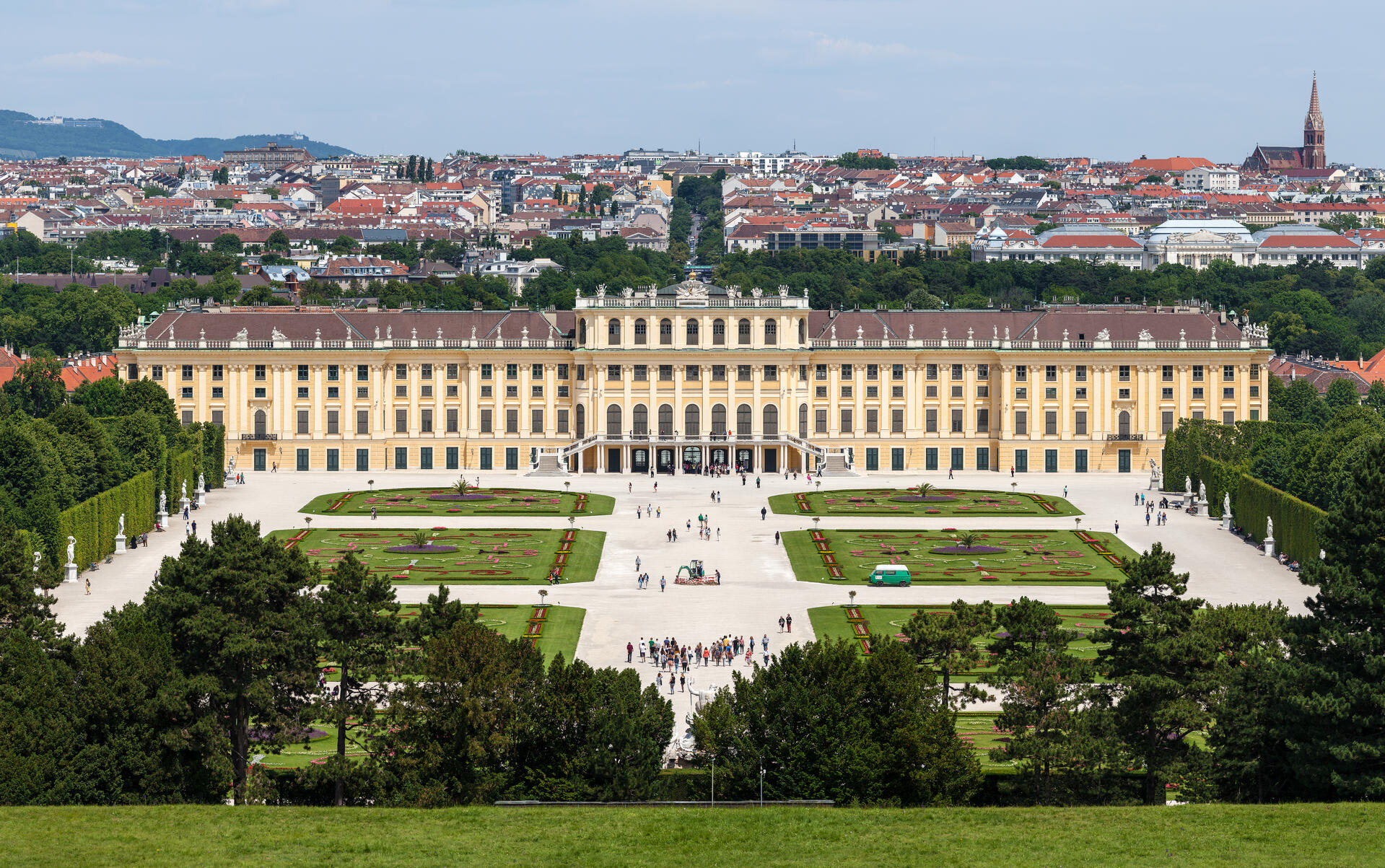
© Thomas Wolf, www.foto-tw.de, CC BY-SA 3.0 de Resized from original. (This derivative is under the same CC BY-SA license.)
World Heritage Research
Discover scientific research and academic studies that deepen our understanding of Palace and Gardens of Schönbrunn from its history and significance to its conservation, management, and contemporary challenges.
-
Mapping Austrofascism in situ: a design exploration of augmented storytelling for contested historical events and sites
A novel approach to augmented storytelling for contested historical events and sites has been explored through the development of site-specific design probes, extending digital-cartography platforms into physical spaces. The research demonstrates how multi-perspective on-screen mediation can be translated into situated, in-place narratives, while navigating risks and benefits. Using the 'Mapping Austrofascism' platform as a reference, three augmented-reality prototypes were designed to mediate the Austrofascist 'Turks Deliverance Celebration' of 1933 in Vienna's Schönbrunn Palace gardens, focusing on historically significant media such as public-address systems, sound-film newsreels, and information visualization. The findings are framed as a design exploration rather than a validated model, emphasizing the partial trajectory of experiments and the questions they leave open. These prototypes, though not yet deployed or evaluated, propose potential effects on visitor experience.
Passecker, M., Ganahl, S., Proksa, F., Miksch, S., & Aigner, W. (2026). Mapping Austrofascism in situ: a design exploration of augmented storytelling for contested historical events and sites. International Journal of Digital Humanities. https://doi.org/10.1007/s42803-026-00133-z
View Publication Record | Read Publication -
“Mapping Austrofascism” and Beyond : Report on the Digital Research Lab Campus Medius
A digital mapping project, 'Mapping Austrofascism,' innovatively combines cartography with cultural studies to explore historical events through interactive visualization. Initially focusing on 15 key events in Vienna over a weekend in 1933, the project now centers on an Austrofascist celebration at Schönbrunn Palace, offering multi-perspective views including bird's-eye and street-level perspectives mediated by five experts. The research leverages theoretical frameworks like 'dispositif' and 'actor-network' to model its technological infrastructure and data, aiming to create a scalable platform for visualizing media experiences in everyday life. This approach bridges historical analysis with digital humanities, providing a dynamic tool for understanding complex socio-political events.
Ganahl, S. (2024). “Mapping Austrofascism” and Beyond : Report on the Digital Research Lab Campus Medius. Colloquia Humanistica, (13). https://doi.org/10.11649/ch.3104
View Publication Record | Read Publication -
Campus Medius: Digitales Kartografieren in den Kulturund Medienwissenschaften/Digital Mapping in Cultural and Media Studies by Simon Ganahl
The digital mapping project 'Campus Medius' offers a novel approach to understanding the relational patterns of space, time, and value through innovative hypertext and visual strategies. By focusing on a 24-hour period in Vienna during the Austrofascist regime's 'Turks Deliverance Celebration' in May 1933, the project uses digital cartography to reflect upon the 'medial atmosphere' and narrativity of this historical moment. It integrates theoretical frameworks such as Mikhail Bakhtin's 'chronotope,' Foucault-Deleuze's 'dispositif,' and Bruno Latour's Actor-Network Theory to analyze networks of power and knowledge, providing a media-archaeological perspective from the 17th century to the present. The project exemplifies how digital tools can be used to trace and interpret complex historical data, offering significant insights into the intersection of theory and technical implementation in cultural and media studies.
Zolles, C. (2023). Campus Medius: Digitales Kartografieren in den Kulturund Medienwissenschaften/Digital Mapping in Cultural and Media Studies by Simon Ganahl. Journal of Austrian Studies, 56(2), 144–146. https://doi.org/10.1353/oas.2023.0043
View Publication Record | Read Publication -
Bureaucratic architecture: Josephist attempts to reform the public works administration in the Habsburg Monarchy in the 1780s
Joseph II's reforms in the Habsburg Monarchy during the 1780s significantly reshaped public works administration, particularly for imperial buildings and gardens. The study reveals that under his leadership, the Court Board of Works (Hofbauamt) faced pressure to complete ongoing projects swiftly and at reduced costs while adhering to strict financial constraints. Unlike his mother, Maria Theresa, Joseph II demanded immediate updates on construction progress and prioritized essential expenses only for maintenance. This shift marked a departure from previous administrative practices, emphasizing efficiency and fiscal responsibility in public works. The research draws on historical records, including the Hofbauamt's structure and its role under both rulers, to illustrate how bureaucratic reforms influenced architectural governance during this period.
Mader-Kratky, A. (2023). Bureaucratic architecture: Josephist attempts to reform the public works administration in the Habsburg Monarchy in the 1780s. The Governance of Style, 17–32. https://doi.org/10.7767/9783205217541.17
View Publication Record | Read Publication -
The East Asian Cabinets at Schönbrunn Palace and their Archive Sources
Research on the East Asian Cabinets at Schönbrunn Palace reveals significant gaps and breakthroughs in their documented history. While records from 1740 to 1772 are fragmented, allowing only scattered insights into the cabinets' creation in 1760, later inventories (1803, 1812) and detailed archives from the Palace Department Schönbrunn (starting 1779) provide a precise account of their restoration history and subsequent decorative changes. The study highlights the role of the Obersthofmeisteramt, which approved all requests related to the cabinets, offering a nuanced understanding of their evolution and maintenance over centuries.
Mader-Kratky, A. (2017). The East Asian Cabinets at Schönbrunn Palace and their Archive Sources. Investigation and Conservation of East Asian Cabinets in Imperial Residences (1700–1900), 335–342. https://doi.org/10.7767/9783205207139.335
View Publication Record | Read Publication -
The decorative in urban Vienna: Its preservation
Vienna's urban landscape, rooted in its Roman and medieval heritage, has evolved through centuries of architectural transformations, including the construction of fortifications, the expansion of gardens, and the development of the Ringstraße. The city's decorative elements—such as pavings, lighting, railings, and symbolic ornaments—reflect a rich history of artistic creation and urban planning. A key finding is the critical role of historic preservation in maintaining Vienna's unique character, highlighted by Camillo Sitte's advocacy for retaining historic details and the cancellation of plans that would have modernized the city at the expense of its heritage. The study also examines the materials used in Viennese decorations, such as stone, lime plaster, stucco, Roman cement, brickwork, and glazed tiles, and their conservation challenges. It notes the impact of speculative tall buildings on protected areas like Schönbrunn Palace and Gardens (a UNESCO World Heritage Site since 1996) and the Ringstraße, which threatens the city's skyline and historic context. The research combines historical analysis with scientific examination to address issues such as façadism and aggressive modern architecture.
Koller, M. (2013). The decorative in urban Vienna: Its preservation. Studies in Conservation, 58(3), 159–175. https://doi.org/10.1179/2047058413y.0000000087
View Publication Record | Read Publication