World Heritage Identification Number: 970
World Heritage since: 2000
Category: Cultural Heritage
WHE Type: Cultural Landscapes
Transboundary Heritage: No
Endangered Heritage: No
Country: 🇦🇹 Austria
Continent: Europe
UNESCO World Region: Europe and North America
Map
Wachau Cultural Landscape: A Glimpse into Austria's Rich History and Viticulture
The Wachau Cultural Landscape, inscribed as a UNESCO World Heritage Site in 2000, offers a unique blend of history, culture, and natural beauty along the Danube River in Austria. Stretching between the picturesque towns of Melk and Krems, this 36-kilometer valley is renowned for its high-quality wines, architectural elegance, and rich historical significance.
More to come…UNESCO Description of the World Heritage Site
The Wachau is a stretch of the Danube Valley between Melk and Krems, a landscape of high visual quality. It preserves in an intact and visible form many traces - in terms of architecture, (monasteries, castles, ruins), urban design, (towns and villages), and agricultural use, principally for the cultivation of vines - of its evolution since prehistoric times.
UNESCO Justification of the World Heritage Site
Criterion (ii): The Wachau is an outstanding example of a riverine landscape bordered by mountains in which material evidence of its long historical evolution has survived to a remarkable degree.
Criterion (iv): The architecture, the human settlements, and the agricultural use of the land in the Wachau vividly illustrate a basically medieval landscape which has evolved organically and harmoniously over time.
Encyclopedia Record: Wachau
The Wachau is an Austrian valley formed by the Danube River. It is one of the most prominent tourist destinations of Lower Austria, located between the towns of Melk and Krems that attracts epicureans for its high-quality wines. It is 36 kilometres (22 mi) in length and has been settled since prehistoric times. Among the tourist attractions is Dürnstein Castle, where King Richard I of England was held captive by Leopold V, Duke of Austria. The architectural elegance of its monasteries, castles and ruins combined with the urban architecture of its towns and villages, and the cultivation of vines as an important agricultural produce are the dominant features of the valley.Additional Site Details
Area: 18,462 hectares
Number of Components: 1
(iv) — Outstanding example of a type of building or landscape
Coordinates: 48.36444444 , 15.43416667
Image
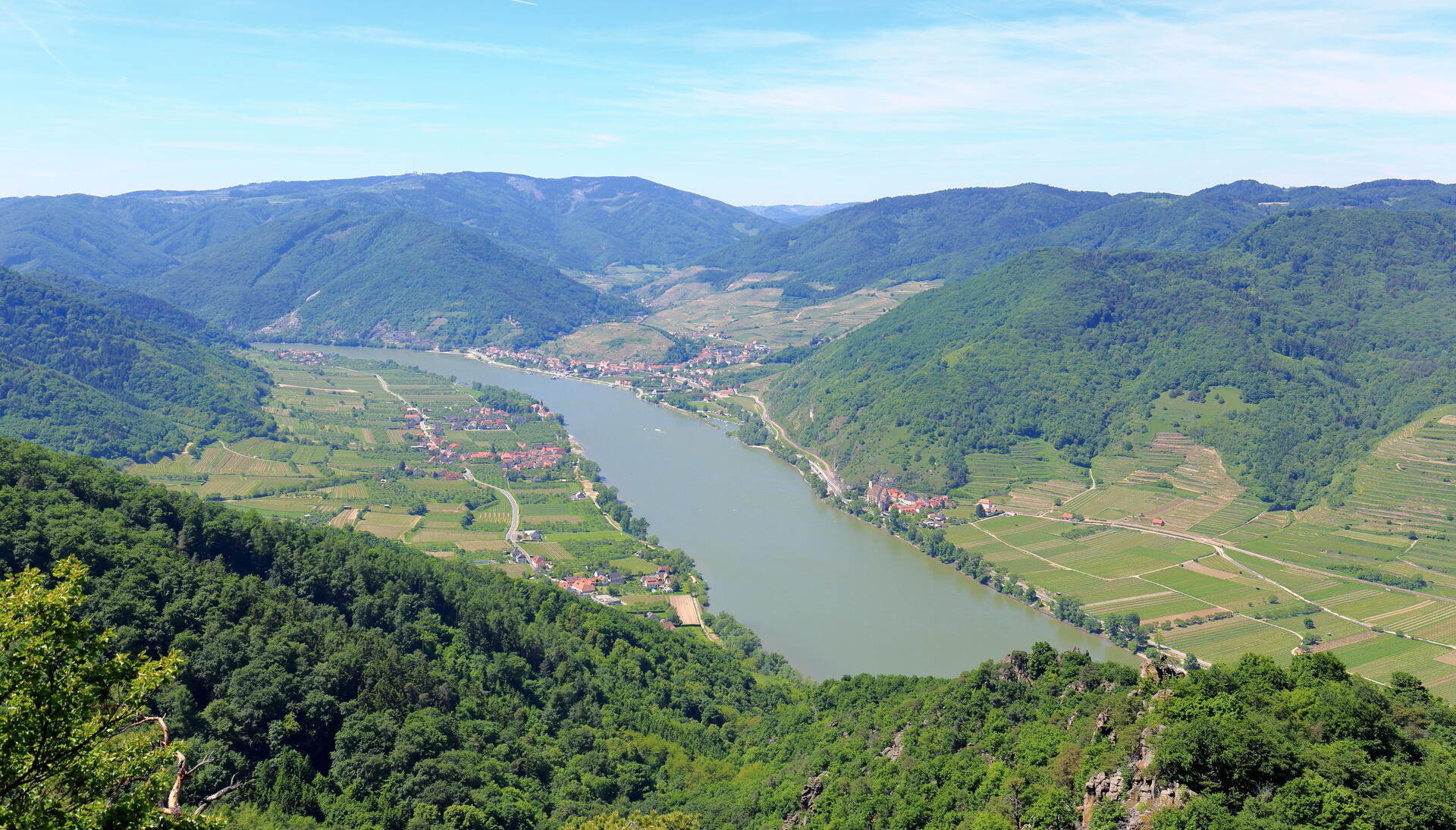
© C.Stadler/Bwag, CC BY-SA 4.0 Resized from original. (This derivative is under the same CC BY-SA license.)
World Heritage Research
Discover scientific research and academic studies that deepen our understanding of Wachau Cultural Landscape from its history and significance to its conservation, management, and contemporary challenges.
-
Hazard Analysis and Vulnerability Assessment of Cultural Landscapes Exposed to Climate Change-Related Extreme Events: A Case Study of Wachau (Austria)
A heightened risk of heavy rain and flooding threatens the Wachau Cultural Landscape, particularly under pessimistic climate change scenarios. Research indicates significant increases in extreme climate indices—R20mm, R95pTOT, and R×5day—by 2071–2100, with spatial resolution showing localized vulnerabilities. The study combines historical hazard data, vulnerability assessments of terraced areas, and climate projections to inform conservation strategies. These findings underscore the urgent need for policymakers and local stakeholders to prioritize interventions in preparedness, emergency response, and recovery to safeguard this UNESCO-listed heritage site.
Canesi, L., Sardella, A., Vogler, R., Kaiser, A., Vaccaro, C., & Bonazza, A. (2024). Hazard Analysis and Vulnerability Assessment of Cultural Landscapes Exposed to Climate Change-Related Extreme Events: A Case Study of Wachau (Austria). Heritage, 7(4), 1917–1934. https://doi.org/10.3390/heritage7040091
View Publication Record | Read Publication -
Risk assessment and vulnerability evaluation of cultural landscapes exposed to extreme events linked to climate change: the Wachau case study
Climate change is significantly increasing the risk of extreme weather events, such as heavy rain and flooding, which threaten cultural heritage sites. A study on the Wachau Cultural Landscape in Austria reveals a high likelihood of increased vulnerability to these risks under pessimistic climate scenarios (RCP 8.5) by 2071-2100. The research quantifies vulnerability for terraced areas using advanced methodologies from the STRENCH project, including risk mapping tools and climate projections derived from EURO Cordex experiments. Findings indicate a general increase in extreme weather indices (R20mm, R95pTOT, Rx5day) with spatial resolution of 12x12 km for both near (2021-2050) and far future periods. These projections support policy-making by providing data-driven insights to enhance preparedness, emergency response, and recovery strategies for cultural heritage protection.
Sardella, A., Canesi, L., Cacciotti, R., Kaiser, A., & Bonazza, A. (2022). Risk assessment and vulnerability evaluation of cultural landscapes exposed to extreme events linked to climate change: the Wachau case study. https://doi.org/10.5194/egusphere-plinius17-93
View Publication Record | Read Publication -
A Middle Pleistocene steppe bison find within the Dürnstein Castle (Wachau, Lower Austria)
During foundation work at Dürnstein Castle, part of the UNESCO-listed Wachau Cultural Landscape, fossilized bones of a Middle Pleistocene steppe bison (Bison priscus) were discovered. The find, dated to between 240,000 and 400,000 years ago, suggests the bison likely drowned in a flood and was rapidly buried by fluvial sediments in a protected bay of the ancient Danube River. Morphometric comparisons and taphonomic analyses supported this reconstruction. Additionally, bones from an adjacent site showed signs of Middle Palaeolithic human influence, indicating possible anthropogenic translocation. The study also provides a preliminary chronological framework for regional Bison species succession, spanning from Early to Late Pleistocene.
Fladerer, F. A., Roetzel, R., & Veitschegger, K. (2020). A Middle Pleistocene steppe bison find within the Dürnstein Castle (Wachau, Lower Austria). Austrian Journal of Earth Sciences, 113(2), 237–250. https://doi.org/10.17738/ajes.2020.0015
View Publication Record | Read Publication -
Landscape co-management practices and power structures at the UNESCO World Heritage site of Wachau, Austria
A study on the UNESCO World Heritage site of Wachau, Austria, reveals that while co-management involving civil society, market forces, and authorities can drive cultural sustainability, it also risks reinforcing existing power structures. The research finds that active citizenship contributes significantly to landscape sustainability, yet new governance platforms often mirror old power dynamics, limiting their potential for transformative change. Pluralistic perspectives and tensions, though beneficial, struggle to disrupt entrenched power constellations.
Gugerell, K., Penker, M., & Kieninger, P. (2018). Landscape co-management practices and power structures at the UNESCO World Heritage site of Wachau, Austria. Cultural Sustainability and the Nature–Culture Interface, 109–124. https://doi.org/10.4324/9781315625294-8
View Publication Record | Read Publication -
Tourist literature and the ideological grammar of landscape in the Austrian Danube Valley, ca. 1870–1945
Tourist literature from the Austrian Danube Valley, particularly focusing on the Wachau region, reveals how narratives and myths have shaped the landscape's ideological grammar between 1870 and 1945. The study demonstrates that guidebooks and other tourist materials embedded the river landscape with powerful symbolic meanings, reflecting contested claims to region, nation, and homeland during the decline of the Habsburg Monarchy and up to World War II. These narratives often invoked lures of Germanic nationalism, Austrianness, or a borderless Europe, illustrating how the Danube's metaphorical flow through space and time facilitated the scripting of history and spatial ordering of landscape for both tourists and local publics.
Ploner, J. (2012). Tourist literature and the ideological grammar of landscape in the Austrian Danube Valley, ca. 1870–1945. Journal of Tourism History, 4(3), 237–257. https://doi.org/10.1080/1755182x.2012.711376
View Publication Record | Read Publication