World Heritage Identification Number: 758
World Heritage since: 1996
Category: Cultural Heritage
WHE Type: Religious Sites & Sacred Architecture
Transboundary Heritage: No
Endangered Heritage: No
Country: 🇭🇺 Hungary
Continent: Europe
UNESCO World Region: Europe and North America
Map
Millenary Benedictine Abbey of Pannonhalma and its Natural Environment: A Thousand Years of History and Culture
The Millenary Benedictine Abbey of Pannonhalma, situated in the picturesque town of Pannonhalma, Hungary, stands as a testament to a thousand years of history, culture, and spirituality. Inscribed as a UNESCO World Heritage Site in 1996, this ancient monastery has played a pivotal role in shaping Central European history, education, and art.
More to come…UNESCO Description of the World Heritage Site
The first Benedictine monks settled here in 996. They went on to convert the Hungarians, to found the country's first school and, in 1055, to write the first document in Hungarian. From the time of its founding, this monastic community has promoted culture throughout central Europe. Its 1,000-year history can be seen in the succession of architectural styles of the monastic buildings (the oldest dating from 1224), which still today house a school and the monastic community.
UNESCO Justification of the World Heritage Site
Criterion (iv): The Monastery of Pannonhalma and its surroundings illustrate in an exceptional manner the characteristic setting, the connections with its environment, the specific structure and the organization of a Christian (Benedictine) monastery that has evolved over a thousand years of continuous use.
Criterion (vi): The Benedictine Monastery with its location and the early date of its foundation in 996 bear special witness to the diffusion of Christianity in Central Europe, which is enriched by the continuing presence of the Benedictine monks who have worked towards peace among countries and people for one thousand years.
Encyclopedia Record: Pannonhalma Archabbey
The Benedictine Pannonhalma Archabbey or Territorial Abbey of Saint Martin on Mount Pannonhalma is a medieval building in Pannonhalma and one of the oldest historical monuments in Hungary. Founded in 996, it is located near the town, on top of a hill. Saint Martin of Tours is believed to have been born at the foot of this hill, hence its former name, Mount of Saint Martin, from which the monastery occasionally took the alternative name of Márton-hegyi Apátság. It is the second largest territorial abbey in the world, after the one in Monte Cassino.Additional Site Details
Area: 47.4 hectares
Number of Components: 1
(vi) — Directly associated with events or living traditions
Coordinates: 47.55889 , 17.78444
Image
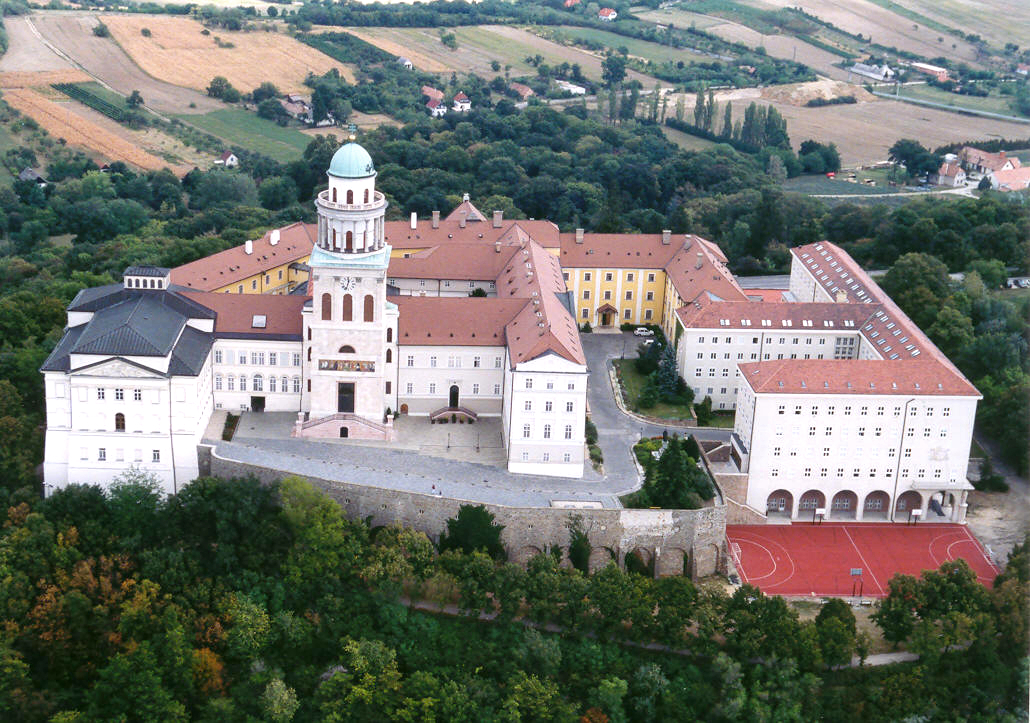
© Unknown author, CC BY-SA 2.5 Resized from original. (This derivative is under the same CC BY-SA license.)
World Heritage Research
Discover scientific research and academic studies that deepen our understanding of Millenary Benedictine Abbey of Pannonhalma and its Natural Environment from its history and significance to its conservation, management, and contemporary challenges.
-
Tourism Without Commodification at a Hungarian World Heritage Site
A balanced approach to tourism at the UNESCO World Heritage-listed Millenary Benedictine Abbey of Pannonhalma demonstrates that visitor attraction and economic benefits can be achieved without compromising heritage values or local traditions. This study highlights how sustainable tourism models can preserve the Outstanding Universal Value of a site while fostering public awareness and economic growth, offering a replicable strategy for other World Heritage Sites facing similar challenges.
Bassa, L. (2022). Tourism Without Commodification at a Hungarian World Heritage Site. 50 Years World Heritage Convention: Shared Responsibility – Conflict & Reconciliation, 391–397. https://doi.org/10.1007/978-3-031-05660-4_30
View Publication Record | Read Publication