World Heritage Identification Number: 701
World Heritage since: 1994
Category: Natural Heritage
WHE Type: Protected Areas & National Parks
Transboundary Heritage: No
Endangered Heritage: No
Country: 🇻🇪 Venezuela (Bolivarian Republic of)
Continent: Americas
UNESCO World Region: Latin America and the Caribbean
Map
Canaima National Park: A Geological Marvel and Biodiversity Haven
Canaima National Park, a sprawling expanse of approximately 3 million hectares in southeastern Venezuela that borders Guyana and Brazil, covers nearly the entirety of the Gran Sabana region. This vast protected area was designated a World Heritage Site by UNESCO in 1994 due to its exceptional geological features and rich biodiversity.
The park's most distinctive topographical characteristic is the presence of table mountains, or tepuis, which cover around 65 percent of the park's surface. These towering sandstone and quartzite plateaus, dating back 1.7–2 billion years, rise abruptly from the surrounding plains, their flat summits often supporting unique cloud forest ecosystems.
The sheer cliffs give rise to spectacular waterfalls, including Angel Falls (Salto Ángel), the world’s tallest waterfall. With a total height of 979 meters and an uninterrupted plunge of 807 meters, it falls from Auyán-tepui, creating one of the most dramatic landscapes on Earth.
One of the most famous tepuis within the park is Mount Roraima, which forms part of the triple border between Venezuela, Guyana, and Brazil. This massive tabletop mountain has been the subject of numerous scientific expeditions and even inspired Sir Arthur Conan Doyle's novel The Lost World. The tepuis collectively form a distinct biogeographical region, hosting flora and fauna, including endemic species of frogs, lizards, birds, orchids, and carnivorous plants, found nowhere else on the planet.
Canaima National Park supports a remarkable diversity of plants and animals. While some species are endemic to the tepuis, the lowlands and savannas host jaguars, giant armadillos, giant otters, black caimans, and a variety of birds. The tepui summits harbor unique plants such as Heliamphora pitcher plants, endemic orchids, and rare tepui frogs, reflecting the park’s extraordinary ecological isolation. This ecosystem is also the ancestral home of the indigenous Pemon people, who revere the tepuis as sacred "houses of the gods."
The park's unique ecosystem is largely attributed to its isolation and the diverse microclimates created by the tepuis. Rainfall is high across the region, typically ranging from 1,200 mm per year in the savanna areas to over 3,000 mm in the rainforests and cloud forests. This abundance of water supports a wide range of habitats, from savannas and grasslands to rainforests and cloud forests.
Despite its remote location and protection status, Canaima National Park faces numerous challenges, primarily from illegal mining activities, gold panning, and the pressures of unregulated tourism. Ongoing conservation efforts aim to mitigate these threats and ensure the long-term preservation of this remarkable natural wonder.
Overall, Canaima National Park stands as a testament to the wonders of nature and the importance of conservation. Its unique geology, rich biodiversity, and stunning landscapes make it a must-visit destination for anyone seeking adventure, discovery, and a deeper appreciation for the planet's natural treasures.
UNESCO Description of the World Heritage Site
Canaima National Park is spread over 3 million ha in south-eastern Venezuela along the border between Guyana and Brazil. Roughly 65% of the park is covered by table mountain (tepui) formations. The tepuis constitute a unique biogeological entity and are of great geological interest. The sheer cliffs and waterfalls, including the world's highest (1,000 m), form a spectacular landscape.
Encyclopedia Record: Canaima National Park
Canaima National Park is a 30,000 km2 (12,000 sq mi) park in south-eastern Venezuela that roughly occupies the same area as the Gran Sabana region. It is located in Bolívar State, reaching the borders with Brazil and Guyana. The park was named a World Heritage Site by UNESCO.Additional Site Details
Area: 3e+06 hectares
Number of Components: 1
(viii) — Outstanding example representing major earth stages
(ix) — Outstanding example representing ecological and biological processes
(x) — Contains most important habitats for biodiversity
Coordinates: 5.337994 , -62.037883
IUCN World Heritage Outlook
The 2025 Conservation Outlook on Canaima National Park reports the following assessment:
Source: International Union for Conservation of Nature (IUCN) · View assessment
Image
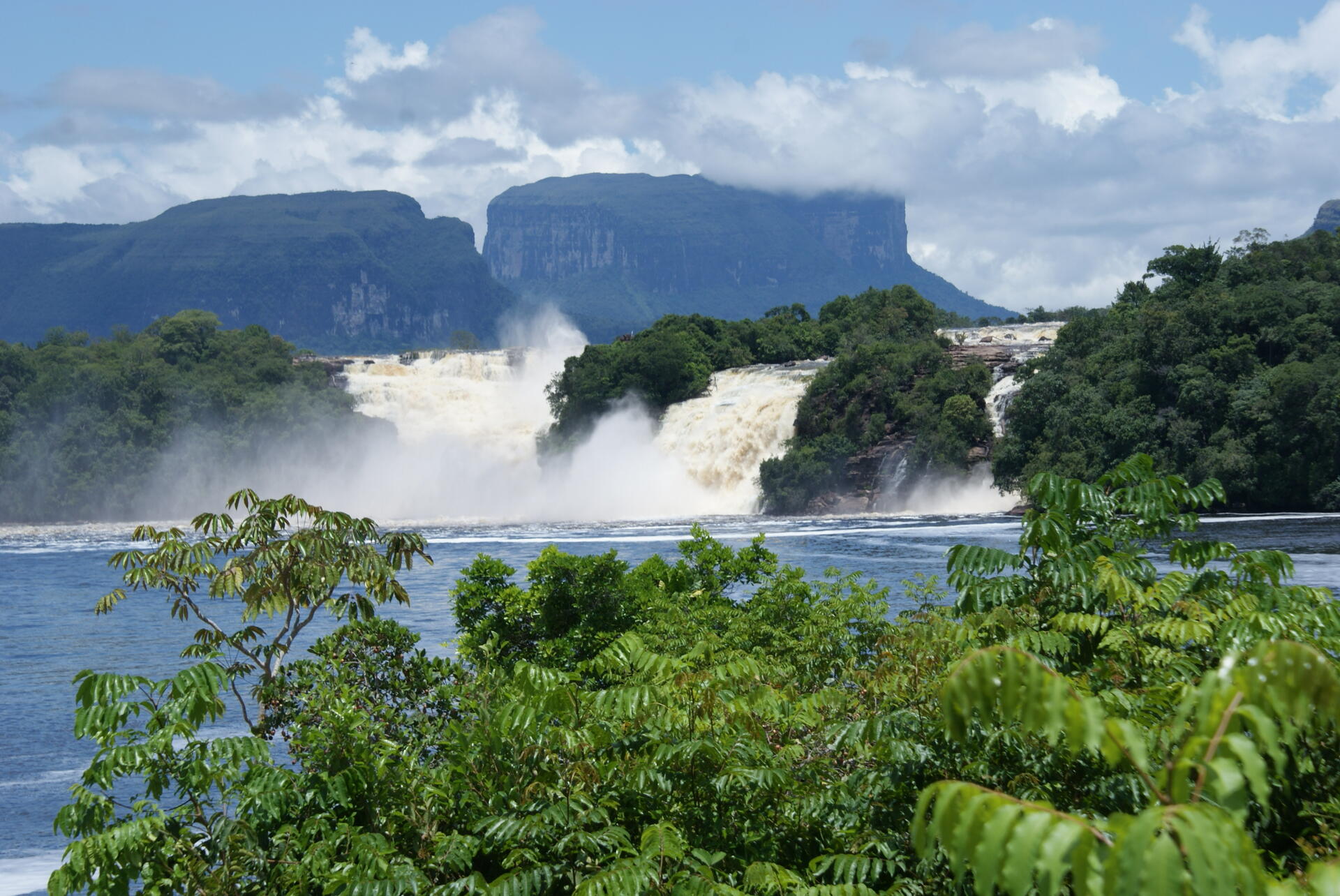
© Tyraelux, CC BY-SA 3.0 Resized from original. (This derivative is under the same CC BY-SA license.)
World Heritage Research
Discover scientific research and academic studies that deepen our understanding of Canaima National Park from its history and significance to its conservation, management, and contemporary challenges.
-
Does biodiversity depend on geodiversity? Canaima National Park, Venezuela – case study.
Research in Canaima National Park, Venezuela, reveals that geodiversity—particularly the presence of distinctive Tepui and Mesa-type mountains—significantly influences biodiversity. The study found that terrain-based geodiversity is a dominant factor shaping species abundance, suggesting a strong link between geological features and ecological richness. To investigate this relationship, scientists mapped geodiversity while analyzing data on plant and animal species distribution. By isolating the impact of terrain in their synthetic geodiversity map, they identified key geological structures as critical determinants of biodiversity patterns.
Strus, P., Chrobak-Zuffova, A., Novotny, J., & Stachowicz, I. (2023). Does biodiversity depend on geodiversity? Canaima National Park, Venezuela – case study. https://doi.org/10.5194/egusphere-egu23-9860
View Publication Record | Read Publication -
Quantification of burnt areas as a fundamental parameter for the estimation of spatial and temporal patterns of fire incidence in Canaima National Park (Venezuela)
A significant increase of 64% in fire incidence was observed between the 2014–2015 and 2015–2016 periods within Canaima National Park (CNP), Venezuela, with total burnt areas reaching 64,200 ha and 106,000 ha respectively. This surge coincided with one of the most severe El Niño-Southern Oscillation (ENSO) episodes, 'Godzilla,' during which extreme drought conditions led to 45,000 ha burning in January 2016 alone—accounting for 43% of the year's total fire damage. While grassy savannas were predominantly affected, forests also experienced heightened vulnerability under these extreme atmospheric conditions. The study, utilizing Landsat-8/OLI satellite data and QGIS analysis, provided the first high-confidence quantification of fire activity in CNP, offering critical insights for identifying vulnerable zones and developing targeted fire management strategies.
Rivera-Lombardi, R., Bilbao, B., Mistry, J., Berardi, A., & Torres, J. (2020). Quantification of burnt areas as a fundamental parameter for the estimation of spatial and temporal patterns of fire incidence in Canaima National Park (Venezuela). Biodiversidade Brasileira, 10(1), 79. https://doi.org/10.37002/biobrasil.v10i1.1566
View Publication Record | Read Publication -
Transforming fire suppression into an intercultural and participative fire management policy in Canaima National Park, Venezuela. A learning together and Indigenous, academic and institutional knowledge integration process
A transformative shift in fire management policies within Canaima National Park, Venezuela, has been achieved through the integration of Indigenous Pemón knowledge with academic and institutional expertise. The study reveals that Indigenous practices, such as controlled burning for shifting cultivation and savanna-forest border management, are sophisticated strategies to mitigate catastrophic wildfires exacerbated by climate change. Over nearly 20 years, collaborative fire experiments involving Indigenous communities, firefighters, and scientists demonstrated that fire exclusion policies, while intended to protect ecosystems, paradoxically increase fuel accumulation, leading to larger, more destructive fires under current hotter and drier conditions. This research highlights the potential of intercultural collaboration in developing sustainable fire management strategies that balance ecological preservation with Indigenous livelihoods.
Bilbao, B. A., Millán, A., Leal, A., Méndez, C., Vessuri, H., Mistry, J., Berardi, A., Constati, V., Chani, H., Lambos, F., Pérez, F., Lanz, I., Mariño, M., Matany, M., León, E., Picón, G., Deza, M. E., Rodríguez, H., Gómez, E., et al. (2019). Transforming fire suppression into an intercultural and participative fire management policy in Canaima National Park, Venezuela. A learning together and Indigenous, academic and institutional knowledge integration process. Biodiversidade Brasileira, 9(1), 316. https://doi.org/10.37002/biodiversidadebrasileira.v9i1.1345
View Publication Record | Read Publication -
Linking well-being with cultural revitalization for greater cognitive justice in conservation: lessons from Venezuela in Canaima National Park
A shift toward intercultural fire management in Canaima National Park, Venezuela, has emerged from integrating Pemon indigenous knowledge with scientific research. This counter-narrative challenges conventional views that attribute landscape changes solely to local fire use. The study demonstrates how participatory processes—such as historical reconstructions, territorial self-demarcation, and community reflexivity—linked to the development of Pemon Life Plans, have revived suppressed environmental knowledge. By centering indigenous well-being agendas, conservation efforts have achieved cognitive justice, making hidden local knowledge visible and influencing policy-making toward more inclusive and effective fire management strategies.
Rodriguez, I. (2017). Linking well-being with cultural revitalization for greater cognitive justice in conservation: lessons from Venezuela in Canaima National Park. Ecology and Society, 22(4). https://doi.org/10.5751/es-09758-220424
View Publication Record | Read Publication -
New Records of Mosquitoes (Diptera: Culicidae) from Bolívar State in South Eastern Venezuela, with 27 New Species for the State and 5 of Them New in the Country
A groundbreaking study identifies 27 new mosquito species for Bolívar State, Venezuela, including five previously unknown to the country. Conducted across 16 localities in Canaima National Park and Gran Sabana Municipality, this research marks a significant contribution to mosquito ecology and biogeography in South Eastern Venezuela. The findings highlight the region's rich biodiversity while emphasizing the medical importance of these species. The study also provides a checklist of mosquito species reported in Gran Sabana County, offering valuable insights for future epidemiological studies.
Berti, J., Guzmán, H., Estrada, Y., & Ramírez, R. (2015). New Records of Mosquitoes (Diptera: Culicidae) from Bolívar State in South Eastern Venezuela, with 27 New Species for the State and 5 of Them New in the Country. Frontiers in Public Health, 2. https://doi.org/10.3389/fpubh.2014.00268
View Publication Record | Read Publication -
Speaking of fire: reflexive governance in landscapes of social change and shifting local identities
Indigenous peoples in Canaima National Park, Venezuela, gain confidence to engage in dialogue with other actors when their marginalized environmental knowledge is publicly acknowledged within endogenous cultural processes. This finding emerges from three participatory research projects in the Gran Sabana region that facilitated dialogue among indigenous groups regarding their conflicting views of fire. The studies fostered community-wide critical reflections on cultural change and identity formations, suggesting a pathway to reflexive environmental governance in intercultural settings marked by conflict and rapid social transformation.
Rodríguez, I., Sletto, B., Bilbao, B., Sánchez-Rose, I., & Leal, A. (2013). Speaking of fire: reflexive governance in landscapes of social change and shifting local identities. Journal of Environmental Policy & Planning, 20(6), 689–703. https://doi.org/10.1080/1523908x.2013.766579
View Publication Record | Read Publication