World Heritage Identification Number: 998
World Heritage since: 2000
Category: Natural Heritage
WHE Type: Protected Areas & National Parks
Transboundary Heritage: No
Endangered Heritage: No
Country: 🇧🇷 Brazil
Continent: Americas
UNESCO World Region: Latin America and the Caribbean
Map
Central Amazon Conservation Complex: A Biodiverse Treasure Trove in the Heart of the Amazon Rainforest
The Central Amazon Conservation Complex (CACC) stands as a testament to the richness and diversity of the Amazon rainforest, earning its designation as a UNESCO World Heritage Site in 2000. Spanning over 39,000 square miles (101,000 square kilometers), it represents the largest protected area within the Amazon Basin and boasts an unparalleled wealth of biodiversity.
More to come…UNESCO Description of the World Heritage Site
The Central Amazon Conservation Complex makes up the largest protected area in the Amazon Basin and is one of the planet’s richest regions in terms of biodiversity. It also includes an important sample of varzea ecosystems, igapó forests, lakes and channels which take the form of a constantly evolving aquatic mosaic that is home to the largest array of electric fish in the world. The site protects key threatened species, including giant arapaima fish, the Amazonian manatee, the black caiman and two species of river dolphin.
UNESCO Justification of the World Heritage Site
Criterion (ix): The várzea and igapó flooded forests, lakes, rivers and islands of the site demonstrate ongoing ecological processes in the development of terrestrial and freshwater ecosystems. They include a constantly changing and evolving mosaic of river channels, lakes, and landforms. In constant movement, the floating mats of vegetation typical of the várzea watercourses include a significant number of endemic species and the largest array of electric fishes in the world. Anavilhanas contains the second largest river archipelago in the world, much better preserved than the larger Mariuá Archipelago, located in the same river upstream of Anavilhanas. It illustrates the process of colonization and evolution of the vegetation on changing landforms.
Criterion (x): The property protects a large and representative sample of the flora and fauna of the forests of the Amazon Central Plain, with a significant number of terrestrial and aquatic ecosystems associated with the forest which are periodically inundated by seasonal flooding, as well as swamps. Known as one of the largest Endemic Bird Areas and also as a Centre of Plant Diversity, the property protects an impressive variety of flora and fauna species of which around 60% of the fish species living in the Negro River watershed, and 60% of the birds recorded in the Central Amazon region. Characterized by a high degree of endemism, much of the wildlife is nocturnal. The property represents one of the most diverse regions for primates, with endangered species such as the bald uakari (Cacajao calvus) and black squirrel monkey saimiri (Saimiri vanzolinii) and some endangered water species as the giant otter (Pteronura brasiliensis), the Amazonian manatee (Trichechus inunguis) and the black caiman (Melanosuchus Niger). Other notable species are the golden-backed black uakari (Cacajao melanocephalus), yellow caiman (Caiman crocodilus), jaguar (Panthera onca) and harpy eagle (Harpy harpyja), the last two being near threatened according to the IUCN Red List. The “pirarucu” (Arapaima gigas), the largest freshwater fish in South America, and two species of river dolphins (Inia geoffrensis and Sotalia fluviatilis), all three with a data deficient status, are also found in the property. In addition, 64 species of electric fish, which is the strongest known diversity for this group unique in the world, with a circulation range and an adaptation rate comparable to those of cichlids in the African Rift Valley, have been identified in the property
Encyclopedia Record: Jaú National Park
The Jaú National Park is a national park located in the state of Amazonas, Brazil. It is one of the largest forest reserves in South America, and part of a World Heritage Site.Additional Site Details
Area: 5,232,018 hectares
Number of Components: 2
(x) — Contains most important habitats for biodiversity
Coordinates: -2.333333333 , -62.00833333
IUCN World Heritage Outlook
The 2025 Conservation Outlook on Central Amazon Conservation Complex reports the following assessment:
Source: International Union for Conservation of Nature (IUCN) · View assessment
Image
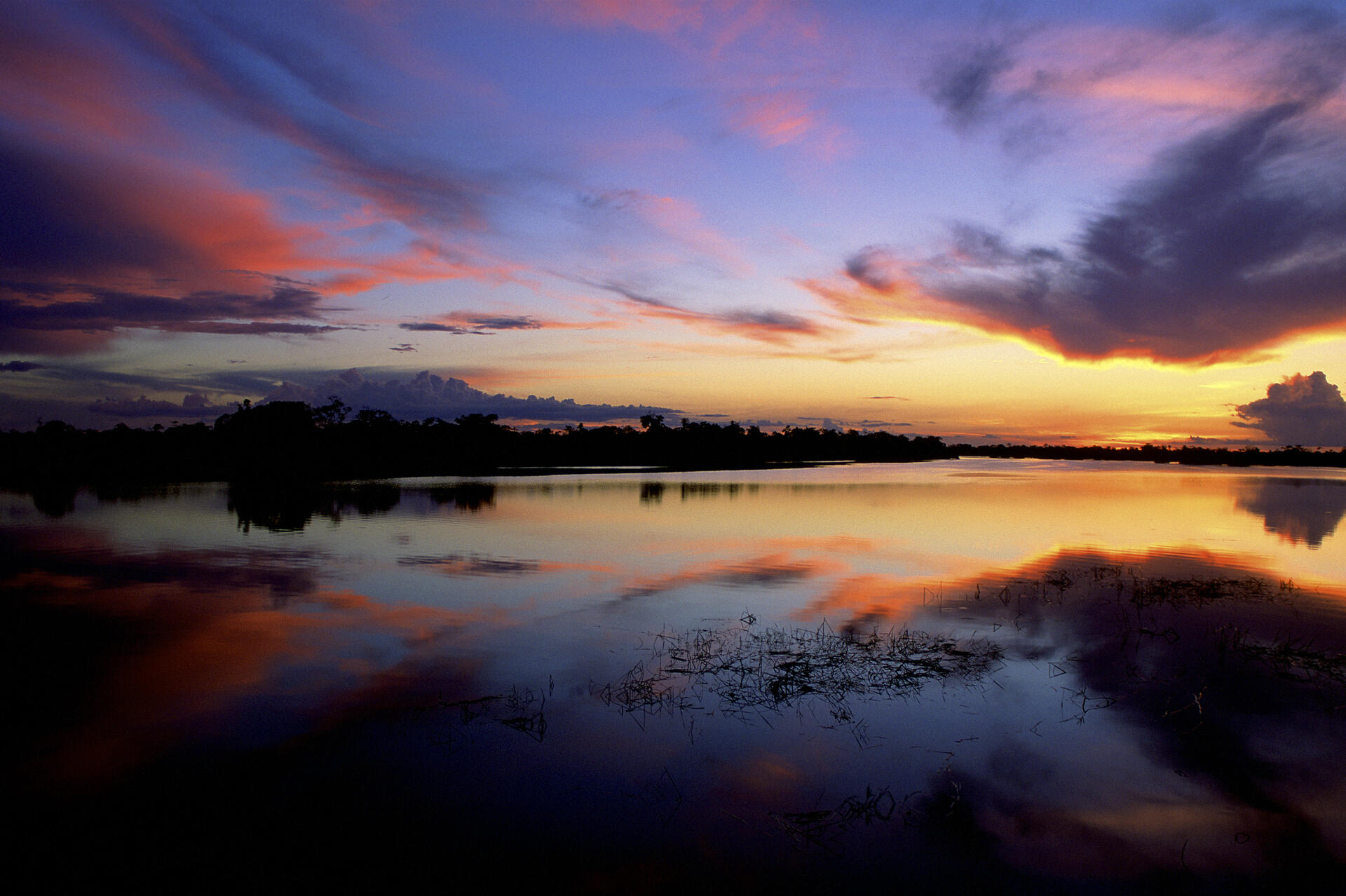
© Diego Lezama, CC BY-SA 4.0 Resized from original. (This derivative is under the same CC BY-SA license.)
World Heritage Research
Discover scientific research and academic studies that deepen our understanding of Central Amazon Conservation Complex from its history and significance to its conservation, management, and contemporary challenges.
-
The specialized white-sand flora of the Uatumã Sustainable Development Reserve, central Amazon, Brazil
A study of the Uatumã Sustainable Development Reserve (USDR) in central Amazon reveals that while white-sand ecosystems, known as campinaranas, host a significant number of endemic plant species, the majority are generalists found across other Neotropical environments. Analyzing a checklist of 167 tree, palm, and shrub species sampled between 2014 and 2020, researchers identified only 30.5% as exclusive to campinaranas, challenging the assumption that these ecosystems are dominated by specialists. The research also describes the phytophysiognomies, habitats, distribution, and phenology of the flora, highlighting the ecological richness and fragility of oligotrophic Amazonian environments. These findings underscore the need for tailored conservation strategies to protect this unique biodiversity.
Demarchi, L. O., Klein, V. P., Aguiar, D. P. P., Marinho, L. C., Ferreira, M. J., Lopes, A., da Cruz, J., Quaresma, A. C., Schöngart, J., Wittmann, F., & Piedade, M. T. F. (2022). The specialized white-sand flora of the Uatumã Sustainable Development Reserve, central Amazon, Brazil. Check List, 18(1), 187–217. https://doi.org/10.15560/18.1.187
View Publication Record | Read Publication -
World Heritage Conservation
World Heritage Conservation emerges as a pivotal interdisciplinary field, leveraging the UNESCO World Heritage Convention to foster sustainable development and global dialogue. The convention, rooted in the principles of outstanding universal value and international cooperation, provides a robust framework for the protection and management of culturally and naturally significant sites worldwide. This book critically examines strategies for implementing the convention and heritage governance processes, offering insights that are applicable across diverse disciplines. It highlights the growing globalization of heritage and the need for inclusive debates, common tools, and shared understanding to address conservation challenges effectively. With over a thousand inscribed properties, from biodiverse regions like the Central Amazon Conservation Complex to urban landscapes such as Rio de Janeiro, this work serves as an essential resource for students, researchers, and professionals engaged in heritage identification, protection, and presentation.
Cave, C., & Negussie, E. (2017). World Heritage Conservation (, Ed.). Routledge. https://doi.org/10.4324/9781315851631
View Publication Record | Read Publication