World Heritage Identification Number: 986
World Heritage since: 2000
Category: Cultural Heritage
WHE Type: Historic Cities & Urban Areas
Transboundary Heritage: No
Endangered Heritage: No
Country: 🇻🇪 Venezuela (Bolivarian Republic of)
Continent: Americas
UNESCO World Region: Latin America and the Caribbean
Map
The Ciudad Universitaria de Caracas: A Masterpiece of Modern Architecture
The Ciudad Universitaria de Caracas (University City of Caracas), located in the heart of the capital city of Venezuela, is a remarkable testament to the power of architectural innovation and artistic collaboration. This expansive university campus, spanning over 35 hectares, was designed by the renowned Venezuelan architect Carlos Raúl Villanueva and has been recognized as a World Heritage Site by UNESCO since 2000.
More to come…UNESCO Description of the World Heritage Site
The Ciudad Universitaria de Caracas, built to the design of the architect Carlos Raúl Villanueva, between 1940 and 1960, is an outstanding example of the Modern Movement in architecture. The university campus integrates the large number of buildings and functions into a clearly articulated ensemble, including masterpieces of modern architecture and visual arts, such as the Aula Magna with the "Clouds" of Alexander Calder, the Olympic Stadium, and the Covered Plaza.
UNESCO Justification of the World Heritage Site
Criterion i: The Ciudad Universitaria de Caracas is a masterpiece of modern city planning, architecture and art, created by the Venezuelan architect Carlos Raúl Villanueva and a group of distinguished avant-garde artists.
Criterion iv: The Ciudad Universitaria de Caracas is an outstanding example of the coherent realization of the urban, architectural, and artistic ideals of the early 20th century. It constitutes an ingenious interpretation of the concepts and spaces of colonial traditions and an example of an open and ventilated solution, appropriate for its tropical environment.
Encyclopedia Record: University City of Caracas
The University City of Caracas, also known by the acronym CUC, is the main campus of the Central University of Venezuela (UCV), located in central Caracas, the capital of Venezuela. It was designed by the Venezuelan architect Carlos Raúl Villanueva and was declared a World Heritage Site by UNESCO in 2000. The Ciudad Universitaria de Caracas is considered a "masterpiece" of architecture and urban planning, and greatly influenced Venezuelan architecture.Additional Site Details
Area: 164.203 hectares
Number of Components: 1
(iv) — Outstanding example of a type of building or landscape
Coordinates: 10.49073 , -66.89068
Image
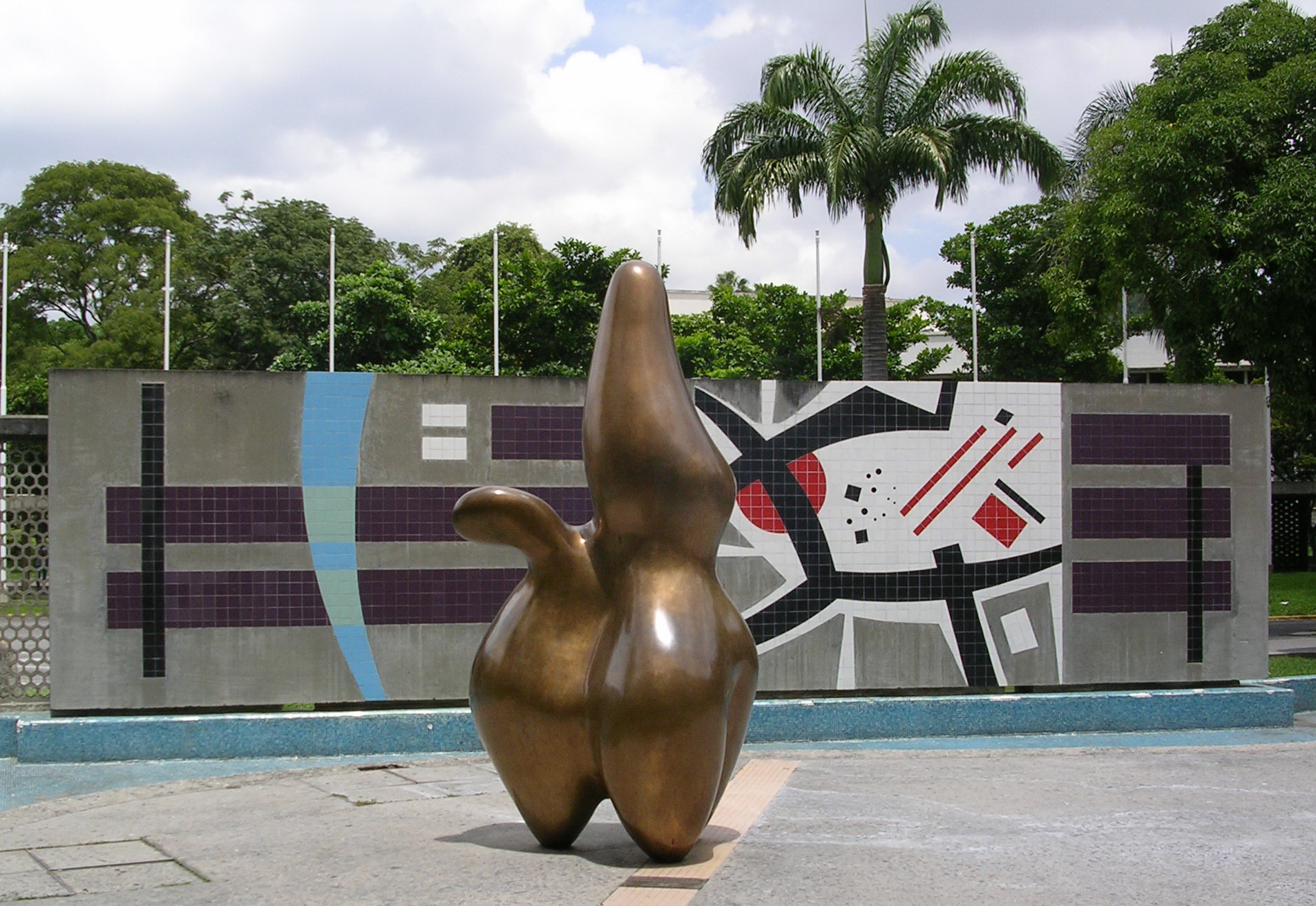
© Unknown, CC BY-SA 2.5 Resized from original. (This derivative is under the same CC BY-SA license.)
World Heritage Research
Discover scientific research and academic studies that deepen our understanding of Ciudad Universitaria de Caracas from its history and significance to its conservation, management, and contemporary challenges.
-
La flecha de Villanueva en Caracas
A groundbreaking analysis reveals that the church designed by Carlos Raúl Villanueva for Caracas' urban development sector '23 de Enero' embodies a double synthesis: it symbolizes the union of God and man through an architectural 'arrow,' while also serving as a guiding metaphor for church design. This insight is derived from Villanueva's conceptual framework, documented in his 'Notas docentes.' The study examines the church's ascending form, characterized by converging walls and a skylight-crowned apex, which creates a sensory experience from the atrium to the presbytery. Despite renovations, the building retains its original expressionistic character, reflecting its historical significance within the UNESCO-listed Ciudad Universitaria de Caracas.
Chacón Ramírez, J. L. (2026). The Arrow of Villanueva in Caracas. Actas de Arquitectura Religiosa Contemporánea, 13, 58–71. https://doi.org/10.17979/aarc.2026.13.13413
View Publication Record | Read Publication -
Photographic Narratives of Modern Public Housing in Venezuela Across Two Moments
Two iconic public housing complexes in Caracas, Venezuela—Unidad de Habitación Cerro Grande and Comunidad 23 de Enero—offer a stark contrast between the propagandistic modernist image promoted under Marcos Pérez Jiménez’s dictatorship and their current state of deterioration. A comparative analysis of photographs from their construction era (1950s) and today reveals budgetary constraints, rushed deadlines, and architectural concessions that shaped their design. Despite these challenges, the complexes retain enduring formal and spatial qualities, sustaining everyday life in Caracas. This study leverages a photographic archive to dissect the interplay between political narratives, architectural principles, and urban resilience.
Jaua, M. F. (2026). Photographic Narratives of Modern Public Housing in Venezuela Across Two Moments. Sophia Journal, 10(1), 1–17. https://doi.org/10.24840/2183-8976_2025_0010_0001_7
View Publication Record | Read Publication -
“Soleil, que me veux-tu?”: Protección climática en la Ciudad Universitaria de Caracas
The Ciudad Universitaria de Caracas, designed by Carlos Raúl Villanueva, exemplifies innovative climate-responsive architecture that integrates protective elements such as brise-soleil and concrete blocks, drawing inspiration from Le Corbusier's designs. A study combining documentary, photographic, planimetric analysis, and bibliographic reviews reveals how these features evolved between 1945 and 1950, reflecting both modernist aesthetics and climate adaptation in tropical contexts. The research highlights the site's role as a symbol of Venezuela's modernist identity, blending technical functionality with cultural heritage.
Chávez Herrera, M. (2025). “Soleil, que me veux-tu?”: Protección climática en la Ciudad Universitaria de Caracas. LC. Revue de Recherches Sur Le Corbusier, (11), 98–120. https://doi.org/10.4995/lc.2025.22261
View Publication Record | Read Publication -
Objetos de reacción poética en la Ciudad Universitaria de Caracas
A groundbreaking analysis reveals that Carlos Raúl Villanueva's architectural designs for the Ciudad Universitaria de Caracas, particularly those from the 1950s, embody a biomorphic approach rooted in poetic intuition. This study demonstrates how these structures challenge traditional rationalism by incorporating fluid, irregular forms inspired by nature and imagination, akin to Le Corbusier's 'objetos à réaction poètique.' The research also explores parallels with Oscar Niemeyer's work, highlighting a shared emphasis on sensuality and expressive innovation in 20th-century architecture. By examining bibliographic, planimetric, and photographic sources, the study traces the evolution of these concepts from their origins to contemporary reinterpretations.
Chávez Herrera, M. O. (2025). Objetos de reacción poética en la Ciudad Universitaria de Caracas. A&P Continuidad, 12(23). https://doi.org/10.35305/23626097v12i23.505
View Publication Record | Read Publication -
Dra. Ileana Vásquez De la Torre
A pioneering figure in Venezuelan heritage conservation, Dra. Ileana Vásquez De la Torre has significantly advanced the preservation of cultural and architectural landmarks, particularly those of religious and earth-based significance. Her expertise spans restoration projects such as the Iglesia San Lorenzo Mártir (estado Sucre) and the Basílica Nuestra Señora del Valle, alongside her leadership in developing inventories like the Inventario de Bienes Inmuebles and diagnostic studies for sites like Casa de la Hacienda La Trinidad. As a key member of ICOMOS and ICOFORT, she has contributed to international discourse on heritage conservation while serving as an academic leader, training future professionals through programs in Venezuela and Ecuador. Her ongoing work at the UNESCO World Heritage Site, Ciudad Universitaria de Caracas, underscores her commitment to integrating modern conservation practices with historical integrity.
Hayakawa Casas, J. (2024). Dra. Ileana Vásquez De la Torre. Devenir - Revista de Estudios Sobre Patrimonio Edificado, 11(21). https://doi.org/10.21754/devenir.v11i21.2215
View Publication Record | Read Publication -
Concierto cromático y diagrama de flujos : Carlos Raúl Villanueva : Ciudad Universitaria de Caracas
A doctoral thesis by Daniel Danés Grases reveals the chromatic harmony and fluid dynamics underlying Carlos Raúl Villanueva's iconic Ciudad Universitaria de Caracas. Through an innovative analysis combining color theory and flow diagrams, the study deciphers how Villanueva's architectural design integrates visual rhythm and spatial movement to create a cohesive urban experience. The research employs a dual approach: chromatic analysis to dissect color relationships across buildings, and fluid dynamics modeling to map pedestrian flows within the campus. This method uncovers the site's underlying structural logic, demonstrating how color and circulation patterns form an interconnected 'chromatic concert.' The findings not only advance understanding of modernist architecture but also offer insights into the spatial organization of UNESCO-listed cultural landscapes.
Danés Grases, D. Concierto cromático y diagrama de flujos : Carlos Raúl Villanueva : Ciudad Universitaria de Caracas. https://doi.org/10.20868/upm.thesis.76790
View Publication Record | Read Publication -
El proyecto del color bajo diagrama de flujos: la Ciudad Universitaria de Caracas y Carlos Raúl Villanueva
The study introduces the 'diagram of flows' as a groundbreaking method for analyzing, projecting, and graphically expressing color in architectural design, demonstrated through its application to the Ciudad Universitaria de Caracas. This approach, developed by architect Carlos Raúl Villanueva, integrates chromaticity with spatial and temporal dimensions, offering a universal framework that assigns constructive and plastic values to color. The research highlights how this method effectively captures the dynamic interplay between color, space, and time, providing a novel tool for architectural design that bridges the gap between artistic expression and functional urban planning.
Danés Grases, D., Marcano Requena, F., Pizarro Juanas, M. J., & Ibañez Montoya, J. (2023). El proyecto del color bajo diagrama de flujos: la Ciudad Universitaria de Caracas y Carlos Raúl Villanueva. EGA Revista de Expresión Gráfica Arquitectónica, 28(49), 224–237. https://doi.org/10.4995/ega.2023.15861
View Publication Record | Read Publication