World Heritage Identification Number: 1493
World Heritage since: 2016
Category: Cultural Heritage
WHE Type: Buildings & Architectural Ensembles
Transboundary Heritage: No
Endangered Heritage: No
Country: 🇧🇷 Brazil
Continent: Americas
UNESCO World Region: Latin America and the Caribbean
Map
A Visionary Urban Project: The Pampulha Modern Ensemble
The Pampulha Modern Ensemble, inscribed as a UNESCO World Heritage Site in 2016, represents a remarkable example of mid-20th century modernism in urban planning and architecture. Located in the district of Pampulha within Belo Horizonte, the capital of Minas Gerais State in Brazil, this cultural and leisure center was conceived as part of a visionary garden city project initiated in 1940.
More to come…UNESCO Description of the World Heritage Site
The Pampulha Modern Ensemble was the centre of a visionary garden city project created in 1940 at Belo Horizonte, the capital of Minas Gerais State. Designed around an artificial lake, this cultural and leisure centre included a casino, a ballroom, the Golf Yacht Club and the São Francisco de Assis church. The buildings were designed by architect Oscar Niemeyer, in collaboration with innovative artists. The Ensemble comprises bold forms that exploit the plastic potential of concrete, while fusing architecture, landscape design, sculpture and painting into a harmonious whole. It reflects the influence of local traditions, the Brazilian climate and natural surroundings on the principles of modern architecture.
UNESCO Justification of the World Heritage Site
Criterion (i): Niemeyer, Burle Marx and Portinari collectively delivered a landscape ensemble that as a whole is an outstanding for the way it manifests a new fluid modern architectural language fused with the plastic arts and design, and one that interacts with its landscape context.
Criterion (ii): The Pampulha Modern Ensemble was linked to reciprocal influences between European and North America and the Latin American periphery and particularly to a poetic reaction to the perceived austerity of modern European architecture. In establishing a synthesis between local regional practices and universal trends, as well as fostering dynamic links between architecture, landscape design and the plastic arts, Pampulha inaugurated a new direction in modern architecture which subsequently was used to assert new national identities in recently independent Latin American countries.
Criterion (iv): The Pampulha ensemble and its innovative architectural and landscape concepts reflects a particular stage in architectural history in South America, which in turn reflects wider socio-economic changes in society beyond the region. The economic crises of 1929 prompted demands for people to have greater inclusion in nation building. These circumstances influenced the design of the new garden city neighbourhood of Belo Horizonte as a place that could reflect creative and cultural ‘autonomy’ through innovative architectural buildings designed for public use, set in a designed ‘natural’ landscape, well endowed with public spaces for leisure and exercise.
Encyclopedia Record: Pampulha Modern Ensemble
The Pampulha Modern Ensemble is an urban project in Belo Horizonte, Minas Gerais state of Brazil. It was designed around an artificial lake, Lake Pampulha, in the district of Pampulha and includes a casino, a ballroom, the Golf Yacht Club and the Church of Saint Francis of Assisi. The buildings were designed by the architect Oscar Niemeyer, in collaboration with the landscape architect Roberto Burle Marx, Brazilian Modernist artists, and structural engineer Joaquim Cardozo.Additional Site Details
Area: 154 hectares
Number of Components: 1
(ii) — Significant interchange of human values
(iv) — Outstanding example of a type of building or landscape
Coordinates: -19.8519444444 , -43.9736111111
Image
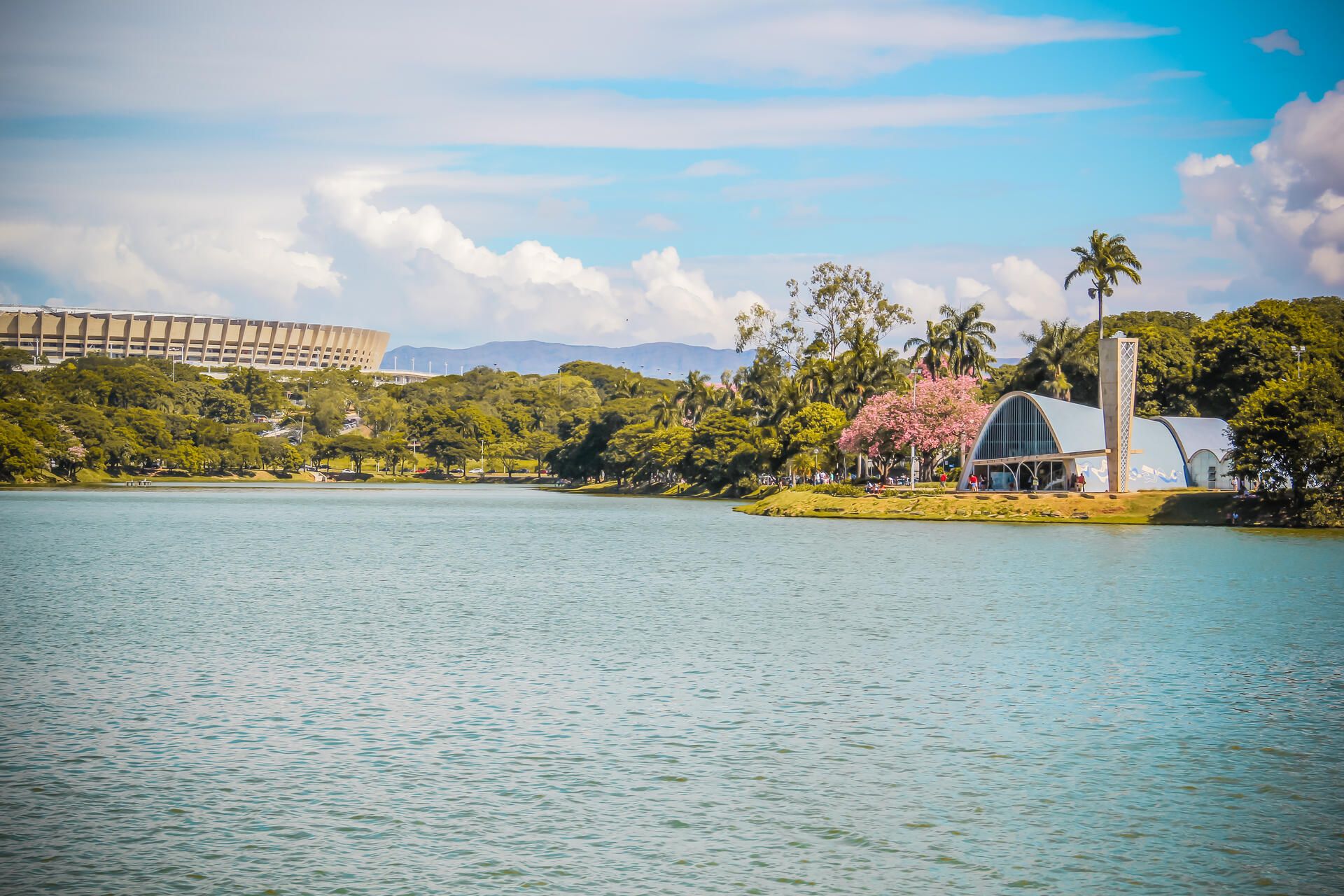
© Daniel Raposo, CC BY-SA 4.0 Resized from original. (This derivative is under the same CC BY-SA license.)
World Heritage Research
Discover scientific research and academic studies that deepen our understanding of Pampulha Modern Ensemble from its history and significance to its conservation, management, and contemporary challenges.
-
Occurrence of Pesticides and Emerging Contaminants in the Pampulha Lake: Anthropic Pollution of a UNESCO Heritage Site
A first-of-its-kind study reveals significant anthropogenic pollution in Pampulha Lake, a UNESCO-listed cultural heritage site in Belo Horizonte, Brazil. The research identifies alarming levels of pesticides (e.g., imidacloprid and fipronil) and emerging contaminants—including pharmaceuticals, personal care products, and hormones—that pose threats to aquatic life. Seasonal and spatial variations in contaminant concentrations point to specific sources tied to urban activities, with caffeine and herbicides like atrazine showing notable fluctuations. Risk assessments highlight imidacloprid and fipronil as particularly hazardous, underscoring the need for targeted monitoring to inform remediation strategies and protect this iconic site.
Domingues, R., Dias, M. A., Madeira, C. L., Starling, M. C. V. M., de A. Neves, T., & Montagner, C. C. (2025). Occurrence of Pesticides and Emerging Contaminants in the Pampulha Lake: Anthropic Pollution of a UNESCO Heritage Site. Emerging Pollutants, 11–33. https://doi.org/10.1007/978-3-031-71758-1_2
View Publication Record | Read Publication -
Cultural heritage management: towards informed decision-making based on integrated hbim-gis
A groundbreaking integration of Historic Building Information Modeling (HBIM) and Geographic Information Systems (GIS) offers a scalable solution for managing UNESCO-listed architectural heritage, as demonstrated by the Pampulha Modern Ensemble. This approach transforms BIM data into geospatial formats, enabling seamless visualization and management in an accessible web database. The study highlights how this framework simplifies complex heritage asset tracking while maintaining usability for non-specialized users, providing a replicable model for global cultural preservation efforts.
Dionizio, R. F., & Dezen-Kempter, E. (2024). Cultural heritage management: towards informed decision-making based on integrated hbim-gis. Blucher Social Sciences Proceedings, 501–516. https://doi.org/10.5151/fgkd24-48
View Publication Record | Read Publication -
Investigação de manifestações patológicas com a utilização de pacometria: um estudo de caso do Museu de Arte da Pampulha
A groundbreaking application of pachymetry reveals critical structural insights for the preservation of modernist heritage. This study demonstrates how non-destructive testing can effectively assess pathological manifestations in reinforced concrete buildings, using the Pampulha Art Museum—a UNESCO-listed masterpiece by Oscar Niemeyer—as a case study. The research highlights the technique's potential to evaluate structural integrity while safeguarding the architectural and cultural significance of modernist landmarks. By analyzing the interplay between solids and voids in the building's design, the study offers a methodologically robust approach to heritage conservation, bridging scientific rigor with the preservation of iconic 20th-century architecture.
Santos, F. F., Bremer, C. F., & Mello, G. N. de A. (2024). Investigação de manifestações patológicas com a utilização de pacometria: um estudo de caso do Museu de Arte da Pampulha (A. A. de A. e Melo, Ed.). UFCG, UNIFACISA. https://doi.org/10.5281/ZENODO.19295415
View Publication Record | Read Publication -
Os desafios da preservação do moderno: a atuação do ICOMOS/BRASIL
Preserving modern heritage, such as the Pampulha Modern Ensemble, presents unique challenges due to its recent history, controversial conceptualization, and diverse connotations. ICOMOS/BRAZIL has addressed these through institutional reorganization since 2015, including the creation of a Scientific Committee on 20th-Century Heritage, annual symposia (e.g., the 2018 event on 'The challenges of preserving the modern'), and specific projects like the Pampulha Mission and France-Brazil Journeys. These initiatives focus on developing preventive monitoring systems for sustainable tourism management and fostering international cooperation to study and preserve reinforced concrete modern heritage, ensuring its continuity while navigating necessary changes.
Castriota, L., & Carsalade, F. (2022). Os desafios da preservação do moderno: a atuação do ICOMOS/BRASIL. Cadernos Do Proarq (Ufrj), 1(38), 16. https://doi.org/10.37180/2675-0392-n38v1-2
View Publication Record | Read Publication -
Towards a Digital Twin for Heritage Interpretation - from HBIM to AR visualization
Researchers successfully developed an augmented reality (AR) application for the Pampulha Modern Ensemble, demonstrating the feasibility of using Historic-BIM and digital twin technologies to enhance heritage interpretation. The study showcases a workflow that integrates data-driven Building Information Modeling (BIM) with interactive virtual environments, enabling more effective preventive maintenance, heritage management, and public dissemination. By creating a digital twin of Oscar Niemeyer’s 1940s architectural marvel, the team bridged the gap between real and virtual environments, offering a novel approach to preserving and interpreting historic assets.
Dezen-Kempter, E., Mezencio, D. L., Miranda, E. D. M., De Sa, D. P., & Dias, U. (2020). Towards a Digital Twin for Heritage Interpretation - from HBIM to AR visualization. Proceedings of the 25th Conference on Computer Aided Architectural Design Research in Asia (CAADRIA) [Volume 2]. https://doi.org/10.52842/conf.caadria.2020.2.183
View Publication Record | Read Publication