World Heritage Identification Number: 723
World Heritage since: 1995
Category: Cultural Heritage
WHE Type: Cultural Landscapes
Transboundary Heritage: No
Endangered Heritage: No
Country: 🇵🇹 Portugal
Continent: Europe
UNESCO World Region: Europe and North America
Map
The Enchanting Cultural Landscape of Sintra: A 19th-Century European Romantic Architectural Masterpiece
The Cultural Landscape of Sintra, located in the heart of Portugal's Greater Lisbon region, is a captivating testament to the rich architectural heritage of Europe during the 19th century. This enchanting ensemble of palaces, castles, parks, and gardens was inscribed as a UNESCO World Heritage Site in 1995, recognizing its significant influence on the development of landscape architecture throughout Europe.
Sintra's allure began in the mid-19th century when King Ferdinand II transformed a long-abandoned and ruined Hieronymite monastery into the Pena Palace. This architectural marvel showcases the newfound sensitivity towards Gothic, Egyptian, Moorish, and Renaissance styles that defined the European Romantic movement. The resulting structure is a breathtaking blend of various artistic influences, creating a unique and visually striking edifice.
Beyond the castle walls, the surrounding landscape continues to dazzle visitors. The park at Pena Palace is home to a diverse array of local and exotic tree species, meticulously cultivated to create a harmonious balance between nature and art. This innovative approach to landscaping would go on to inspire countless European designers and architects, shaping the way we view and interact with our natural environments today.
However, Pena Palace is not Sintra's only architectural gem. The municipality boasts numerous other dwellings, each displaying similar romantic sensibilities. Monserrate Palace, for instance, features Neo-Gothic, Indian, and Moorish Revival elements. Quinta da Regaleira, another notable estate, is renowned for its eclectic mix of architectural styles, including Neo-Gothic, Neo-Renaissance, and Neo-Manueline elements.
Despite their grandeur, these structures are not isolated monuments. They are intimately connected to their surroundings, nestled within the rolling hills of the Serra de Sintra. The lush greenery and undulating terrain provide a stunning backdrop, enhancing the beauty and allure of these architectural masterpieces.
Moreover, Sintra's cultural landscape extends beyond its iconic buildings. The wider municipality, outside of the UNESCO heritage site, is also home to several scenic beaches, offering visitors a chance to explore the coastline and enjoy the Atlantic Ocean's refreshing waters. Additionally, the verdant parks and gardens found throughout Sintra provide tranquil spaces for reflection and relaxation, allowing visitors to fully immerse themselves in the region's rich history and natural beauty.
In conclusion, the Cultural Landscape of Sintra represents a remarkable achievement in European Romantic architecture. Its influence can still be felt today, as it continues to inspire and captivate visitors from around the world. By preserving and celebrating this unique ensemble of palaces, castles, parks, and gardens, Sintra stands as a testament to the power of human creativity and ingenuity.
UNESCO Description of the World Heritage Site
In the 19th century Sintra became the first centre of European Romantic architecture. Ferdinand II turned a ruined monastery into a castle where this new sensitivity was displayed in the use of Gothic, Egyptian, Moorish and Renaissance elements and in the creation of a park blending local and exotic species of trees. Other fine dwellings, built along the same lines in the surrounding serra , created a unique combination of parks and gardens which influenced the development of landscape architecture throughout Europe.
UNESCO Justification of the World Heritage Site
Criterion (ii): In the 19th century, Sintra became the first centre of European Romantic architecture where this new sensitivity was displayed in the use of Gothic, Egyptian, Moorish and Renaissance elements and in the creation of parks, blending local and exotic species of trees. Ferdinand II (1836-1885) thereby developed romanticism in a splendid form that was unique in the Mediterranean region.
Criterion (iv): The landscape is a unique example of European Romanticism with the cultural occupation of the northern slope of the Serra that has maintained its essential integrity as the representation of diverse successive cultures, as well as the associated flora and fauna. The romantic atmosphere, strengthened over time, and the reminders of the Victorian period as well as the exotic allusions are still potent and can be easily recognized throughout the landscape. The villas and quintas with their gardens and parks that cover the major area of the property correspond to a clearly defined landscape designed and created intentionally by people through landscape design.
Criterion (v): The cultural landscape, with its local and exotic vegetation - such as Mexican cypress, Australian acacias and eucalyptus, and pine trees -, its crests and piles of granite rocks covering the archaeological remains, palaces and parks, as well as the historic centre of Sintra and other fine dwellings, built along the same lines in the surrounding Serra, forms a continuing and organically evolved landscape, which has been sustained by painstaking restoration and preservation projects. This unique combination of parks and gardens turned the landscape into an abundant world, which offers surprises at every turn in the paths, leading the visitor from a discovery to another, and influenced the development of landscape architecture throughout Europe.
Encyclopedia Record: Sintra
Sintra, officially the Town of Sintra, is a town and municipality in the Greater Lisbon region of Portugal, located on the Portuguese Riviera. The population of the municipality in 2021 was 385,654, in an area of 319.23 square kilometres (123.26 sq mi). Sintra is one of the most urbanized and densely populated municipalities of Portugal. A major tourist destination famed for its picturesqueness, the municipality has several historic palaces, castles, scenic beaches, parks and gardens.Additional Site Details
Area: 946 hectares
Number of Components: 1
(iv) — Outstanding example of a type of building or landscape
(v) — Outstanding example of traditional human settlement
Coordinates: 38.78333 , -9.41667
Image
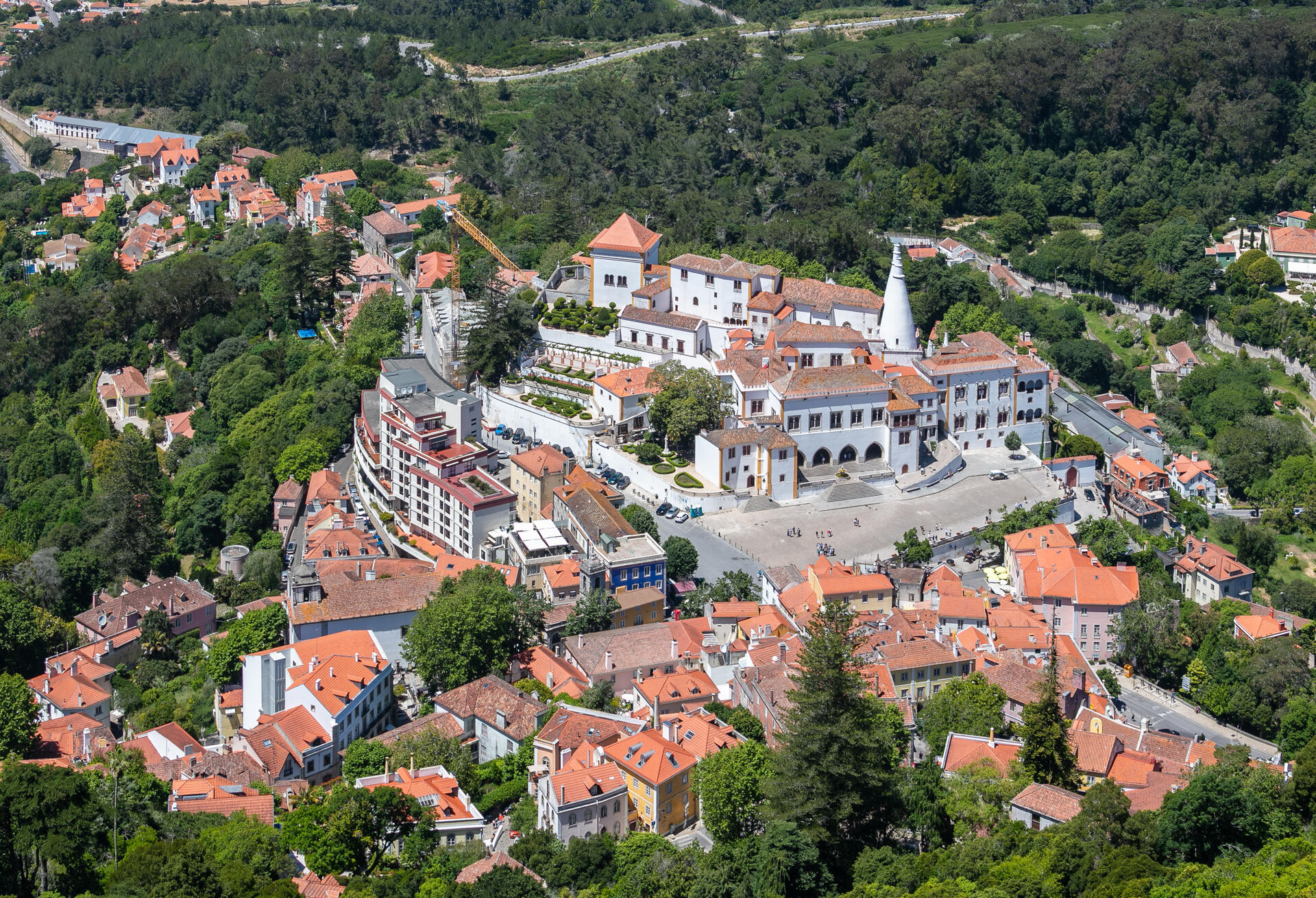
© Diego Delso, CC BY-SA 4.0 Resized from original. (This derivative is under the same CC BY-SA license.)
World Heritage Research
Discover scientific research and academic studies that deepen our understanding of Cultural Landscape of Sintra from its history and significance to its conservation, management, and contemporary challenges.
-
Enhancing the Visitor Experience with Immersive Technologies and Gaming: The Monserrate Use Case
Immersive technologies, such as augmented reality (AR) and virtual reality (VR), significantly enhance visitor engagement at cultural heritage sites. A proposed AR/VR-based Web app for Monserrate Palace, a UNESCO-listed site in Sintra, Portugal, demonstrates this potential by offering interactive storytelling and immersive experiences that deepen the connection between visitors and historical narratives. The study explores how these technologies can address challenges in traditional tourism, such as limited visitor engagement, while addressing technical constraints and preservation concerns. Findings suggest that AR and VR not only enrich the visitor experience but also create memorable and enjoyable interactions with cultural heritage, making them valuable tools for modern audiences.
Portugal, C., Vaz, D., Dias, M. S., Trocado, P., Prata, A., & Abreu, F. B. e. (2025). Enhancing the Visitor Experience with Immersive Technologies and Gaming: The Monserrate Use Case. Smart Life and Smart Life Engineering, 273–291. https://doi.org/10.1007/978-3-031-75887-4_13
View Publication Record | Read Publication -
Digital Twin for Heritage Structural Health Monitoring: First Experimental Tests.
A digital twin approach integrated with structural health monitoring (SHM) shows promise for real-time conservation of heritage buildings, such as the Palace of Monserrate in Sintra. The study compared low-cost MEMS sensors with a reference sensor to assess data accuracy, finding that while cost-effective solutions can capture meaningful kinematic data, their confidence levels must be carefully evaluated. This research highlights the potential of IoT-enabled wireless sensor networks (WSNs) for continuous SHM, offering a scalable and efficient method to monitor cultural landscapes without compromising structural integrity.
Machete, R., Ponte, M., Falcão, A. P., & Bento, R. (2025). DIGITAL TWIN FOR HERITAGE STRUCTURAL HEALTH MONITORING: FIRST EXPERIMENTAL TESTS. International Association for Earthquake Engineering. https://doi.org/10.71846/18-WCEE-0773
View Publication Record | Read Publication -
A BIM-Based Model for Structural Health Monitoring of the Central Body of the Monserrate Palace: A First Approach
A novel IoT-based structural health monitoring (SHM) system, integrated with Building Information Modeling (BIM), demonstrates significant potential for real-time vibration analysis of historic structures. The study, conducted at the Monserrate Palace in Sintra, Portugal—a UNESCO-listed cultural landscape—shows how low-cost sensors can effectively track structural dynamics during normal and seismic events. By leveraging a hybrid BIM model (H-BIM) combined with numerical simulations, researchers achieved precise monitoring of the palace's central tower, enabling data-driven maintenance strategies. This approach could revolutionize heritage preservation by reducing costs and optimizing interventions, addressing longstanding challenges in safeguarding vulnerable cultural assets.
Machete, R., Neves, M., Ponte, M., Falcão, A. P., & Bento, R. (2023). A BIM-Based Model for Structural Health Monitoring of the Central Body of the Monserrate Palace: A First Approach. Buildings, 13(6), 1532. https://doi.org/10.3390/buildings13061532
View Publication Record | Read Publication -
A Sacred Place, an Enchanted Space: Crisis and Spiritual Elasticity in the Mountain of the Moon
Sintra's Cultural Landscape, recognized as a UNESCO World Heritage Site, embodies a unique 'sensuous sacred geography' where spiritual elasticity and transreligiosity thrive. This study reveals how the mountain's natural setting, layered with historical religious significance, serves as an 'enchanted space' for individuals seeking relief from personal crises or collective eco-anxiety through vernacular spirituality. Utilizing ethnographic data, the research demonstrates that Sintra's landscape facilitates diverse spiritual practices, from ceremonies to meditations, showcasing its role as a dynamic site of spiritual resilience and adaptability.
Saraiva, C. (2023). A Sacred Place, an Enchanted Space: Crisis and Spiritual Elasticity in the Mountain of the Moon. Religions, 14(9), 1153. https://doi.org/10.3390/rel14091153
View Publication Record | Read Publication -
Security and safety challenges of a palace-museum in nature environment. The case of Pena, Sintra
The National Palace of Pena, a UNESCO-listed cultural landscape in Sintra, Portugal, faces significant security and safety challenges due to its unique natural environment. A study highlights that Parques de Sintra - Monte da Lua (PSML), the managing entity since 2007, has developed an Integrated Strategic Territorial Planning through collaboration with Civil Protection bodies and stakeholders. This approach establishes sustained protocols for territorial management while implementing a Conservation Plan for Built Heritage, focusing on maintenance, space usage rules, and performance evaluation. The study underscores the importance of international principles, ethical guidelines, and cost-effective methodologies in preserving such heritage sites, offering a model for balanced security and conservation efforts.
Pereira, T., & Rego, J. S. (2023). Security and safety challenges of a palace-museum in nature environment. The case of Pena, Sintra. Integrated Risk Management in Museums. Past Lessons, Future Ways, 106–119. https://doi.org/10.21747/978-989-9082-15-1/inta6
View Publication Record | Read Publication -
The Use of a Building Information Model to Support Seismic Analysis: Application to the National Palace of Sintra, Portugal
A novel approach using Heritage Building Information Modelling (H-BIM) demonstrates significant potential for seismic analysis of complex historical structures, exemplified by the National Palace of Sintra. This UNESCO-listed site, characterized by its intricate unreinforced masonry architecture, was analyzed through a detailed H-BIM model that integrates geometric and material data, enabling nonlinear static seismic assessments. The study highlights how advanced digital modeling, combined with UAV and laser scanning technologies, can provide precise inputs for structural analysis software like 3Muri, offering an integrated platform for building management. This methodology not only advances the understanding of seismic behavior in heritage sites but also provides a scalable solution for preserving culturally significant structures under potential seismic threats.
Ponte, M., Bento, R., Machete, R., Godinho, M., Gonçalves, A., & Falcão, A. (2021). The Use of a Building Information Model to Support Seismic Analysis: Application to the National Palace of Sintra, Portugal. 12th International Conference on Structural Analysis of Historical Constructions. https://doi.org/10.23967/sahc.2021.302
View Publication Record | Read Publication -
Gamifying the visit to places with valuable landscapes
A mobile tool designed to engage users in discovering and sharing valuable landscapes through gamification has been shown to enhance user experience, particularly within UNESCO World Heritage Sites. The study, conducted in Sintra's Cultural Landscape—a site recognized for its global significance since 1995—evaluated the tool's effectiveness by assessing both user engagement and the impact of gamification features. Findings indicate that integrating playful elements can motivate exploration and sharing of lesser-known landscapes, offering a novel approach to cultural heritage preservation and public engagement.
Jesus, R., Conceição, C., & Lopes, G. (2019). Gamifying the visit to places with valuable landscapes. EAI Endorsed Transactions on Creative Technologies, 6(20), 162946. https://doi.org/10.4108/eai.30-7-2019.162946
View Publication Record | Read Publication