World Heritage Identification Number: 264
World Heritage since: 1983
Category: Cultural Heritage
WHE Type: Religious Sites & Sacred Architecture
Transboundary Heritage: No
Endangered Heritage: No
Country: 🇵🇹 Portugal
Continent: Europe
UNESCO World Region: Europe and North America
Map
The Monastery of Batalha: A Gothic Masterpiece Commemorating a Battle and Shaping a Nation
The Monastery of Batalha, located in the municipality of Batalha, Centro region of Portugal, stands as a testament to the country's rich history, architectural prowess, and religious devotion. Officially known as the Monastery of Saint Mary of the Victory, this Dominican convent was constructed between 1386 and 1517 to honor the Portuguese victory over the Castilians at the Battle of Aljubarrota in 1385. Inscribed as a UNESCO World Heritage Site in 1983, the Monastery of Batalha is a significant cultural and historical landmark that offers insights into Portugal's past while showcasing the evolution of Gothic architecture.
More to come…UNESCO Description of the World Heritage Site
The Monastery of the Dominicans of Batalha was built to commemorate the victory of the Portuguese over the Castilians at the battle of Aljubarrota in 1385. It was to be the Portuguese monarchy's main building project for the next two centuries. Here a highly original, national Gothic style evolved, profoundly influenced by Manueline art, as demonstrated by its masterpiece, the Royal Cloister.
UNESCO Justification of the World Heritage Site
Criterion (i): The Dominican Monastery of Batalha is one of the absolute masterpieces of Gothic art.
Criterion (ii): The Monastery of Batalha was, for more than two centuries, an important workshop of the Portuguese monarchy. The most characteristic features of a national art were determined here, both during the Gothic and the Renaissance periods.
Encyclopedia Record: Batalha Monastery
The Monastery of Batalha is a Dominican convent in the municipality of Batalha, historical Beira Litoral province, in the Centro of Portugal. Originally, and officially, known as the Monastery of Saint Mary of the Victory, it was erected in commemoration of the 1385 Battle of Aljubarrota and would serve as the burial church of the 15th-century Aviz dynasty of Portuguese royalty. It is one of the best and original examples of Late Flamboyant Gothic architecture in Portugal, intermingled with the Manueline style. The monastery is a historic and cultural monument and was listed as a UNESCO World Heritage site in 1983.Additional Site Details
Area: 0.98 hectares
Number of Components: 1
(ii) — Significant interchange of human values
Coordinates: 39.65778 , -8.82694
Image
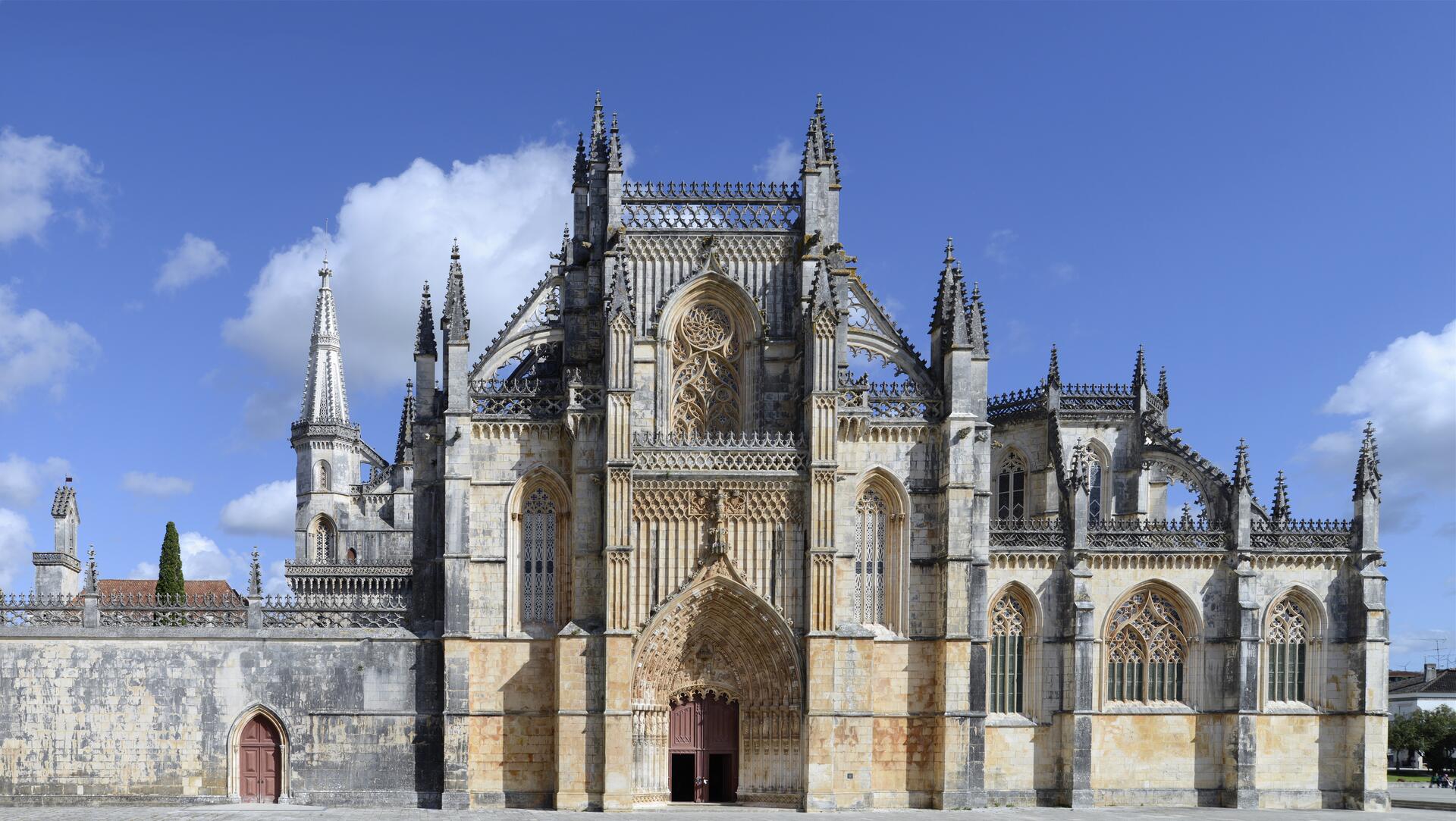
© Alvesgaspar, CC BY-SA 4.0 Resized from original. (This derivative is under the same CC BY-SA license.)
World Heritage Research
Discover scientific research and academic studies that deepen our understanding of Monastery of Batalha from its history and significance to its conservation, management, and contemporary challenges.
-
Influence of environmental factors in the assessment of mechanical properties of masonry in historic construction
Environmental humidity significantly influences the mechanical properties of historic masonry, as demonstrated by a study at the Monastery of Batalha. The research found that humidity acts as a confounding factor, altering measurements of wave propagation velocity and Schmidt hardness obtained through non-destructive testing. Predictive models incorporating humidity improved the accuracy of estimating P-wave velocity, offering a more reliable approach for assessing elastic properties in heritage structures. This study establishes a framework for integrating environmental effects into conservation practices, enhancing the reliability of mechanical characterisation in historic masonry.
Bourgeois, I., Ferreira, V., & Rodrigues, H. (2026). Influence of environmental factors in the assessment of mechanical properties of masonry in historic construction. Nondestructive Testing and Evaluation, 1–33. https://doi.org/10.1080/10589759.2025.2612259
View Publication Record | Read Publication -
From monitoring to forecasting: predictive modelling of thermal-induced displacements in heritage masonry – the Batalha Monastery case study
A groundbreaking study at the Monastery of Batalha, Portugal, demonstrates that predictive modelling can accurately forecast thermal-induced displacements in heritage masonry, moving beyond traditional reactive monitoring. By integrating fibre optic sensing with lag-based regression models, researchers achieved high predictive accuracy (R² values above 0.93 for crack monitoring and 0.75–0.95 for joint monitoring), effectively capturing the delayed thermal response of limestone due to its thermal inertia. This approach enables passive alert systems capable of anticipating structural behaviour under climate-driven temperature cycles, offering a scalable solution for preventive conservation worldwide. The methodology transforms high-resolution monitoring data into a proactive tool, directly addressing the resilience challenges faced by monuments exposed to environmental change.
Bourgeois, I., Ferreira, V., & Rodrigues, H. (2026). From monitoring to forecasting: predictive modelling of thermal-induced displacements in heritage masonry – the Batalha Monastery case study. International Journal of Building Pathology and Adaptation, 44(9), 16–34. https://doi.org/10.1108/ijbpa-10-2025-0253
View Publication Record | Read Publication -
SubD and traditional modelling techniques for Gothic architecture: insights from the Founder’s Chapel into HBIM integration
A hybrid approach combining parametric modelling with SubD, NURBS, and mesh-based techniques emerges as the optimal strategy for documenting complex Gothic architecture, such as the Founder’s Chapel at the Monastery of Batalha. This study demonstrates that while parametric modelling excels in adaptability and integration with surrounding elements, SubD offers a novel, highly efficient method for capturing intricate vaulted geometries with high accuracy. The research, leveraging terrestrial laser scanning point cloud data, evaluated geometric accuracy, time efficiency, and model flexibility across four techniques, revealing that project-specific requirements should guide the selection of modelling approaches rather than technical preferences alone. This integrated strategy enhances documentation fidelity while emphasizing the need for improved interoperability between HBIM methods.
Sugiyama, G., Rodrigues, F., & Rodrigues, H. (2026). SubD and traditional modelling techniques for Gothic architecture: insights from the Founder’s Chapel into HBIM integration. Journal of Building Pathology and Rehabilitation, 11(3). https://doi.org/10.1007/s41024-026-00871-1
View Publication Record | Read Publication -
Image-based automatic detection of efflorescence on limestone heritage constructions: Application to the Monastery of Batalha
A breakthrough in the automated detection of efflorescence on limestone heritage structures has been achieved, demonstrating that material-specific training enhances segmentation performance. The study revealed that convolutional neural networks (CNNs) can accurately delineate efflorescence with a best Binary IoU score of 92%, and even a specific model achieved 76% accuracy. This advancement was validated using imagery from the UNESCO-listed Monastery of Batalha in Portugal, showcasing its real-world applicability. The research highlights that training dataset composition significantly influences segmentation performance, providing practical guidance for quantitative documentation and monitoring of efflorescence in limestone masonry. Unlike previous qualitative assessments, this methodology offers a reproducible, data-driven approach to heritage conservation.
Bourgeois, I., Silva, D., Ferreira, V., & Rodrigues, H. (2026). Image-based automatic detection of efflorescence on limestone heritage constructions: Application to the Monastery of Batalha. Journal of Building Engineering, 129, 116924. https://doi.org/10.1016/j.jobe.2026.116924
View Publication Record | Read Publication -
Smart 3D printed elements for conservation of damaged heritage structures
Smart 3D-printed elements integrating sensor technologies offer a groundbreaking approach to the conservation of UNESCO World Heritage Sites, such as the Monastery of Batalha. This study demonstrates that 3D printing, when paired with materials like natural hydraulic lime (NHL) pastes and thermoplastics, can achieve high shape fidelity while maintaining compatibility with traditional structures. A comparative analysis revealed a trade-off between detailing precision and material authenticity, with NHL pastes showing promise for closer alignment to historical building practices. Innovatively, the incorporation of sensors enables real-time monitoring of environmental conditions and structural integrity, providing a scalable model for heritage conservation efforts worldwide.
Bourgeois, I., Sugiyama, G., Capistrano, J., Ascensão, G., Ferreira, V., & Rodrigues, H. (2025). Smart 3D printed elements for conservation of damaged heritage structures. Journal of Building Engineering, 112, 113595. https://doi.org/10.1016/j.jobe.2025.113595
View Publication Record | Read Publication -
Modelling Techniques for Gothic Built Heritage: An HBIM Case Study of the Founder’s Chapel, Batalha Monastery
Research on Gothic built heritage reveals that no single modelling technique is universally optimal for Heritage Building Information Modelling (HBIM). Instead, the study of Batalha Monastery’s Founder’s Chapel vaults demonstrates that parametric modelling should serve as the foundational approach, strategically complemented by NURBS and mesh generation based on project-specific requirements. Parametric modelling excels in establishing relational connections with adaptability, while NURBS offers mathematically precise surface representation, and mesh generation ensures documentation fidelity. These findings underscore the need for improved interoperability between techniques to enhance heritage preservation efforts.
Sugiyama, G., Rodrigues, F., & Rodrigues, H. (2025). Modelling Techniques for Gothic Built Heritage: An HBIM Case Study of the Founder’s Chapel, Batalha Monastery. Proceedings of CIRMARE 2025, 313–322. https://doi.org/10.1007/978-3-032-08224-4_26
View Publication Record | Read Publication -
Fiber Bragg grating based displacement sensors with low visual impact for structural health monitoring applications – Monastery of Batalha case
A novel, low-visibility displacement sensing system using fiber Bragg gratings has been successfully implemented for long-term structural health monitoring at the UNESCO-listed Monastery of Batalha. This minimally intrusive approach allows for precise tracking of crack and joint movements with minimal visual impact, addressing preservation challenges for heritage sites. The sensors, featuring transparent holders and adjustable pre-strain mechanisms, offer a cost-effective, versatile alternative to traditional methods. Initial data collected over months demonstrates their operational efficacy, providing valuable insights for future conservation interventions.
Pereira, L., Bourgeois, I., Rodrigues, H., Varum, H., & Antunes, P. (2024). Fiber Bragg grating based displacement sensors with low visual impact for structural health monitoring applications – Monastery of Batalha case. Sensors and Actuators A: Physical, 368, 115117. https://doi.org/10.1016/j.sna.2024.115117
View Publication Record | Read Publication