World Heritage Identification Number: 1573
World Heritage since: 2019
Category: Cultural Heritage
WHE Type: Buildings & Architectural Ensembles
Transboundary Heritage: No
Endangered Heritage: No
Country: 🇵🇹 Portugal
Continent: Europe
UNESCO World Region: Europe and North America
Map
The Royal Building of Mafra: A Grand Baroque Monument in Portugal
The Royal Building of Mafra, officially recognized as a UNESCO World Heritage Site since 2019, stands as a testament to the grandeur and ambition of King João V of Portugal. Situated approximately 30 kilometers northwest of Lisbon, this monumental complex is a unique blend of Baroque and Neoclassical architecture, showcasing the power and influence of the Portuguese Empire during the 18th century.
More to come…UNESCO Description of the World Heritage Site
Located 30 km northwest of Lisbon, the property was conceived by King João V in 1711 as a tangible representation of his conception of the monarchy and the State. This imposing quadrangular building houses the king’s and queen's palaces, the royal chapel, shaped like a Roman baroque basilica, a Franciscan monastery and a library containing 36,000 volumes. The complex is completed by the Cerco garden, with its geometric layout, and the royal hunting park (Tapada). The Royal Mafra Building is one of the most remarkable works undertaken by King João V, which illustrates the power and reach of the Portuguese Empire. João V adopted Roman and Italian baroque architectural and artistic models and commissioned works of art that make Mafra an exceptional example of Italian Baroque.UNESCO Justification of the World Heritage Site
Criterion (iv): The Royal Building of Mafra reflects the materialization of absolute power from the time of the King João V, as well as a strategy for consolidation of the Portuguese empire and national sovereignty, affirmation of the dynastic legitimacy, a closer proximity to the international sources of authority, namely of the Papacy of Rome, as well as distancing from the Spanish Crown. The international dimension of the Portuguese empire and the grandeur of its sovereign are at the origin of the gigantism of this construction and the aesthetic options taken, directly inspired by some of the best examples of Baroque architecture in the city of Rome. Other features in this Monument contribute to making this royal residential complex one of the most important in Europe, considering not only its size and constructive accuracy, but also some integrated pieces such as the Carillons and the Organs of the Basilica, musical sets of exceptional relevance in the world. The Hunting Park (Tapada) is an example of large-scale landscape creation forming a territorial unit management umbilically connected with the Palace and the Convent.
Encyclopedia Record: Palace of Mafra
The Palace of Mafra, also known as the Palace-Convent of Mafra and the Royal Building of Mafra, is a monumental Baroque and Neoclassical palace-monastery located in Mafra, Portugal, some 28 kilometres from Lisbon. Construction began in 1717 under King John V of Portugal and was completed in 1755.Additional Site Details
Area: 1,213.17 hectares
Number of Components: 1
Coordinates: 38.9371666667 , -9.3255277778
Image
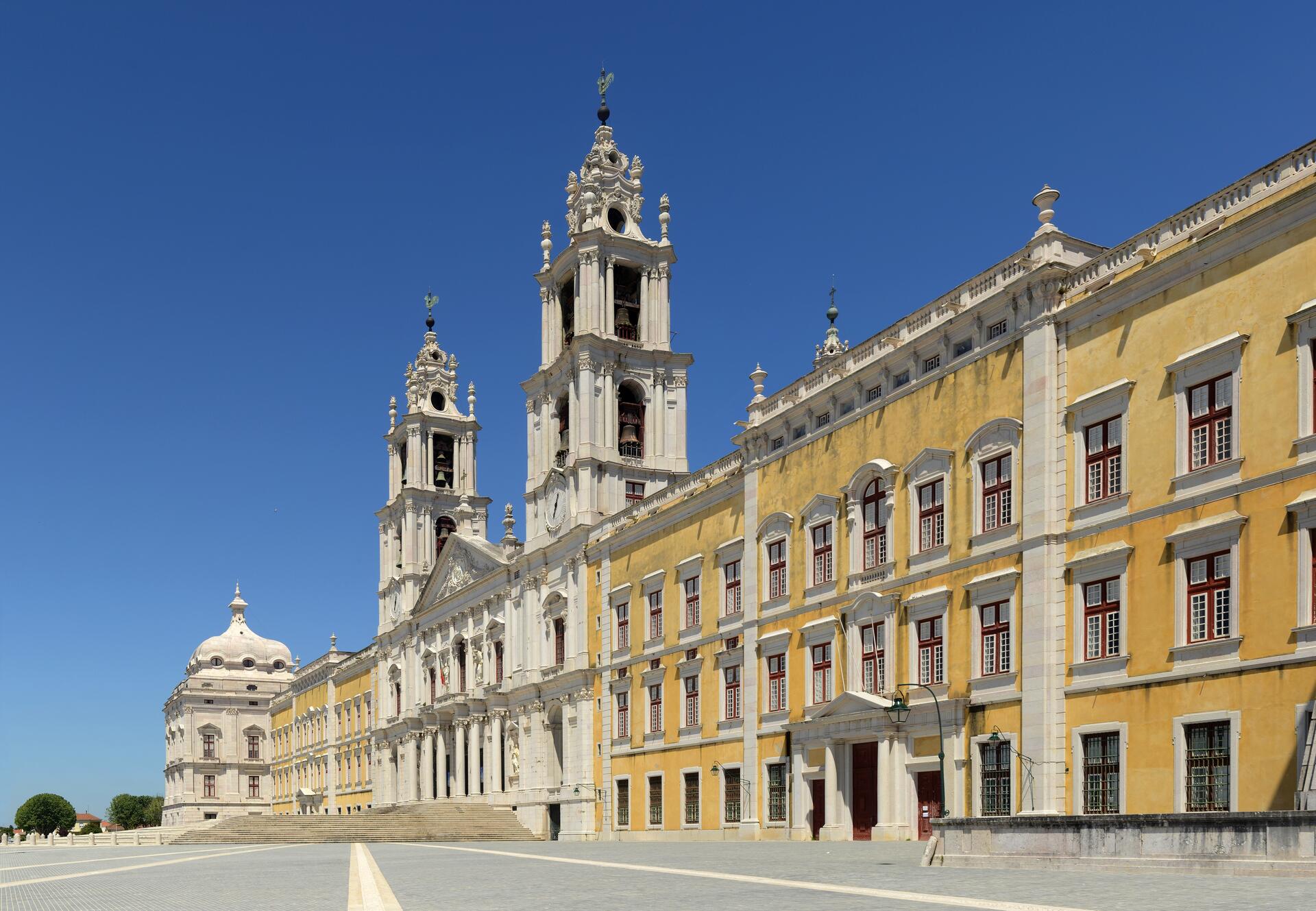
© Alvesgaspar, CC BY-SA 3.0 Resized from original. (This derivative is under the same CC BY-SA license.)