World Heritage Identification Number: 505
World Heritage since: 1989
Category: Cultural Heritage
WHE Type: Religious Sites & Sacred Architecture
Transboundary Heritage: No
Endangered Heritage: No
Country: 🇵🇹 Portugal
Continent: Europe
UNESCO World Region: Europe and North America
Map
The Monastery of Alcobaça: A Masterpiece of Cistercian Gothic Art
The Monastery of Alcobaça, officially known as the Monastery of Santa Maria d'Alcobaça, is a remarkable example of Cistercian Gothic architecture that stands proudly in the heart of Portugal. This historic monument, located approximately 120 kilometers north of Lisbon and 110 kilometers south of Coimbra, was founded in the 12th century by King Alfonso I, making it one of the most significant historical sites in the country.
More to come…UNESCO Description of the World Heritage Site
The Monastery of Santa Maria d'Alcobaça, north of Lisbon, was founded in the 12th century by King Alfonso I. Its size, the purity of its architectural style, the beauty of the materials and the care with which it was built make this a masterpiece of Cistercian Gothic art.
UNESCO Justification of the World Heritage Site
Criterion (i): By virtue of its magnificent dimensions, the clarity of the architectural style, the beauty of the material used and the care with which it was built, the Monastery of Alcobaça is a masterpiece of Gothic Cistercian art. It bears witness to the spreading of an aesthetic style that developed in Burgundy at the time of St Bernard, and to the survival of the ascetic ideal which characterised the order's early establishments like Fontenay. The tombs of Dom Pedro and Dona Inês de Castro are beautiful examples of Gothic funerary sculptures.
Criterion (iv): The Monastery of Alcobaça is an example of a great Cistercian establishment with a unique infrastructure of hydraulic systems and functional buildings. Deservedly renowned, the 18th-century kitchen adds to the interest of the group of monastic buildings from the medieval period (cloister and lavabo, chapter house, parlor, dormitory, the monks' room and the refectory).
Encyclopedia Record: Alcobaça Monastery
The Alcobaça Monastery or Alcobasa Monastery is a Catholic monastic complex located in the town of Alcobaça, in central Portugal, 120 km (75 mi) north of Lisbon and 110 km (68 mi) south of Coimbra.Additional Site Details
Area: Not available
Number of Components: 1
(iv) — Outstanding example of a type of building or landscape
Coordinates: 39.55 , -8.97667
Image
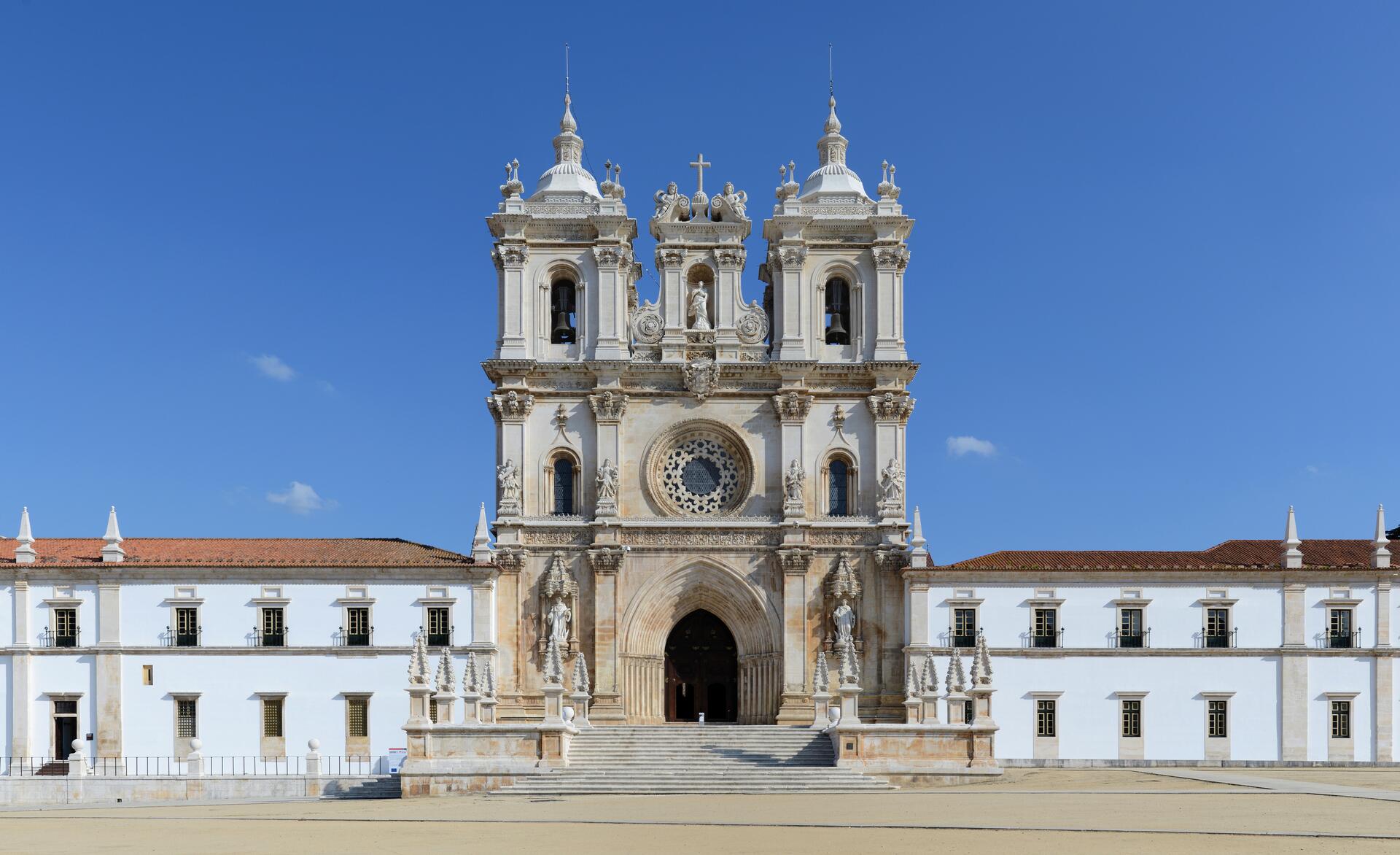
© Alvesgaspar, CC BY-SA 4.0 Resized from original. (This derivative is under the same CC BY-SA license.)
World Heritage Research
Discover scientific research and academic studies that deepen our understanding of Monastery of Alcobaça from its history and significance to its conservation, management, and contemporary challenges.
-
Historical lime‐based flooring mortars from the Church of Santa Maria de Alcobaça monastery (12th century), Portugal: A multi‐analytical approach
A multi-analytical study of historical lime-based mortars from the 12th-century Church of Santa Maria de Alcobaça reveals consistent mineralogical characteristics and aggregate properties across samples, despite compositional variations. These findings suggest a shared historical origin linked to local geology, providing insights into the construction practices and materials used in this UNESCO World Heritage Site. The research employed advanced techniques such as X-ray fluorescence, diffraction, scanning electron microscopy, Raman spectroscopy, thermogravimetry, optical microscopy, and colorimetry to analyze 21 mortar samples preserved on ceramic tiles removed during rehabilitation.
Carvalho, F., Nunes, A., Pagará, A., Costeira, I., da Silva, T. P., Lima, M. M. R. A., & Veiga, J. P. (2024). Historical lime‐based flooring mortars from the Church of Santa Maria de Alcobaça monastery (12th century), Portugal: A multi‐analytical approach. Archaeometry, 66(6), 1177–1190. Portico. https://doi.org/10.1111/arcm.12971
View Publication Record | Read Publication -
Filling the gap: new approaches to medieval bookbinding studies
A novel digital tool for recording and comparing medieval bookbinding features has been developed, addressing a gap in the field where such studies lag behind other aspects of manuscript research. This innovative method, applied to codices from the Monastery of Alcobaça, combines a multilanguage glossary with a structured, table-based approach to document book structures (bookblock, sewing, endbands, supports, boards, covering, fastening, and furnishing elements) alongside material analysis. Preliminary case studies demonstrate its potential for enhancing comparative research, enabling broader insights into medieval bookbinding practices.
Tourais, A., Casanova, C., & Barreira, C. F. (2022). Filling the gap: new approaches to medieval bookbinding studies. Journal of Medieval Iberian Studies, 14(1), 109–126. https://doi.org/10.1080/17546559.2021.2021589
View Publication Record | Read Publication -
Narrating codex history: the case study of a psalter-hymnal from Alcobaça Monastery, Portugal
A twelfth-century psalter-hymnal from Alcobaça Monastery, Portugal, has been confirmed as originating from the monastery's scriptorium through multidisciplinary analysis. This study, combining textual, liturgical, codicological, and material composition analyses, traced the manuscript's historical trajectory, revealing successive additions and interventions that underscore its significant role in the Cistercian monastery during the Middle Ages and beyond. The findings highlight the monks' intensive use of this precious codex and their meticulous care in preserving it, providing crucial insights for future digital access policies and conservation efforts.
Casanova, C., Rodrigues, S. A., Barreira, C. F., Miguel, C., Quilhó, T., & Tourais, A. S. (2022). Narrating codex history: the case study of a psalter-hymnal from Alcobaça Monastery, Portugal. Journal of Medieval Iberian Studies, 14(1), 127–141. https://doi.org/10.1080/17546559.2021.2021590
View Publication Record | Read Publication -
Para o estudo de um direito senhorial nas terras medievais de Alcobaça: o montado dos porco
A significant manorial right, the 'montado dos porco,' emerged in medieval Alcobaça, Portugal, as a tax on pig grazing in monastery-owned forests during the 'montanheira' season (September to January). This practice, initially absent from early charters, was formalized by the 14th century and sparked prolonged conflicts with local communities. The study reveals that these disputes were resolved only through revised charters in the 16th century, highlighting the dynamic evolution of feudal rights and their societal impact. By analyzing historical documents and legal texts, the research reconstructs this lesser-known aspect of medieval land tenure, offering insights into the intersection of economic practices, power dynamics, and community resistance during this period.
Gonçalves, I. (2017). Para o estudo de um direito senhorial nas terras medievais de Alcobaça: o montado dos porco. Medievalista Online, 22. https://doi.org/10.4000/medievalista.1310
View Publication Record | Read Publication -
Sources of theNotabilia(1427), a medieval handwritten grammatical treatise from the Portuguese monastery of Alcobaça
A significant medieval Latin-Portuguese grammatical treatise, known as the Notabilia (1427), has been identified within the Cistercian Monastery of Alcobaça's collection, housed in the Portuguese National Library. This elaborate manuscript, comprising 31 chapters and potentially copied by two scribes, remains unpublished despite its complexity and historical importance. The study reveals that the Notabilia draws from multiple influential sources, including Donatus (mid-4th century), Priscian (late 5th to early 6th century), Alexander of Villa Dei (c.1170–c.1250), Giovanni Balbi de Genova (fl.1286–1298), and two pre-modist grammarians, Petrus Helias (c.1100–post-1166) and Robert Kilwardby (c.1215–1279). The treatise may also reference lesser-known works such as the Catalan-Aragonese grammaticae proverbiandi or Giovanni da Soncino's Italian Notabilia. This analysis sheds light on the intellectual and linguistic exchanges of the time, particularly within monastic and academic circles.
Fernandes, G. (2017). Sources of theNotabilia(1427), a medieval handwritten grammatical treatise from the Portuguese monastery of Alcobaça. Folia Linguistica, 51(s38-s1), 75–89. https://doi.org/10.1515/flih-2017-0003
View Publication Record | Read Publication -
The Cistercian glazed tiles of the Monastery of Alcobaça: characterization of the colour palette
A rare medieval color palette was identified in the glazed tiles of Alcobaça Monastery, representing some of the earliest examples of tin-opacified glazes in Christian Portugal. The study found that the variety of colors—white, turquoise, brown, and shades of green—arose from different proportions of CuO, Fe2O3, and SnO2 within a lead-glazed matrix, combined with a K-feldspar-rich slip layer. This technology reflects a fusion of Cistercian traditions and Islamic tin-glazing techniques introduced to the Iberian Peninsula in the 10th century. Analytical methods including µ-PIXE, µ-Raman spectroscopy, and optical microscopy were used to characterize the tiles' chemical composition, providing insights into their historical significance.
Carvalho, F., Coentro, S., Costeira, I., Trindade, R. A. A., Alves, L. C., da Silva, R. C., & Muralha, V. S. F. (2016). The Cistercian glazed tiles of the Monastery of Alcobaça: characterization of the colour palette. Journal of Medieval Iberian Studies, 8(2), 196–216. https://doi.org/10.1080/17546559.2016.1222447
View Publication Record | Read Publication -
Application of energy dispersive X-ray fluorescence spectrometry to polychrome terracotta sculptures from the Alcobaça Monastery, Portugal
Researchers used portable energy dispersive X-ray fluorescence spectrometry (EDXRF) to analyze polychrome terracotta sculptures from the Alcobaça Monastery, revealing that these 17th-century artworks underwent at least two subsequent interventions: a likely 19th-century refurbishment and an 18th-century repolychroming. By comparing elemental compositions across statues, the study provided the first material characterization of the coatings, offering new insights into their conservation history. The findings highlight the potential of EDXRF for non-invasive analysis of layered chromatic materials in cultural heritage.
Le Gac, A., Pessanha, S., & Carvalho, M. L. d. (2014). Application of energy dispersive X-ray fluorescence spectrometry to polychrome terracotta sculptures from the Alcobaça Monastery, Portugal. Conservar Património, 20, 35–51. https://doi.org/10.14568/cp2014008
View Publication Record | Read Publication -
Combining SERS and microspectrofluorimetry with historically accurate reconstructions for the characterization of lac dye paints in medieval manuscript illuminations
Researchers successfully identified lac dye paints in medieval manuscript illuminations using innovative spectroscopic techniques, revealing their molecular composition and formulation. By combining surface-enhanced Raman spectroscopy (SERS) with microspectrofluorimetry, the study provided a conclusive fingerprint of lac dye while offering insights into additional paint components like binders and fillers. Historically accurate reconstructions of lac dye paints, prepared according to medieval recipes, served as reference materials to enhance the interpretation of spectroscopic results. This multi-analytical approach, including Raman microscopy and micro-Fourier transform infrared spectroscopy, established a robust database for studying complex medieval dyes, advancing our understanding of their use in art and conservation.
Castro, R., Pozzi, F., Leona, M., & Melo, M. J. (2014). Combining SERS and microspectrofluorimetry with historically accurate reconstructions for the characterization of lac dye paints in medieval manuscript illuminations. Journal of Raman Spectroscopy, 45(11-12), 1172–1179. Portico. https://doi.org/10.1002/jrs.4608
View Publication Record | Read Publication -
Micro‐Raman study of Medieval Cistercian 12–13th century manuscripts: Santa Maria de Alcobaça, Portugal
A Micro-Raman study of 12–13th century manuscripts from the Monastery of Alcobaça, a UNESCO World Heritage Site and Cistercian monastery founded in 1153, reveals distinct medieval color palettes characterized by consistent use of pink (vermilion or organic red mixed with lead white) and grey (carbon-based black pigment with lead white). Lazurite was the primary blue pigment, while azurite appeared only in one manuscript. Green hues were identified as bottle green, likely verdigris, showing signs of degradation. The study also detected darkening in lead white pigments, linked to galena formation and arsenate-based species, suggesting orpiment's role in degradation. Experimental validation confirmed these findings, indicating the presence of a new lead carbonate phase.
Muralha, V. S. F., Miguel, C., & Melo, M. J. (2012). Micro‐Raman study of Medieval Cistercian 12–13th century manuscripts: Santa Maria de Alcobaça, Portugal. Journal of Raman Spectroscopy, 43(11), 1737–1746. Portico. https://doi.org/10.1002/jrs.4065
View Publication Record | Read Publication