World Heritage Identification Number: 518
World Heritage since: 1991
Category: Cultural Heritage
WHE Type: Religious Sites & Sacred Architecture
Transboundary Heritage: No
Endangered Heritage: No
Country: 🇪🇸 Spain
Continent: Europe
UNESCO World Region: Europe and North America
Map
Poblet Monastery: A Gothic Masterpiece in Catalonia, Spain
The Poblet Monastery, officially known as the Royal Abbey of Santa Maria de Poblet, stands as a testament to the rich history and architectural prowess of medieval Spain. Inscribed as a UNESCO World Heritage Site in 1991, this Cistercian abbey nestled at the foot of the Prades Mountains in the Conca de Barberà region of Catalonia is one of the most significant religious structures in Spain.
More to come…UNESCO Description of the World Heritage Site
This Cistercian abbey in Catalonia is one of the largest in Spain. At its centre is a 12th-century church. The austere, majestic monastery, which has a fortified royal residence and contains the pantheon of the kings of Catalonia and Aragon, is an impressive sight.
UNESCO Justification of the World Heritage Site
Criterion (i): Poblet is a unique artistic achievement and one of the most perfect expressions of Cistercian style in the 12th, 13th and 14th centuries. The abbey contains masterpieces from every period such as the great alabaster altarpiece by Damià Forment (1529).
Criterion (iv): The Santa Maria of Poblet complex presents a unique blend of architectural forms generally reserved for distinct applications. Poblet has served as one of the largest and most complete of the Cistercian abbeys, as a massive military complex, and as a royal palace, residence and pantheon.
Encyclopedia Record: Poblet Abbey
Poblet Abbey, otherwise the Royal Abbey of Santa Maria de Poblet, is a Cistercian monastery, founded in 1151, located at the foot of the Prades Mountains, in the comarca of Conca de Barberà, in Catalonia (Spain). It was founded by Cistercian monks from France. The main architect was Arnau Bargués.Additional Site Details
Area: 18 hectares
Number of Components: 1
(iv) — Outstanding example of a type of building or landscape
Coordinates: 41.38083 , 1.0825
Image
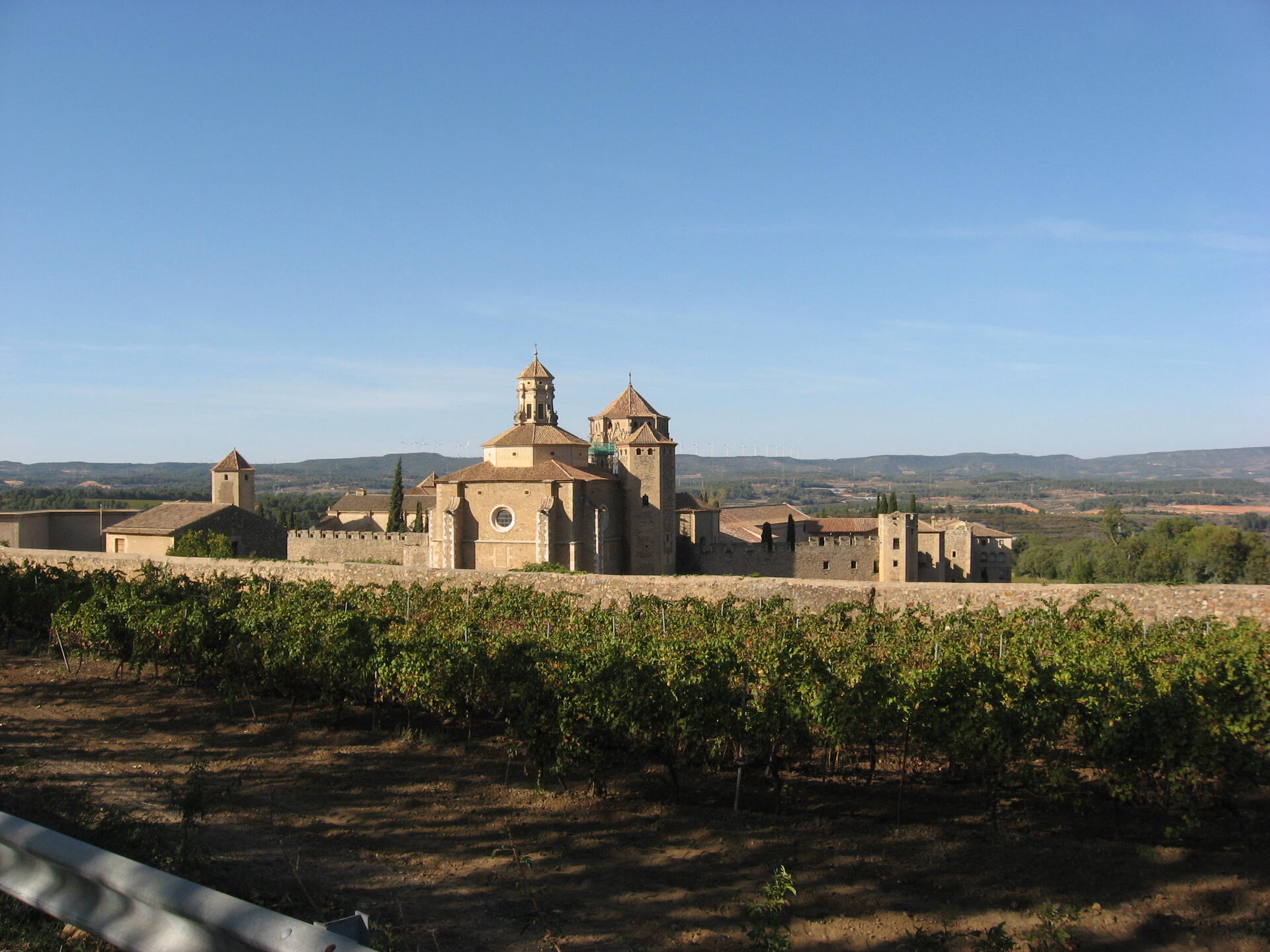
© Sergi Esteve (sel_commons), CC BY-SA 3.0 Resized from original. (This derivative is under the same CC BY-SA license.)
World Heritage Research
Discover scientific research and academic studies that deepen our understanding of Poblet Monastery from its history and significance to its conservation, management, and contemporary challenges.
-
Food and Monastic Space: From Routine Dining to Sacred Worship—Comparative Review of Han Buddhist and Cistercian Monasteries Using Guoqing Si and Poblet Monastery as Detailed Case Studies
Monastic dining rituals and food regulations shape the spatial organization, layout, and sanctity of monastic sites. This comparative study of Guoqing Si (Han Buddhist) and Poblet Monastery (Cistercian) reveals how food taboos, self-sufficiency, and labor practices influence the distinction between sacred and secular spaces. Both monasteries developed sustainable agri-food systems, integrating food production, waste management, and water utilization into their routines. The research employs anthropology and architectural analysis to demonstrate that ordinary meals occur in extraordinary dining spaces, transforming daily rituals into acts of worship. Food taboos, rooted in religious concepts of purity, further establish a distinct spatial order, ensuring sustainable and sacred monastic environments.
Wang, W. (2024). Food and Monastic Space: From Routine Dining to Sacred Worship—Comparative Review of Han Buddhist and Cistercian Monasteries Using Guoqing Si and Poblet Monastery as Detailed Case Studies. Religions, 15(2), 217. https://doi.org/10.3390/rel15020217
View Publication Record | Read Publication -
El Panteón Real de Poblet. Afirmación de la monarquía e innovación artística
The Royal Pantheon of Poblet, commissioned by King Pedro IV the Ceremonious in 1340, stands as a testament to the political and artistic ambition of the Aragonese monarchy. This monumental project, designed to affirm the dynasty's power and prestige, brought together some of the finest artists of the time, including Norman sculptor Aloy de Montbray, who introduced Parisian stylistic influences. The pantheon not only served as a burial site for prominent figures like Alfonso II el Casto and Jaime I the Conqueror but also emerged as a hub of artistic innovation in the Crown of Aragon. Through an analysis of historical records and artistic contributions, this study highlights how the pantheon's design and execution reflected the monarchy's desire to project strength and legitimacy during a period of political decline.
Liaño Martínez, E. (2023). El Panteón Real de Poblet. Afirmación de la monarquía e innovación artística. Loci Sepulcrales, 3–44. https://doi.org/10.1484/m.tema-eb.5.136960
View Publication Record | Read Publication -
Teología moral y justicia eclesiástica en los delitos de palabra: Cataluña (siglos XVI-XVIII)
Scholastic theological doctrine, particularly that of Saint Thomas Aquinas, significantly shaped the categorization of sins of speech and influenced pastoral practices, clerical strategies for eradicating evil speech, and legal proceedings in 16th-18th century Catalonia. The study reveals how these teachings impacted civil and canonical law, especially in cases of insult, within the jurisdiction of Poblet Monastery, a prominent Cistercian monastery. Researchers analyzed moralist works from Castilian and Catalan authors to assess the doctrine's influence on daily pastoral practices and legal strategies. By examining court records and ecclesiastical proceedings, the study provides insights into the intersection of religious doctrine, moral philosophy, and legal practice during this period.
Gelabertó-Vilagran, M. (2022). Moral Theology and Ecclesiastical Justice in the Crime of Speech: Catalonia (16th-18th Centuries). Memoria Y Civilización, 25, 347–376. https://doi.org/10.15581/001.25.007
View Publication Record | Read Publication -
Los libros de D. Pedro Antonio de Aragón (1611-1690) en la Biblioteca del Palacio de Peralada
A significant portion of the Peralada Palace Library, one of Catalonia's most notable collections, was preserved through the legacy of D. Pedro Antonio de Aragón (1611-1690) to Poblet Monastery. This library, assembled by the Rocabertí brothers, remained intact at Poblet for over two centuries before being confiscated during Spain's Liberal Triennium (1820-1823). The study sheds light on this historical collection, detailing its significance and the devastating impact of the Desamortización Law, which led to the spoilage or dispersal of a substantial part of its holdings. The research methodically catalogs and analyzes the surviving books, offering insights into the library's composition and its cultural importance.
Padrosa Gorgot, I. (2021). The books of D. Pedro Antonio de Aragón (1611-1690) in Peralada’s Palace Library. Revista General de Información Y Documentación, 31(1), 149–178. https://doi.org/10.5209/rgid.77086
View Publication Record | Read Publication -
Comparative Review of Worship Spaces in Buddhist and Cistercian Monasteries: The Three Temples of Guoqing Si (China) and the Church of the Royal Abbey of Santa Maria de Poblet (Spain)
A comparative analysis of worship spaces in Buddhist and Cistercian monasteries reveals significant architectural similarities despite their distinct religious, cultural, and constructional backgrounds. The study focuses on the Three Temples of Guoqing Si (China) and the Church of the Royal Abbey of Santa Maria de Poblet (Spain), highlighting two fundamental parallels: both worship spaces derive from imperial prototypes, hold priority in construction, occupy central positions within their respective sacred venues, and serve as foundational references for monastic layout. Additionally, they share a similar programmed functional layout, including analogous space dominators and itineraries. While surface similarities abound, the research further explores three key differences rooted in differing conceptions of deities, worship practices, and spatial relationships with divine figures. The study leverages field research and firsthand experience of monastic life to draw these insights, offering a nuanced understanding of how worship spaces mediate interactions between deities, monks, and pilgrims.
Wang, W. (2021). Comparative Review of Worship Spaces in Buddhist and Cistercian Monasteries: The Three Temples of Guoqing Si (China) and the Church of the Royal Abbey of Santa Maria de Poblet (Spain). Religions, 12(11), 972. https://doi.org/10.3390/rel12110972
View Publication Record | Read Publication -
Tiempo y espacio : Investigación sobre el espacio monástico a través de la vida en los monasterios budistas y cistercienses = Time and space : Research on Monastic Space through Monks' Life in Buddhist and Cistercian Monasteries
A new architectural design theory, 'Patch in time and space,' emerges from the parallel analysis of 20 Han Buddhist monasteries in Southern China and 20 Cistercian monasteries in Western Europe. This study reveals a unique Space-time Pattern adopted by monks, demonstrating how they perceive time through layout pragmatism, space integrity, and route continuity. The research challenges traditional views on architecture by conceptualizing monastic space as an integral part of self-sufficient and self-sustained monastic life. It explores the translation of monastic rules into ideal layouts and construction principles, using database-assisted field research methods and comparative analysis with graphical presentation. Notably, the in-depth comparison of Guoqing Si and Poblet Monastery highlights the transformation of wilderness into a heavenly-like sanctuary, offering valuable insights for architects and scholars seeking a constant core of architecture that transcends superficial differences.
Wang, W. Tiempo y espacio : Investigación sobre el espacio monástico a través de la vida en los monasterios budistas y cistercienses = Time and space : Research on Monastic Space through Monks’ Life in Buddhist and Cistercian Monasteries. https://doi.org/10.20868/upm.thesis.68991
View Publication Record | Read Publication -
Nonlinear Numerical Modeling of Complex Masonry Heritage Structures Considering History-Related Phenomena in Staged Construction Analysis and Material Uncertainty in Seismic Assessment
A novel numerical approach reveals how historical masonry structures, such as the Mallorca Cathedral and Poblet Monastery's church, develop deformations and cracks due to long-term strain accumulation, architectural alterations, seismic activity, and material uncertainty. The study combines a constitutive model for time-dependent behavior with crack-tracking techniques, enabling staged construction analysis that explains current structural conditions. Probabilistic analysis further assesses seismic vulnerability by accounting for uncertainties in material properties. This method offers a robust framework for diagnosing and preserving complex heritage structures.
Saloustros, S., Pelà, L., & Roca, P. (2020). Nonlinear Numerical Modeling of Complex Masonry Heritage Structures Considering History-Related Phenomena in Staged Construction Analysis and Material Uncertainty in Seismic Assessment. Journal of Performance of Constructed Facilities, 34(5). https://doi.org/10.1061/(asce)cf.1943-5509.0001494
View Publication Record | Read Publication