World Heritage Identification Number: 344
World Heritage since: 1985
Category: Cultural Heritage
WHE Type: Archaeological Sites
Transboundary Heritage: No
Endangered Heritage: No
Country: 🇫🇷 France
Continent: Europe
UNESCO World Region: Europe and North America
Map
The Pont du Gard: A Remarkable Roman Engineering Marvel
The Pont du Gard, a remarkable testament to the engineering prowess of the ancient Romans, stands amid the landscapes of southern France. This monumental structure, built in the middle of the first century AD, forms the most spectacular surviving section of the aqueduct that supplied water to the Roman city of Nemausus, modern-day Nîmes. In recognition of its exceptional preservation, historical significance, and architectural importance, the Pont du Gard was inscribed on UNESCO's World Heritage List in 1985.
The Pont du Gard spans the Gardon River near the picturesque village of Vers-Pont-du-Gard. Rising to approximately 48.8 meters and extending about 275 meters at its upper level today, the aqueduct bridge consists of three tiers. The upper level originally extended for approximately 360 meters, but its length was reduced by the destruction of twelve arches. The bridge's design is a remarkable achievement of Roman architecture and hydraulic engineering, demonstrating the builders' sophisticated understanding of surveying, structural design, and water management.
One of the most striking features of the Pont du Gard is its innovative use of arches. The monument has 52 surviving arches distributed across its three levels: six on the lowest level, eleven on the middle level, and 35 on the upper level. The upper level originally contained 47 arches, but twelve have since been lost. The arches are supported by massive piers constructed primarily from locally quarried limestone. Their carefully calculated arrangement allowed the aqueduct to cross the Gardon valley while supporting the water channel at the required elevation. The principal arch on the lowest level, spanning approximately 24.5 meters, was particularly important in allowing the river's waters to pass beneath the monument.
Another noteworthy aspect of the Pont du Gard is the broader water-management system of which it formed a part. The Nîmes aqueduct extended for approximately 50 kilometers, carrying water from the Eure spring near Uzès to Nîmes. At its peak, the system could deliver an estimated 30,000 to 40,000 cubic meters of water per day, providing the growing Roman city with a substantial and reliable supply.
The system relied on gravity rather than pumps: Roman engineers designed an exceptionally gentle and carefully controlled gradient—averaging roughly 25 centimeters per kilometer—to allow water to flow continuously toward the city. Along its route, the aqueduct incorporated tunnels, bridges, and other structures that enabled it to follow the natural terrain while maintaining the necessary gradient. The Pont du Gard itself provided the monumental bridge section required to carry the channel across the Gardon valley.
The construction of the aqueduct required extraordinary precision. The water channel, or specus, was carried along the top of the Pont du Gard and carefully designed to convey water by gravity. Along the roughly 50-kilometer route, Roman engineers had to maintain a remarkably consistent downward gradient despite the area's varied terrain. They used surveying techniques, tunnels, bridges, and carefully constructed channels to negotiate hills and valleys while keeping the water moving steadily toward the city. The Pont du Gard represents the most spectacular surviving section of this larger engineering system.
The aqueduct supplied Nîmes for approximately five centuries before being abandoned at the beginning of the sixth century, following centuries of declining maintenance and the gradual deterioration of the water system. The Pont du Gard, however, continued to have a practical role long after the water stopped flowing. Its lower level was adapted to accommodate traffic crossing the Gardon, helping to preserve the structure through the medieval and early modern periods. Over the centuries, the monument also attracted the attention of travelers, scholars, and antiquarians, contributing to its recognition as an important surviving example of Roman engineering.
The monument's survival is therefore the result not only of its exceptional Roman construction but also of centuries of reuse, maintenance, and conservation. Restoration and preservation efforts have sought to protect its masonry while respecting its historical character. Today, the Pont du Gard forms part of a protected cultural and natural landscape and serves both as a major archaeological monument and as an enduring example of Roman water engineering. Its survival allows visitors to appreciate not merely the beauty of the structure itself, but also the remarkable infrastructure and technical knowledge that made it possible.
Today, the Pont du Gard continues to captivate visitors with its imposing scale, architectural elegance, and historical significance. As one of the finest surviving monuments of Roman hydraulic engineering, it stands as a powerful testament to the ancient past and an enduring part of Europe's shared cultural heritage. Whether admired from a distance or explored up close, the site offers a remarkable glimpse into the extraordinary achievements of Roman engineers.
UNESCO Description of the World Heritage Site
The Pont du Gard was built shortly before the Christian era to allow the aqueduct of Nîmes (which is almost 50 km long) to cross the Gard river. The Roman architects and hydraulic engineers who designed this bridge, which stands almost 50 m high and is on three levels – the longest measuring 275 m – created a technical as well as an artistic masterpiece.UNESCO Justification of the World Heritage Site
Criterion (i): The Pont du Gard is a masterpiece of Roman technique and an outstanding artistic achievement which, by its presence, transfigures the landscape.
Criterion (iii): An exceptional building in the series of Roman aqueduct works, the Pont du Gard bears unique witness to the technique of Roman engineers and builders in the service of urban and territorial development, which is one of the characteristics of this civilization.
Criterion (iv): The Pont du Gard is one of the most representative works of the construction processes of the Roman imperial era.
Encyclopedia Record: Pont du Gard
The Pont du Gard is an ancient Roman aqueduct bridge built in the first century AD to carry water over 50 km (31 mi) to the Roman colony of Nemausus (Nîmes). It crosses the river Gardon near the town of Vers-Pont-du-Gard in southern France. The Pont du Gard is one of the best preserved Roman aqueduct bridges. It was added to UNESCO's list of World Heritage sites in 1985 because of its exceptional preservation, historical importance, and architectural ingenuity.Additional Site Details
Area: 0.3257 hectares
Number of Components: 1
(iii) — Unique or exceptional testimony to a cultural tradition
(iv) — Outstanding example of a type of building or landscape
Coordinates: 43.94722222 , 4.535277778
Image
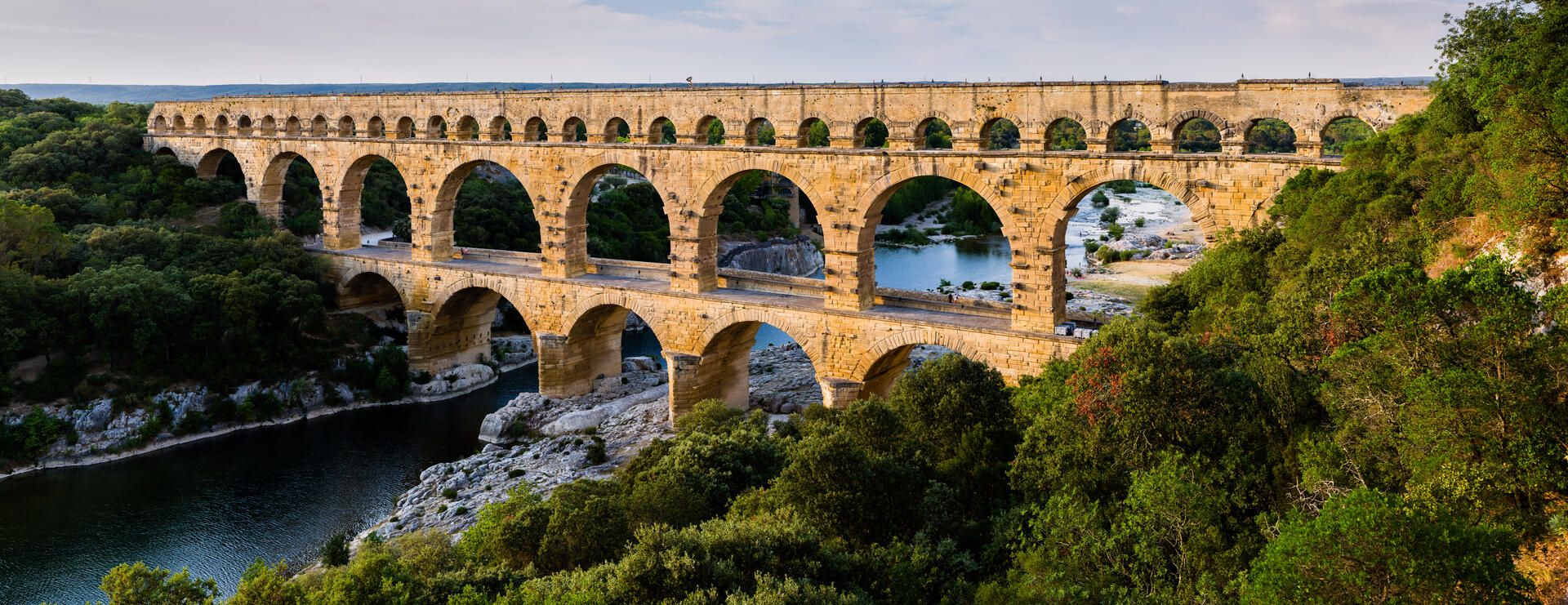
© Benh LIEU SONG (Flickr), CC BY-SA 3.0 Resized from original. (This derivative is under the same CC BY-SA license.)
World Heritage Research
Discover scientific research and academic studies that deepen our understanding of Pont du Gard (Roman Aqueduct) from its history and significance to its conservation, management, and contemporary challenges.
-
Footbridge in History
Footbridges, including the UNESCO-listed Pont du Gard (Roman Aqueduct), serve as cultural and historical symbols that integrate with their surrounding landscapes. This study highlights how these structures embody the 'genius loci'—the unique spirit of a place—through their ties to history, events, and intangible heritage. Unlike conventional views of bridges as mere functional or aesthetic objects, this research demonstrates their role in shaping cultural narratives, from ancient Roman aqueducts to medieval 'Devil's Bridges,' war-rebuilt structures like Mostar Bridge, and modern interventions such as Istanbul's requalified aqueducts and Venice's Calatrava Bridge. The analysis underscores how footbridges bridge not only physical spaces but also temporal and symbolic dimensions, reflecting the dynamic interplay between architecture, landscape, and human experience.
Siviero, E. (2022). Footbridge in History. Footbridge 2022, Madrid: Creating Experience. https://doi.org/10.24904/footbridge2022.152
View Publication Record | Read Publication -
Monitoring of the rock mass deformation under the Pont du Gard pier VII foundation
A long-term monitoring study of the Pont du Gard, a Roman aqueduct built around 50 AD to supply water to Nîmes (France), revealed that rock mass deformation under pier VII is influenced by both atmospheric temperature variations and water temperature changes during river floods. The research involved instrumenting two rock bolts in the foundation and tracking their movements over several years. While seasonal thermal effects were dominant, localized deformations correlated with flood events, suggesting dynamic interactions between the aqueduct's structure and hydrological conditions. This finding underscores the need for nuanced monitoring of World Heritage Sites to account for both climatic and environmental factors.
Serratrice, J. F. (2022). Monitoring of the rock mass deformation under the Pont du Gard pier VII foundation. Geotechnical Engineering for the Preservation of Monuments and Historic Sites III, 469–480. https://doi.org/10.1201/9781003308867-32
View Publication Record | Read Publication -
Roman Hydraulic Engineering: The Pont du Gard Aqueduct and Nemausus (Nîmes) Castellum
A new analysis of the Pont du Gard aqueduct's terminal water distribution castellum reveals that Roman engineers employed advanced hydraulic principles to optimize water flow. By applying modern critical flow theory, researchers discovered that the 10 basin wall pipelines were designed to maximize output flow rates while closely matching the input from the aqueduct. The three drainage floor ports further fine-tuned this balance, demonstrating a sophisticated integration of engineering and aesthetics typical of Roman values. This study bridges the gap between descriptive archaeological accounts and the underlying engineering knowledge, offering unprecedented insights into Roman hydraulic innovation.
Ortloff, C. R. (2020). Roman Hydraulic Engineering: The Pont du Gard Aqueduct and Nemausus (Nîmes) Castellum. Water, 13(1), 54. https://doi.org/10.3390/w13010054
View Publication Record | Read Publication -
The Pont du Gard and the aqueduct of Nîmes
The Pont du Gard, a Roman aqueduct spanning 50 kilometers from its source near Uzes to Nîmes, remains notable for its engineering precision and historical significance. This structure, part of the Nîmes aqueduct system, demonstrates the Romans' advanced ability to channel water with minimal slope (6 meters over 34 kilometers). The aqueduct's design reflects evolutionary changes in Roman bridge construction, including a shift toward more regular and rational use of concrete. Despite its frequent documentation, the Pont du Gard lacks a confirmed date, leaving its exact historical placement uncertain. The study highlights its architectural details, composition, and the extensive pictorial records housed in the Musée de Vieux Nîmes, offering insights into Roman engineering practices.
Smith, N. A. F. (2017). The Pont du Gard and the aqueduct of Nîmes. Masonry Bridges, Viaducts and Aqueducts, 35–58. https://doi.org/10.4324/9781315249513-3
View Publication Record | Read Publication -
Nemausus
Nemausus, originally a Celtic settlement and later a significant Roman city in Gallia Narbonensis (modern Nîmes), emerged as a rival to Narbo, becoming one of the most successful urban centers in Roman Gaul. By 28 BCE, it was established as a *colonia Latina, hosting an important mint and expanding its walls to enclose approximately 220 hectares. The city's prominence is underscored by its architectural marvels, including an amphitheater, a precinct dedicated to Deus Nemausus, and the iconic Maison Carrée temple, later dedicated to Julius Caesar. Additionally, the Pont-du-Gard aqueduct, part of its extensive water infrastructure, stands as a testament to Roman engineering. Nemausus produced notable figures, including ancestors of Emperor Antoninus Pius, reflecting its enduring cultural and economic influence.
Drinkwater, J. F. (2016). Nemausus. Oxford Classical Dictionary. https://doi.org/10.1093/acrefore/9780199381135.013.4368
View Publication Record | Read Publication -
Lessons from a lost technology: The secrets of Roman concrete
Roman concrete, renowned for its durability and use in iconic structures like the Pont du Gard aqueduct and the Colosseum, harbors a hidden secret: the mineral al-tobermorite. This discovery, detailed by Jackson et al. (2013), reveals that Roman seawater concrete undergoes a unique chemical process over time, forming this stable mineral which enhances its longevity. The study analyzed samples from 11 ancient Mediterranean harbors, part of the ROMACONS project (2002-2009), demonstrating how Roman engineers leveraged volcanic ash and seawater to create a material that defies modern concrete's typical degradation. This insight offers potential for developing more resilient, long-lasting infrastructure materials today.
Elsen, J., Cizer, O., & Snellings, R. (2013). Lessons from a lost technology: The secrets of Roman concrete. American Mineralogist, 98(11-12), 1917–1918. https://doi.org/10.2138/am.2013.4643
View Publication Record | Read Publication