World Heritage Identification Number: 164
World Heritage since: 1981
Category: Cultural Heritage
WHE Type: Archaeological Sites
Transboundary Heritage: No
Endangered Heritage: No
Country: 🇫🇷 France
Continent: Europe
UNESCO World Region: Europe and North America
Map
Arles, Roman and Romanesque Monuments: A Blend of Ancient and Medieval Architecture
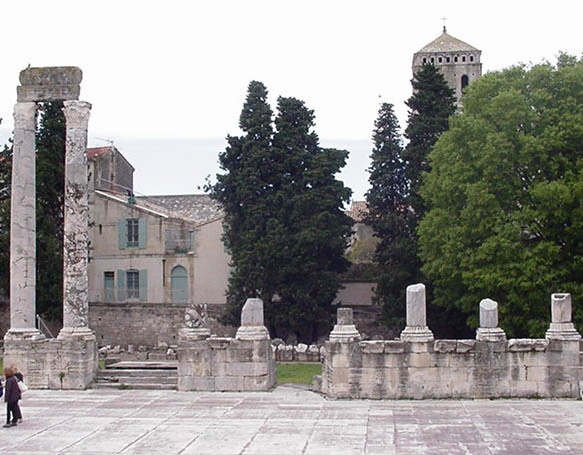
The Arles, Roman and Romanesque Monuments, located in the heart of the picturesque city of Arles, France, is a remarkable testament to the rich history and cultural evolution of this ancient settlement. Designated as a UNESCO World Heritage Site in 1981, this site offers a unique blend of Roman and Romanesque architecture, showcasing the city's transformation from an important Roman colony to a significant center of medieval European civilization.
More to come…UNESCO Description of the World Heritage Site
Arles is a good example of the adaptation of an ancient city to medieval European civilization. It has some impressive Roman monuments, of which the earliest – the arena, the Roman theatre and the cryptoporticus (subterranean galleries) – date back to the 1st century B.C. During the 4th century Arles experienced a second golden age, as attested by the baths of Constantine and the necropolis of Alyscamps. In the 11th and 12th centuries, Arles once again became one of the most attractive cities in the Mediterranean. Within the city walls, Saint-Trophime, with its cloister, is one of Provence's major Romanesque monuments.
UNESCO Justification of the World Heritage Site
Criterion (ii): The Cathedral of Saint-Trophime, together with its cloister, ranks among the major monuments of Provençal Romanesque art. Its influence was considerable in the 12th and 13th centuries across the Mediterranean world.
Criterion (iv): Arles, with its Roman and Romanesque monuments, stands as a particularly significant example of how an ancient city was adapted to medieval European civilization.
Encyclopedia Record: Arles, Roman and Romanesque Monuments
Arles, Roman and Romanesque Monuments is an area containing a collection of monuments in the city centre of Arles, France, that has been listed as a UNESCO World Heritage Site since 1981.Additional Site Details
Area: 65 hectares
Number of Components: 1
(iv) — Outstanding example of a type of building or landscape
Coordinates: 43.67763889 , 4.630694444
World Heritage Research
Discover scientific research and academic studies that deepen our understanding of Arles, Roman and Romanesque Monuments from its history and significance to its conservation, management, and contemporary challenges.
-
Caesarius of Arles, Sermons 53 and 54
Caesarius of Arles, a prominent figure in early Christian history, emerged as a pivotal bishop and religious leader whose influence extended across Gaul. Born around 470 in Chalons-sur-Saône, he transitioned from monastic life to become the abbot of Trinquetaille before succeeding Aeonius as bishop of Arles. His tenure was marked by political involvement amid conflicts between the Visigoths, Franks, and Gallo-Romans. In 514, Pope Symmachus recognized him as metropolitan and papal vicar for Gaul, solidifying his role in the Gallic Church. Caesarius's legacy is further cemented by his leadership at significant synods, including the Council of Orange in 529, where he played a key role in shaping theological doctrine, particularly regarding grace, aligning with a modified Augustinian position.
DelCogliano, M. (2025). Caesarius of Arles, Sermons 53 and 54. The Cambridge Edition of Early Christian Writings, 554–563. https://doi.org/10.1017/9781107449657.030
View Publication Record | Read Publication -
The Roman Water Management of Arles as Read in Aqueduct Carbonate Archives
Anthropogenic carbonate deposits within the Roman aqueduct of Arles reveal a dynamic history of water management, including changes in water source provenance and structural modifications. The study identifies that the aqueduct initially relied on water from the Caparon tributary, which was later diverted to power mills at Barbegal. Subsequently, the Eygalières branch became the primary water source, transforming the basin into a distribution structure. Stable isotope analysis of carbonate incrustations also indicates a significant cleaning effort in the early fourth century. This research demonstrates that carbonate archives can provide critical insights into the evolution and functionality of ancient aqueduct systems.
Sürmelihindi, G., Passchier, C., Wilson, A., & Spötl, C. (2025). The Roman Water Management of Arles as Read in Aqueduct Carbonate Archives. Geoarchaeology, 40(4). Portico. https://doi.org/10.1002/gea.70020
View Publication Record | Read Publication -
The Rock of Arles
The Rock of Arles, a limestone eminence with a 2,600-year history, serves as a testament to the city's complex past, from Roman conquest to modern French democracy. This study uniquely frames Arlesian history through the lens of its 'genius loci,' revealing a narrative rich in radical thought and dissent. It resurrects the memories of three largely forgotten figures—Hellenistic philosopher Favorinus, medieval Hebrew poet Kalonymus ben Kalonymus, and subversive aristocrat Pierre-Antoine Antonelle—who represent freethinking currents that challenged reactionary forces dominating the city for fifteen centuries. The approach blends erudition with wit, offering a contrarian perspective on European history while hinting at Arles' potential future. This work stands out for its innovative narrative style and deep historical insight.
Klein, R. (2024). The Rock of Arles. https://doi.org/10.1215/9781478027850
View Publication Record | Read Publication -
Systematic sourcing of granite shafts from Gallia Narbonensis and comparison with other western Mediterranean areas
A systematic analysis of granite shafts from the ancient region of Gallia Narbonensis reveals that 75% originated in Turkey, with smaller contributions from Elba (20.5%), Aswan, Sardinia, and Corsica. Using non-invasive techniques like magnetic susceptibility and chemical analysis, researchers identified at least 174 original shafts among 276 fragments across 21 localities, with four key sites accounting for 54% of the corpus. Portable X-ray fluorescence resolved ambiguities between Corsican and Egyptian granites by measuring strontium (Sr) and rubidium (Rb) contents. While most shafts date to medieval or modern contexts, the findings suggest long-distance transport may have occurred after Roman times, complicating interpretations of ancient trade patterns.
Rochette, P., Ambrosi, J. P., Amraoui, T., Andrieu, V., Badie, A., Borgard, Ph., Gattacceca, J., Hartmann-Virnich, A., Panneau, M., & Planchon, J. (2022). Systematic sourcing of granite shafts from Gallia Narbonensis and comparison with other western Mediterranean areas. Journal of Archaeological Science: Reports, 42, 103372. https://doi.org/10.1016/j.jasrep.2022.103372
View Publication Record | Read Publication -
Ruricius of Limoges, Caesarius of Arles, and Council of Agde 506
The Council of Agde, held in 506 under the leadership of Bishop Caesarius of Arles, was convened by Visigothic King Alaric II to strengthen unity among the former Roman provinces amid external threats. This historic event, attended by over thirty Gallic clergy representatives, resulted in forty-seven canons addressing Church discipline. Analysis of the Council's resolutions and the correspondence between Caesarius and Ruricius of Limoges reveals the hierarchical dynamics within the Christian clergy, where seniority of see and social status influenced relationships. The study highlights the interplay between secular and spiritual authorities during this period, offering insights into the political and religious landscape of early medieval Europe.
Litovchenko, E. (2022). Ruricius of Limoges, Caesarius of Arles, and Council of Agde 506. St. Tikhons’ University Review, 109, 9–26. https://doi.org/10.15382/sturii2022109.9-26
View Publication Record | Read Publication -
Reconfiguring Civic Identity and Civic Participation in a Christianizing World. The Case of Sixth-Century Arles
In sixth-century Arles, Christian identity and civic participation were redefined through the lens of ancient Roman terminology. This study reveals that Caesarius of Arles, a prominent bishop, employed Latin civic vocabulary—such as civis, civitas, and patria—but infused these terms with new Christian meanings, shaping civic life around religious values. The analysis of his sermons demonstrates how post-Roman authors maintained continuity in language while adapting its semantic content to reflect the evolving political and spiritual landscape of early medieval Europe. This research highlights the dynamic interplay between tradition and transformation during a pivotal period of societal change.
Rose, E. (2021). Reconfiguring Civic Identity and Civic Participation in a Christianizing World. The Case of Sixth-Century Arles. Civic Identity and Civic Participation in Late Antiquity and the Early Middle Ages, 271–294. https://doi.org/10.1484/m.celama-eb.5.123824
View Publication Record | Read Publication -
Carmenin the Midi Amphitheatres: A ‘Tauro-Comique’ Spectacle
Hybrid spectacles blending opera and bullfighting, termed 'opéra tauro-comique,' emerged in the Roman amphitheatres of Arles and Nîmes during the Third Republic, democratizing cultural experiences. These performances, combining Bizet's Carmen with live corridas, were a popular attraction from 1899 to 1981, particularly at Whitsun ferias. The study examines how these spectacles articulated disparate elements of opera and bullfighting, challenging perceptions of Spanish local color and ritualistic violence while fostering a shared meridional identity. Audience reactions and the cultural significance of this fusion are explored through historical analysis.
Lardic, S. T. (2020). Carmenin the Midi Amphitheatres: A ‘Tauro-Comique’ Spectacle. ≪I>Carmen Abroad, 335–349. https://doi.org/10.1017/9781108674515.021
View Publication Record | Read Publication