World Heritage Identification Number: 1569
World Heritage since: 2023
Category: Cultural Heritage
WHE Type: Archaeological Sites
Transboundary Heritage: No
Endangered Heritage: No
Country: 🇫🇷 France
Continent: Europe
UNESCO World Region: Europe and North America
Map
The Maison Carrée of Nîmes: A Symbol of Imperial Worship and Architectural Mastery
The Maison Carrée of Nîmes, inscribed as a UNESCO World Heritage Site in 2023, stands as a testament to the architectural prowess and cultural influence of the Roman Empire. Situated in the heart of the modern-day city of Nîmes, in the Occitanie region of France, this ancient edifice offers a unique glimpse into the Roman colonial past.
More to come…UNESCO Description of the World Heritage Site
Built in the 1st century AD in the Roman colony of Nemausus – today’s city of Nîmes in the Occitanie region– the Maison Carrée is one of the earliest examples of a Roman temple which can be connected to the imperial worship in the provinces of Rome. Dedicated to the presumptive heirs of Augustus, the princes of Youth, prematurely deceased, this building confirmed the control of Rome on the conquered territory while expressing in a symbolic way the allegiance and attachment of the people from the city of Nemausus to Augustus’ dynasty. The architecture of the Maison Carrée and its sophisticated decoration took part, symbolically, in the dissemination of Augustus ideologic program which turned the Ancient Rome from republic to empire, thus opening a new golden age bearer of promises of peace, prosperity and stability known by the name of Pax Romana.
UNESCO Justification of the World Heritage Site
Criterion (iv): The Maison Carrée is an early and one of the best-preserved examples of a Roman temple dedicated to the imperial cult in the Roman provinces that testifies to the period of Rome’s transition from republic to empire, reflecting the political system and the imperial ideology that underlay the process of consolidation of the territory conquered by Ancient Rome in the hands of Augustus. Through the historical circumstances of its construction in the Roman colony of Nemausus, its ideological significance as a place of imperial cult, as well as the symbolic architectural and decorative programme, the edifice manifests the values brought to the Roman Empire by Pax Romana.
Encyclopedia Record: Maison carrée
The Maison carrée is an ancient Roman temple in Nîmes, southern France; it is one of the best-preserved Roman temples to survive in the territory of the former Roman Empire. It is a mid-sized Augustan provincial temple of the Imperial cult, a caesareum.Additional Site Details
Area: 0.0474 hectares
Number of Components: 1
Coordinates: 43.8382222222 , 4.3561944444
Image
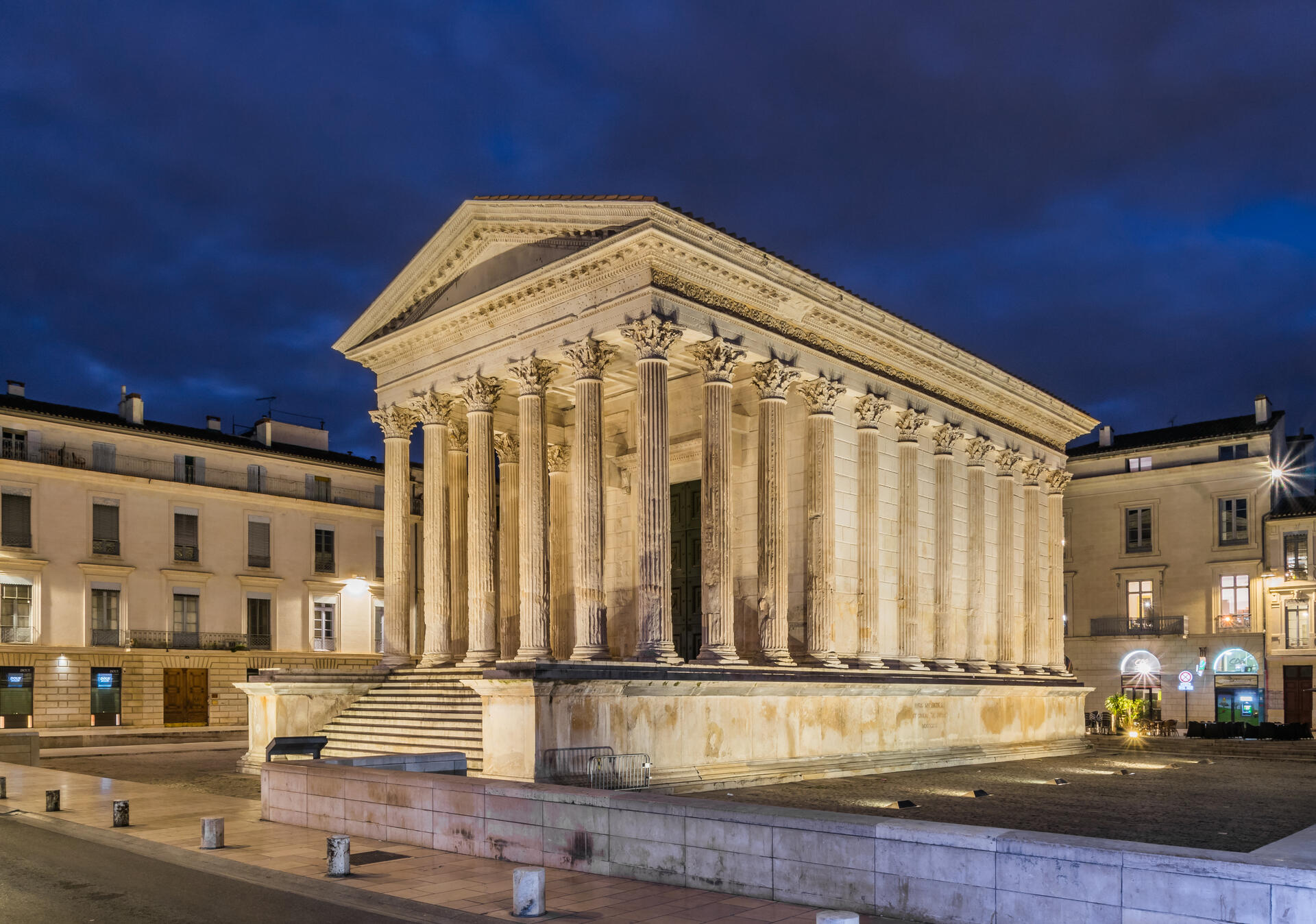
© Krzysztof Golik, CC BY-SA 4.0 Resized from original. (This derivative is under the same CC BY-SA license.)
World Heritage Research
Discover scientific research and academic studies that deepen our understanding of The Maison Carrée of Nîmes from its history and significance to its conservation, management, and contemporary challenges.
-
Benchmarking Tree-Inspired-Fractal Branching Dendriform Structures From BC to L-System Based Contemporary Structures
Contrary to expectations, dendriform structures—inspired by fractal branching patterns found in nature—are not more complex today than they were in ancient times. A study benchmarking historical and contemporary architectural designs revealed that modern parametric tools, while sophisticated, do not necessarily produce more intricate geometric compositions than those observed in classical structures like the Maison Carrée of Nîmes or the Sagrada Familia. Researchers analyzed plans and column head views using FracLac software, applying fractal analysis to compare Euclidean geometry from hand-drawn environments to digital CAD models. The findings challenge the notion that contemporary parametric design tools inherently lead to greater complexity, suggesting instead a continuity in geometric sophistication across millennia.
Kökçam, Z. G., Şahin, M., & Gülten, A. (2025). Benchmarking Tree-Inspired-Fractal Branching Dendriform Structures From BC to L-System Based Contemporary Structures. Turkish Journal of Science and Technology, 20(1), 193–207. https://doi.org/10.55525/tjst.1555517
View Publication Record | Read Publication -
Chapter 32: 1875, Darboux
Chapter 32 of the publication '1875, Darboux' explores the historical and cultural significance of Nîmes, France, particularly focusing on the Maison Carrée, a Roman monument and UNESCO World Heritage Site. The chapter highlights the city's origins dating back to 6th century BC and its evolution through various historical periods, including Roman colonization, invasions by Vandals and Visigoths, Arab-Muslim rule, and eventual liberation under Pepin III le Bref in 752 AD. It also notes the reunion of Nîmes with the royal domain in 1226 under Louis VIII. The text provides a contextual backdrop to the life of Jean Gaston Darboux, born in Nîmes in 1842, linking his birthplace to the city's rich heritage and its enduring architectural legacy.
(Ed.). (2025). Chapter 32: 1875, Darboux. The Birth and Early Developments of Orthogonal Polynomials, 421–434. https://doi.org/10.1137/1.9781611978513.ch32
View Publication Record | Read Publication -
Des Héraclides aux Caesares . Note sur la continuité des généalogies joviennes à Nemausus
A new analysis reveals that the persistence of Jupiter's cult at Nemausus and the construction of the Maison Carrée temple reflect a deliberate ideological continuity, linking local Heraclidean traditions with imperial Roman lineage. The study identifies systematic efforts to trace an Olympian origin, providing fresh context for the temple's dedication to 'Princes of Youth.' Marble elements from a Doric portico near the Vierne Bridge further confirm this coherence, aligning Nemausus' religious and political landscape with Rome's eastern Forum during the Julio-Claudian era. The research combines archaeological evidence with historical genealogy to redefine the site's significance in Roman cultural integration.
Gros, P. (2025). Des Héraclides aux Caesares . Note sur la continuité des généalogies joviennes à Nemausus. Revue Archéologique, n° 79(2), 339–354. https://doi.org/10.3917/arch.252.0339
View Publication Record | Read Publication -
Chapter XXIX
A detailed exploration of the Maison Carrée, a well-preserved Roman temple located in Nîmes, France, reveals its architectural significance and historical context. The study contrasts its ancient dimensions with modern measurements, highlighting its enduring structure despite centuries of change. It also examines other notable Roman sites in the region, including the Pont-du-Gard aqueduct and the Roman Amphitheatre, providing insights into their design and preservation. The research draws from women's travel writings from Revolutionary France, offering a unique perspective on how these ancient monuments were documented and perceived during a pivotal period in European history.
Bending, S., & Bygrave, S. (2024). Chapter XXIX. Women’s Travel Writings in Revolutionary France, Part II Vol 5, 434–456. https://doi.org/10.4324/9781003577935-30
View Publication Record | Read Publication -
Une politique numérique à dimension artistique et créative (Nîmes)
A digital strategy integrating artistic and creative dimensions has been successfully implemented at the Maison Carrée in Nîmes, France. This approach, developed through the Labo2 initiative since 2003, aimed to modernize public services while preserving cultural heritage. The strategy involved redistributing spaces and collections within the library, which shares a building with the contemporary art museum, the Carré d’Art, designed by Norman Foster. Completed in 2018, this rehabiliation project enhanced accessibility and engagement for visitors, demonstrating how digital innovation can be harmonized with architectural and cultural preservation. The findings highlight the potential of integrating artistic and technological advancements to revitalize historical sites while maintaining their educational and cultural value.
Very-Mathieu, C. (2021). Une politique numérique à dimension artistique et créative (Nîmes). Valoriser et Diffuser Les Arts Numériques En Bibliothèque, 134–142. https://doi.org/10.4000/books.pressesenssib.13880
View Publication Record | Read Publication -
Confronting Vitruvius: a geometric framework and design methodology for Roman rectangular temples
Roman rectangular temples, including the Maison Carrée of Nîmes, were likely designed using a square grid framework rather than adhering strictly to Vitruvius' colonnade-based model. This challenges the long-held assumption that the lower column diameter (D) was the primary module for temple design. Archaeological evidence and geometric analyses of temple-podia from central Italy, Sufetula, and Baelo Claudia support this alternative approach, suggesting that temples were planned relative to a square grid derived from their base proportions. This finding reframes our understanding of Roman architectural methodology, indicating that deviations from Vitruvian principles may stem from practical design choices rather than adjustments or corrections.
Fuchs, W. (2020). Confronting Vitruvius: a geometric framework and design methodology for Roman rectangular temples. Journal of Roman Archaeology, 33, 93–112. https://doi.org/10.1017/s1047759420000938
View Publication Record | Read Publication