World Heritage Identification Number: 1303
World Heritage since: 2009
Category: Cultural Heritage
WHE Type: Infrastructure & Industry
Transboundary Heritage: No
Endangered Heritage: No
Country: 🇬🇧 United Kingdom of Great Britain and Northern Ireland
Continent: Europe
UNESCO World Region: Europe and North America
Map
Pontcysyllte Aqueduct and Canal: A Marvel of Industrial Engineering
The Pontcysyllte Aqueduct and Canal, located in the picturesque Vale of Llangollen in northeastern Wales, stands as a testament to the ingenuity and ambition of the Industrial Revolution. Inscribed as a UNESCO World Heritage Site in 2009, this 18-kilometer long waterway system showcases the harmonious blend of artistic vision, technical prowess, and practical problem-solving that characterized the era.
More to come…UNESCO Description of the World Heritage Site
Situated in north-eastern Wales, the 18 kilometre long Pontcysyllte Aqueduct and Canal is a feat of civil engineering of the Industrial Revolution, completed in the early years of the 19th century. Covering a difficult geographical setting, the building of the canal required substantial, bold civil engineering solutions, especially as it was built without using locks. The aqueduct is a pioneering masterpiece of engineering and monumental metal architecture, conceived by the celebrated civil engineer Thomas Telford. The use of both cast and wrought iron in the aqueduct enabled the construction of arches that were light and d strong, producing an overall effect that is both monumental and elegant. The property is inscribed as a masterpiece of creative genius, and as a remarkable synthesis of expertise already acquired in Europe. It is also recognized as an innovative ensemble that inspired many projects all over the world.
UNESCO Justification of the World Heritage Site
Criterion (i): The Pontcysyllte Aqueduct is a highly innovative monumental civil engineering structure, made using metal arches supported by high, slender masonry piers. It is the first great masterpiece of the civil engineer Thomas Telford and formed the basis of his outstanding international reputation. It bears witness to the production capacities of the British ironmaking industry, which were unique at that time.
Criterion (ii): The intensive construction of canals in Great Britain, from the second half of the 18th century onwards, and that of the Pontcysyllte Canal in particular in a difficult region, bear witness to considerable technical interchanges and decisive progress in the design and construction of artificial waterways.
Criterion (iv): The Pontcysyllte Canal and its civil engineering structures bear witness to a crucial stage in the development of heavy cargo transport in order to further the Industrial Revolution. They are outstanding representatives of its new technical and monumental possibilities.
Encyclopedia Record: Pontcysyllte Aqueduct
The Pontcysyllte Aqueduct is a navigable aqueduct that carries the Llangollen Canal across the River Dee in the Vale of Llangollen in northeast Wales.Additional Site Details
Area: 105 hectares
Number of Components: 1
(ii) — Significant interchange of human values
(iv) — Outstanding example of a type of building or landscape
Coordinates: 52.9702777778 , -3.0877777778
Image
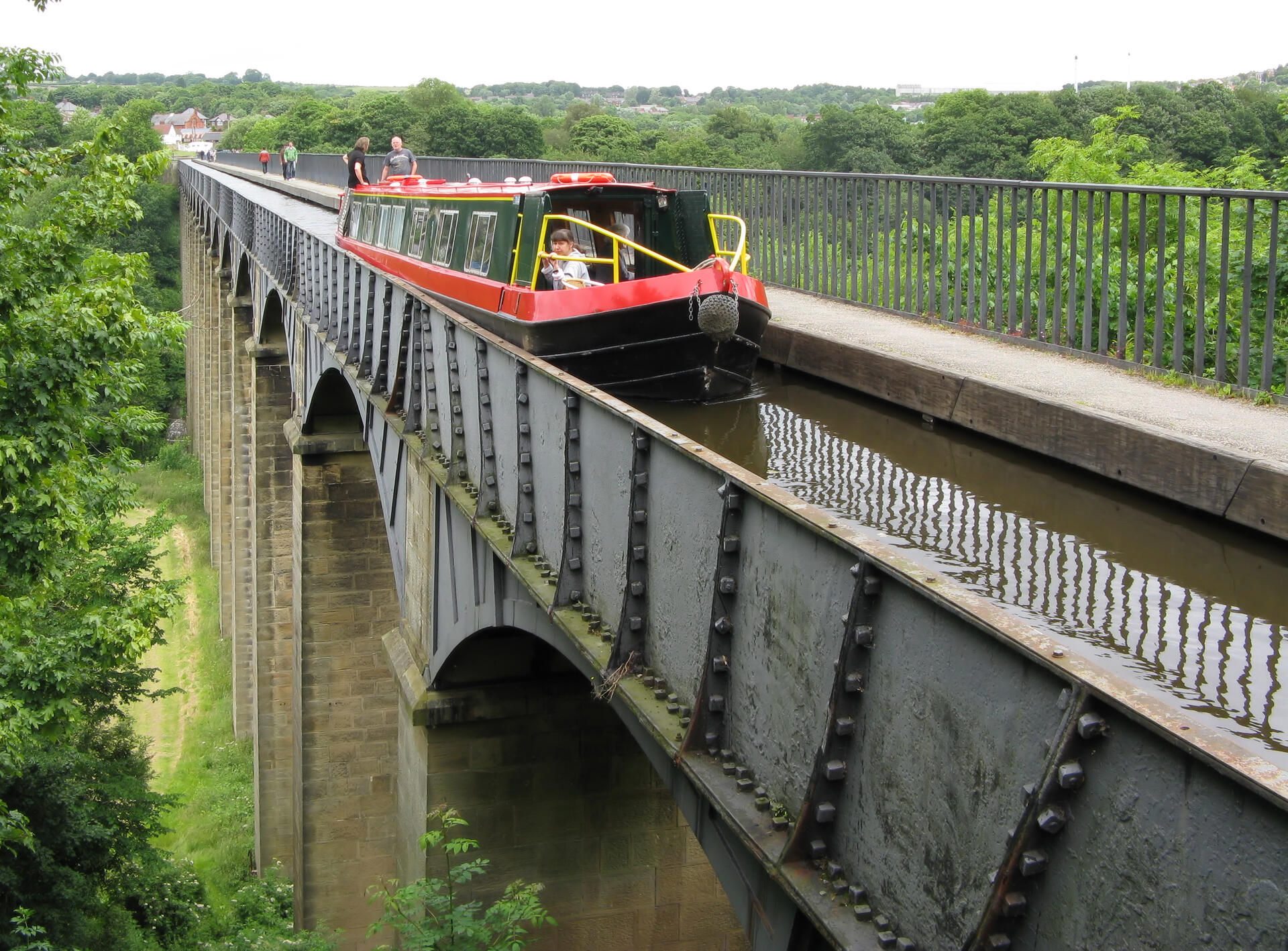
Adrian Pingstone, Public domain
World Heritage Research
Discover scientific research and academic studies that deepen our understanding of Pontcysyllte Aqueduct and Canal from its history and significance to its conservation, management, and contemporary challenges.
-
World Heritage Canal: Thomas Telford and the Pontcysyllte Aqueduct
The Pontcysyllte Aqueduct, designed by Thomas Telford, stands as a testament to engineering innovation during the Industrial Revolution. This study highlights its significance as a UNESCO World Heritage Site, emphasizing its role in transforming transportation and infrastructure in 19th-century Britain. The research examines the aqueduct's construction challenges, such as its elevated height and the use of cast iron, which set new standards for civil engineering. By analyzing historical records and technical documents, the study underscores how Telford's design integrated aesthetic and functional brilliance, influencing canal engineering globally. Its legacy persists in modern infrastructure projects, reflecting enduring principles of sustainability and efficiency.
Falconer, K. (2019). World Heritage Canal: Thomas Telford and the Pontcysyllte Aqueduct. Industrial Archaeology Review, 41(2), 147. https://doi.org/10.1080/03090728.2019.1668611
View Publication Record | Read Publication -
The Pontcysyllte Aqueduct and Canal World Heritage Site
A groundbreaking engineering marvel, the Pontcysyllte Aqueduct and Canal, stands as a testament to 19th-century innovation. This UNESCO World Heritage Site features an elevated aqueduct spanning 30 meters above the Dee Valley, constructed without rivets or bolts, showcasing advanced masonry techniques. The canal system, designed by Thomas Telford and William Jessop, revolutionized waterway transportation in North Wales, enabling efficient movement of goods across challenging terrain. The study highlights its significance as a pioneering example of civil engineering, blending aesthetic design with functional brilliance. Research approaches include historical analysis of construction methods, material science, and the socio-economic impact on regional development.
Gwyn, D. (2017). The Pontcysyllte Aqueduct and Canal World Heritage Site. The International Journal for the History of Engineering & Technology, 87(1), 152. https://doi.org/10.1080/17581206.2017.1325160
View Publication Record | Read Publication -
Pontcysyllte Aqueduct and Canal World Heritage site
The Pontcysyllte Aqueduct and Canal stands as a testament to 19th-century engineering innovation. This publication by Peter Wakelin explores the aqueduct's unique design, which includes a 384-meter-long, 36-meter-high structure that carries boats across the Tredegar Valley without the use of locks or tunnels. The research delves into the canal's historical significance, its construction challenges, and its enduring legacy as a symbol of industrial ingenuity. Wakelin examines the aqueduct's role in transforming transportation and economic development during the Industrial Revolution, while also addressing its preservation and cultural value today. The study combines archival research with engineering analysis to provide a comprehensive understanding of this remarkable feat of civil engineering.
Trinder, B. (2016). Peter Wakelin, Pontcysyllte Aqueduct and Canal: World Heritage Site. Milton Keynes: Canals & River Trust in Wales, in association with The Royal Commission on the Ancient & Historical Monuments of Wales, 2015. 144 pp., illus. isbn 978-1-78461-146-0. £12.50 (includes P&P), payable to Canal & River Trust, addressed to Jenny Rogers, National Waterways Museum, South Pier Road, Ellesmere Port ch64 4fw. Industrial Archaeology Review, 38(1), 76–77. https://doi.org/10.1080/03090728.2016.1156846
View Publication Record | Read Publication -
Repairs to the Llangollen arm of the Shropshire Union Canal
The Llangollen arm, a critical navigable feeder to the Shropshire Union Canal and part of the UNESCO World Heritage Site Pontcysyllte Aqueduct and Canal, has faced persistent structural challenges since its 1805 construction. A study by Peters and Brown (2015) highlights that this section has experienced 20 significant leaks or breaches over two centuries, primarily due to its geotechnically challenging hillside location near the River Dee, a railway line, and a major road. The research documents innovative repair methods employed, including stonewalling, concrete lining, corrugated iron sheets, interlocking steel sheets, asphalt lining, and traditional clay puddling, offering insights into historical civil engineering solutions for water retention in difficult terrains. These findings underscore the arm's complex maintenance history and its significance as a testament to 19th-century engineering ingenuity.
Peters, T. J., & Brown, S. F. (2015). Repairs to the Llangollen arm of the Shropshire Union Canal. Proceedings of the Institution of Civil Engineers - Engineering History and Heritage, 168(4), 150–166. https://doi.org/10.1680/jenhh.15.00007
View Publication Record | Read Publication