World Heritage Identification Number: 1030
World Heritage since: 2001
Category: Cultural Heritage
WHE Type: Infrastructure & Industry
Transboundary Heritage: No
Endangered Heritage: No
Country: 🇬🇧 United Kingdom of Great Britain and Northern Ireland
Continent: Europe
UNESCO World Region: Europe and North America
Map
The Birthplace of Modern Factory System: Derwent Valley Mills
The Derwent Valley Mills, located in central England, hold a significant place in history as they mark the birthplace of the modern factory system. Inscribed as a UNESCO World Heritage Site in 2001, this industrial landscape spanning the River Derwent in Derbyshire, England, offers a unique insight into the early days of the Industrial Revolution.
More to come…UNESCO Description of the World Heritage Site
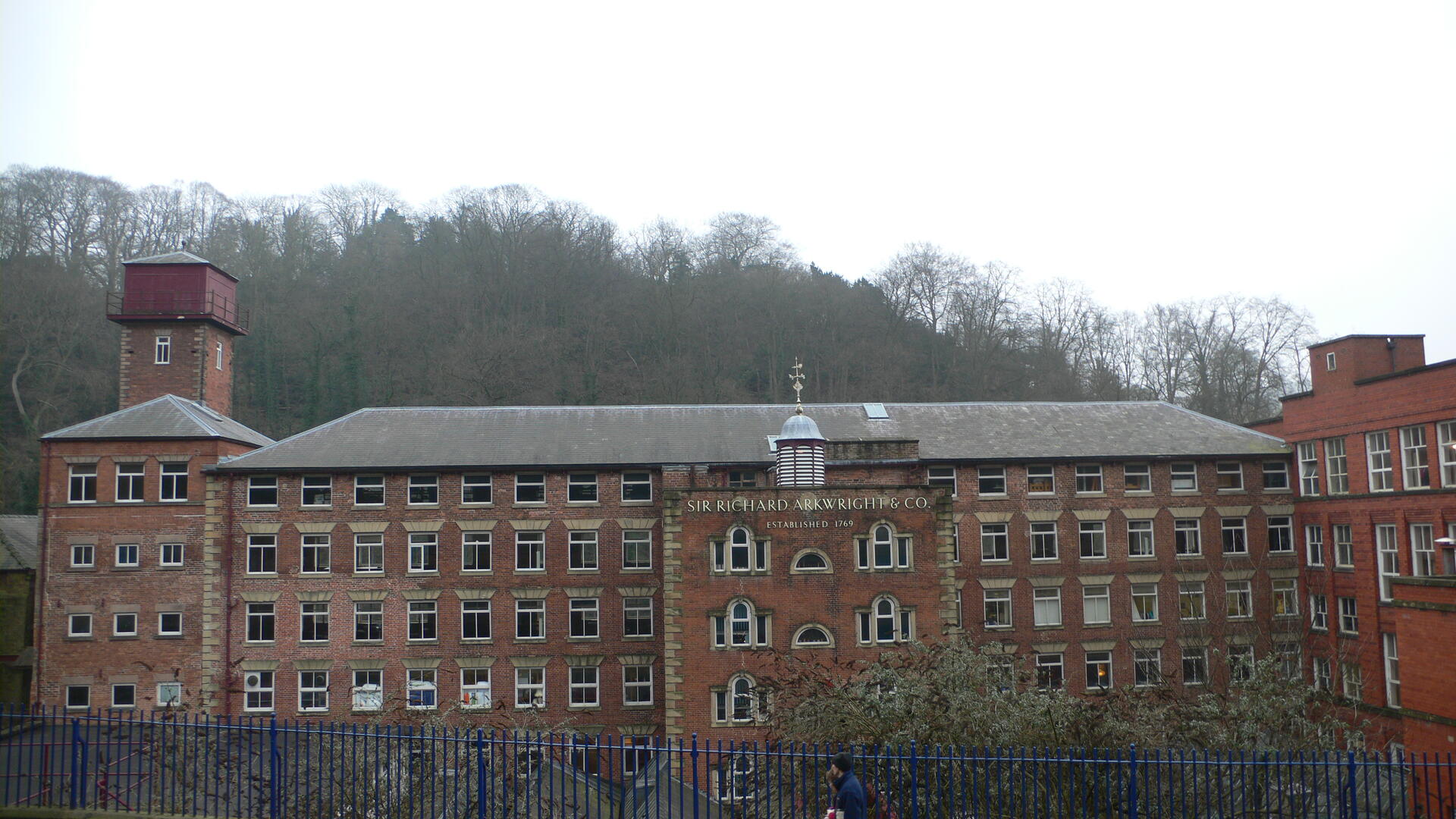
The Derwent Valley in central England contains a series of 18th- and 19th- century cotton mills and an industrial landscape of high historical and technological interest. The modern factory owes its origins to the mills at Cromford, where Richard Arkwright's inventions were first put into industrial-scale production. The workers' housing associated with this and the other mills remains intact and illustrate the socio-economic development of the area.
UNESCO Justification of the World Heritage Site
Criterion (ii): The Derwent Valley saw the birth of the factory system, when new types of building were erected to house the new technology for spinning cotton developed by Richard Arkwright in the late 18th century.
Criterion (iv): In the Derwent Valley for the first time there was large-scale industrial production in a hitherto rural landscape. The need to provide housing and other facilities for workers and managers resulted in the creation of the first modern industrial settlements.
Encyclopedia Record: Derwent Valley Mills
Derwent Valley Mills is a World Heritage Site along the River Derwent in Derbyshire, England, designated in December 2001. It is administered by the Derwent Valley Mills Partnership. The modern factory, or 'mill', system was born here in the 18th century to accommodate the new technology for spinning cotton developed by Richard Arkwright. With advancements in technology, it became possible to produce cotton continuously. The system was adopted throughout the valley, and later spread so that by 1788 there were over 200 Arkwright-type mills in Britain. Arkwright's inventions and system of organising labour was exported to Europe and the United States.Additional Site Details
Area: 1,228.7 hectares
Number of Components: 1
(iv) — Outstanding example of a type of building or landscape
Coordinates: 53.02888889 , -1.488055556
Image
© Unknown, CC BY-SA 2.0 Resized from original. (This derivative is under the same CC BY-SA license.)
World Heritage Research
Discover scientific research and academic studies that deepen our understanding of Derwent Valley Mills from its history and significance to its conservation, management, and contemporary challenges.
-
Creating Balance Between Transformation and Preservation Within UNESCO World Heritage Sites: A Case Study of Belper, UK
An innovative design-led strategy for UNESCO World Heritage Sites (WHS) balances transformation and preservation, demonstrated through the case study of Belper in the Derwent Valley Mills WHS. The research proposes treating heritage sites as palimpsests—layers of historical significance that can be reinforced while integrating modern development. This approach addresses derelict landscapes caused by industrial abandonment, offering a cohesive regeneration plan that enhances community life without compromising heritage integrity. By analyzing urban grain, natural environment, social landscape, and economic forces, the study knits together existing structures with mixed-use development, ensuring sustainability and cultural recognition in 21st-century contexts.
CAROUPAPOULLÉ, A. (2019). CREATING BALANCE BETWEEN TRANSFORMATION AND PRESERVATION WITHIN UNESCO WORLD HERITAGE SITES: A CASE STUDY OF BELPER, UK. The Sustainable City XIII, 1, 395–405. https://doi.org/10.2495/sc190351
View Publication Record | Read Publication -
Vermuyden, Arkwright, and Slater the Traitor: Derwent Valley Mills—Birthplace of the Water Powered Cotton Spinning Industry and Skyscraper Construction Techniques
The Derwent Valley Mills, located in Derbyshire, England, represent a pivotal development in industrial history as the birthplace of the water-powered cotton spinning industry and advanced skyscraper construction techniques. This study reveals how Cornelius Vermuyden's drainage of a lead mine catalyzed legal reforms and mining practices that facilitated the establishment of early mills in the valley. Sir Richard Arkwright's innovations, including the Masson Mill at Matlock Bath, marked significant advancements in mill design, leveraging mine drainage water for power. The research also explores the competitive dynamics among mills and their influence on high-rise building designs. Additionally, it recounts the controversial figure of Samuel Slater, known locally as 'Slater the Traitor' for his alleged betrayal by illegally taking technical knowledge to the USA, where he established his own mills.
Newman, A. P., Rodríguez, Á. M., & Hunt, W. F. (2018). Vermuyden, Arkwright, and Slater the Traitor: Derwent Valley Mills—Birthplace of the Water Powered Cotton Spinning Industry and Skyscraper Construction Techniques. World Environmental and Water Resources Congress 2018, 87–100. https://doi.org/10.1061/9780784481394.010
View Publication Record | Read Publication -
David Knight (ed.), Derwent Valley Mills World Heritage Site Research Framework. Matlock: The Derwent Valley Mills Partnership, 2016. 124 pp., illus. ISBN 978-0-9541940-7-9
The Derwent Valley Mills World Heritage Site Research Framework, edited by David Knight, provides a comprehensive approach to understanding the significance of this UNESCO-listed area. It identifies key research priorities that focus on the industrial heritage, technological innovation, and cultural landscape of the 18th- and 19th-century mills along the River Derwent in England. The framework integrates historical analysis with archaeological and environmental studies to uncover the site's role in the Industrial Revolution. By synthesizing existing knowledge and outlining future research directions, it aims to deepen the understanding of how these mills contributed to industrial development while preserving their legacy for future generations.
Holden, R. N. (2017). David Knight (ed.), Derwent Valley Mills World Heritage Site Research Framework. Matlock: The Derwent Valley Mills Partnership, 2016. 124 pp., illus. ISBN 978-0-9541940-7-9. Industrial Archaeology Review, 39(1), 78–79. https://doi.org/10.1080/03090728.2017.1298284
View Publication Record | Read Publication -
Stitching Together the Fabric of Industrial Houses: Investigating the Origins and Development of Cotton Workers’ Accommodation in the Derwent Valley, Derbyshire
The Derwent Valley Mills showcases the innovative yet traditional influences on cotton workers' housing during the late 18th century. This study reveals that the accommodation built by three mill-owning families across Cromford, Belper, Milford, and Darley Abbey was a nuanced blend of experimental and conventional designs, reflecting the evolving needs of both occupants and patrons. By analyzing historic building fabric, researchers demonstrated that these houses were not uniform but varied significantly, embodying the complex dynamics of early industrialization. This buildings-led approach highlights the interplay between architectural innovation and traditional practices, offering insights into the social and economic forces shaping industrial communities during this pivotal period.
Lilley, S. (2017). Stitching Together the Fabric of Industrial Houses: Investigating the Origins and Development of Cotton Workers’ Accommodation in the Derwent Valley, Derbyshire. Industrial Archaeology Review, 39(2), 117–128. https://doi.org/10.1080/03090728.2017.1387351
View Publication Record | Read Publication -
Understanding geohazards in the UNESCO WHL site of the Derwent Valley Mills (UK) using geological and remote sensing data
A comprehensive analysis of geohazards in the UNESCO World Heritage Site of Derwent Valley Mills (UK) reveals that flooding, both from fluvial water flow and groundwater emergence, poses significant risks across over 50% and 40% of the Core Area, respectively. Slope instability along the steep sides of the Derwent river valley, notably a 1.4 km² landslide deposit in Cromford within the Buffer Zone, further exacerbates these challenges. The study utilized key hazard datasets from the British Geological Survey, including GeoSure, DiGMapGB, and the National Landslide Database, to provide baseline geohazard characterization. Projections under a medium greenhouse gas emission scenario suggest drier summers, wetter winters, and increased annual temperatures, which could intensify these hazards. This research contributes to the PROTHEGO project, aimed at mapping geohazards across 400+ European UNESCO sites using satellite radar interferometry and geological data.
Cigna, F., Harrison, A., Tapete, D., & Lee, K. (2016). Understanding geohazards in the UNESCO WHL site of the Derwent Valley Mills (UK) using geological and remote sensing data. Fourth International Conference on Remote Sensing and Geoinformation of the Environment (RSCy2016), 9688, 96881V. https://doi.org/10.1117/12.2240848
View Publication Record | Read Publication -
How to ‘Enlighten’ museum visitors: Curating Derby Museum’s Enlightenment Exhibition
Curating museum exhibitions effectively to engage visitors with historical objects is challenging, especially when balancing the need for informative interpretation without overwhelming or boring audiences. The 'Enlightenment' exhibition at Derby Museums (2013) tackled this by displaying 18th-century objects—such as trade-related items and natural history artifacts—in a way that highlighted their significance while maintaining visitor interest. Funded by the Heritage Lottery Fund, the project involved three institutions (Derby Museums, Buxton Museum, and Strutt’s North Mill) to enrich collections and contextualize Derbyshire's Enlightenment period within the UNESCO-listed Derwent Valley Mills site. The exhibition aimed to link objects like a polar bear plate to themes of trade, fashion, and natural history, demonstrating how strategic curation can bridge academic depth and public engagement.
Dunning, L. (2013). How to ‘Enlighten’ museum visitors: Curating Derby Museum’s Enlightenment Exhibition. Scene, 1(3), 429–442. https://doi.org/10.1386/scene.1.3.429_1
View Publication Record | Read Publication -
Towards sustainable energy: are there lessons from the history of the early factory system?
Historical analysis of the Derwent Valley Mills suggests that sustainable energy innovation could benefit from bottom-up, context-driven approaches rather than top-down strategies. The study found that rapid technological advancement in 18th-century England—despite limited resources and remote location—was driven by local expertise and market demand, not capital or cutting-edge technology like steam engines. This challenges current assumptions about sustainable energy development, proposing that regions with skilled labor, growing markets, and supportive institutions may outperform those relying solely on financial investment. The findings imply that state and international cooperation could play a pivotal role in fostering such grassroots innovation.
Bellaby, P., Flynn, R., & Ricci, M. (2010). Towards sustainable energy: are there lessons from the history of the early factory system? Innovation: The European Journal of Social Science Research, 23(4), 333–348. https://doi.org/10.1080/13511610.2010.545276
View Publication Record | Read Publication