World Heritage Identification Number: 372
World Heritage since: 1986
Category: Cultural Heritage
WHE Type: Agriculture Landscapes, Parks & Gardens
Transboundary Heritage: No
Endangered Heritage: No
Country: 🇬🇧 United Kingdom of Great Britain and Northern Ireland
Continent: Europe
UNESCO World Region: Europe and North America
Map
Studley Royal Park and the Ruins of Fountains Abbey: A Unique Blend of History and Landscape Design
Studley Royal Park and the Ruins of Fountains Abbey, located in North Yorkshire, England, are a remarkable fusion of history, architecture, and landscape design that have earned them a place on the prestigious list of UNESCO World Heritage Sites since 1986. This unique site offers visitors a captivating journey through time, showcasing the grandeur of a medieval monastery, the elegance of a Georgian water garden, and the charm of a picturesque English park.
More to come…UNESCO Description of the World Heritage Site
In the 18th century a designed landscape of exceptional beauty was created around the ruins of the Cistercian Fountains Abbey, in Yorkshire. The spectacular ruins of the 12th century abbey and water mill, the Jacobean mansion of Fountains Hall, the Victorian masterpiece St Mary’s Church and one of the most magnificent Georgian water gardens ever created, make this a landscape of outstanding merit.
UNESCO Justification of the World Heritage Site
Criterion (i): Studley Royal Park including the ruins of Fountains Abbey owes its originality and striking beauty to the fact that a humanised landscape was created around the largest medieval ruins in the United Kingdom. The use of these features, combined with the planning of the water garden itself, is a true masterpiece of human creative genius.
Criterion (iv): Combining the remains of the richest abbey in England, the Jacobean Fountains Hall, and Burges’s miniature neo-Gothic masterpiece of St Mary’s, with the water gardens and deer park into one harmonious whole, Studley Royal Park including the ruins of Fountains Abbey illustrates the power of medieval monasticism and the taste and wealth of the European upper classes in the 18th century.
Encyclopedia Record: Fountains Abbey
Fountains Abbey is one of the largest and best preserved ruined Cistercian monasteries in England, 3 miles (5 km) south-west of Ripon in North Yorkshire, near the village of Aldfield. Founded in 1132, the abbey operated for 407 years, becoming one of the wealthiest monasteries in England until its dissolution, by order of Henry VIII, in 1539.Additional Site Details
Area: 310 hectares
Number of Components: 2
(iv) — Outstanding example of a type of building or landscape
Coordinates: 54.11611111 , -1.573055556
Image
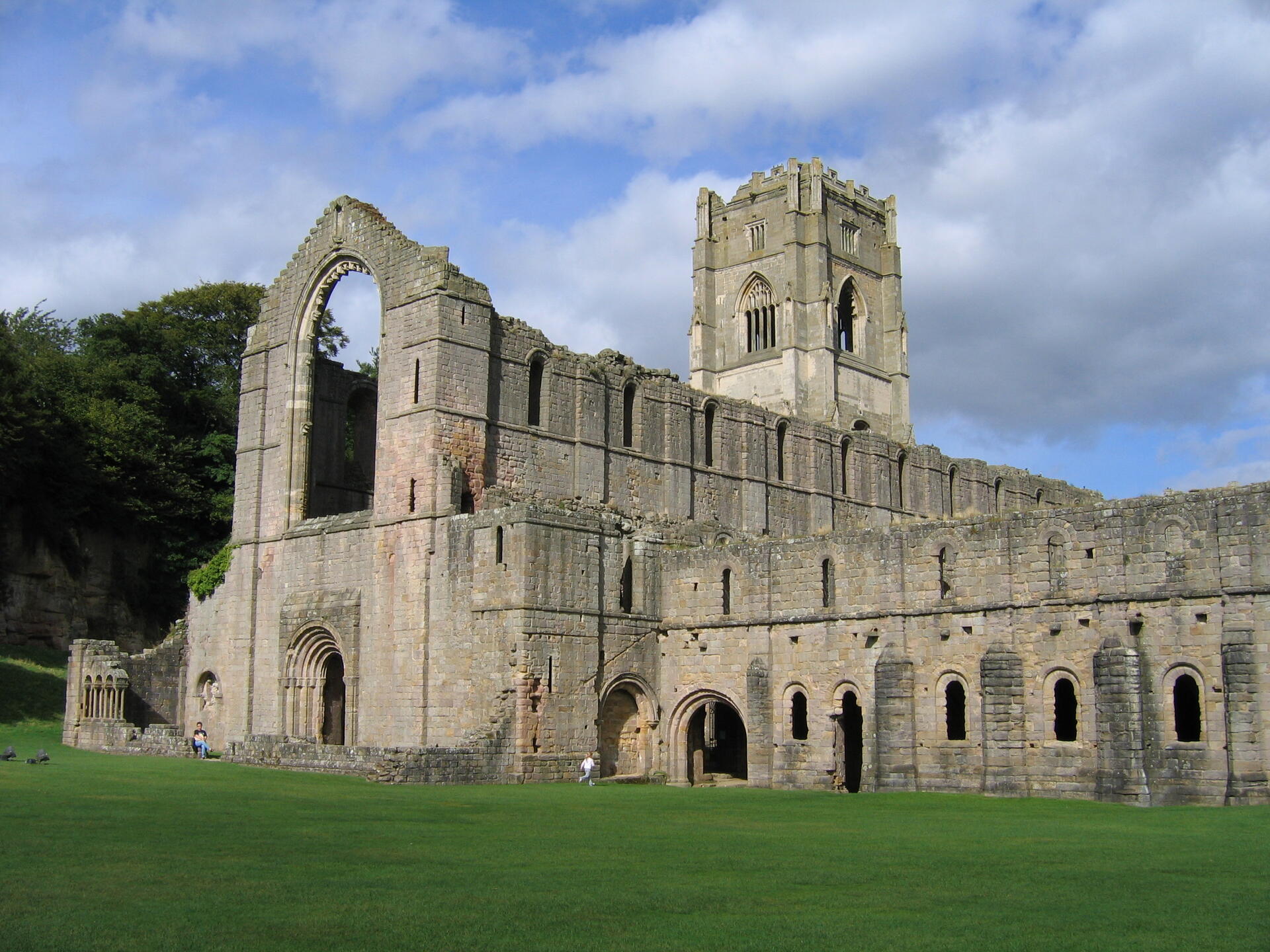
© User:Klaus with K, CC BY-SA 3.0 Resized from original. (This derivative is under the same CC BY-SA license.)
World Heritage Research
Discover scientific research and academic studies that deepen our understanding of Studley Royal Park including the Ruins of Fountains Abbey from its history and significance to its conservation, management, and contemporary challenges.
-
On-site and understood? Evaluating meaning in the interpretation of geophysical data at Fountains Abbey
A pilot digital interpretation at Fountains Abbey, part of Studley Royal Park, reveals that augmented reality (AR) significantly enhances visitor understanding and experience when integrated with geophysical data. The study found that AR-based presentations improved user comprehension by visually translating complex subsurface information into accessible formats. Researchers used a combination of on-site evaluations and digital technologies to measure the effectiveness of these interpretations, demonstrating their potential to deepen engagement with UNESCO World Heritage Sites like Fountains Abbey.
Gaffney, C., Dunn, R., Newman, M., Pisz, M., Naresh, D., Taylor, D., & Sparrow, T. (2025). On-site and understood? Evaluating meaning in the interpretation of geophysical data at Fountains Abbey. ArchéoSciences, 49-1, 567–568. https://doi.org/10.4000/14nud
View Publication Record | Read Publication -
Final Report: Skell Valley Catchment Scale Monitoring
A comprehensive long-term monitoring study of the Skell Valley catchment in North Yorkshire, UK, reveals critical insights into the dynamics of flashy river systems like the River Skell. The research, conducted before, during, and after the installation of Natural Flood Management (NFM) interventions and Nature-Based Solutions (NBS), demonstrates how rapid precipitation events significantly impact river levels and sediment loads, posing flooding risks to downstream sites such as Fountains Abbey and Studley Royal. Notably, the study captured Storm Barbet, a major storm event, providing unprecedented data on the catchment's response to extreme weather conditions. By integrating meteorological, hydrodynamic, and sediment data with water quality measurements collected by volunteers, this extensive dataset offers a robust framework for assessing the effectiveness of NFM and NBS over time. The findings underscore the importance of long-term monitoring in understanding river behavior and mitigating flood risks in vulnerable heritage sites.
Brown, H., Keevil, G., & Hodgson, D. (2025). Final Report: Skell Valley Catchment Scale Monitoring (I. Mann & G. Crisp, Eds.; Version 1.0). iCASP. https://doi.org/10.5281/ZENODO.18802137
View Publication Record | Read Publication -
The Cistercians and the Transformation of Monastic Friendships
A century of Cistercian monastic evolution, from the death of Bernard of Clairvaux to the 1260s dispute between Cîteaux and Clairvaux abbots, reveals a rigorous effort to uphold founding ideals. This study identifies two key sources—decisions from General Chapter meetings compiled in the Libri Definitionum and edifying literature like the Vita Prima of Bernard and later works by Herbert of Clairvaux, Caesarius of Heisterbach, and others—that illustrate the Order’s commitment to purity. Hagiographical writings and miracle accounts, particularly from Villers Abbey (Brabant) and Heisterbach (near Bonn), provide a comprehensive view of Cistercian development. The Exordium Magnum Cisterciense by Conrad of Eberbach synthesizes this period’s challenges, while other exordia, such as those for Øm Abbey (Denmark) or Fountains Abbey (Yorkshire), offer localized perspectives on early monastic experiences.
McGuire, B. P. (2024). The Cistercians and the Transformation of Monastic Friendships. Friendship and Faith: Cistercian Men, Women, and Their Stories, 1100-1250, III. https://doi.org/10.4324/9781003555148-3
View Publication Record | Read Publication -
Michael Spence. The Late Medieval Cistercian Monastery of Fountains Abbey, Yorkshire: Monastic Administration, Economy, and Archival Memory. Medieval Monastic Studies 5. Turnhout: Brepols, 2020. Pp. 250. $91.00 (cloth).
Fountains Abbey, a late medieval Cistercian monastery in Yorkshire, emerges as a pivotal case study for understanding monastic administration, economic resilience, and the preservation of archival memory. Michael Spence's work reveals that despite the Dissolution of the Monasteries under Henry VIII, Fountains Abbey maintained sophisticated administrative practices and economic strategies, including diverse income streams from agriculture, trade, and property management. The study leverages surviving abbey records—charters, accounts, and chronicles—to reconstruct its operational dynamics, demonstrating how monastic institutions adapted to political and economic pressures while systematically documenting their history. This approach offers a rare, data-driven insight into the inner workings of a Cistercian community, challenging assumptions about their uniformity and highlighting regional variations in monastic governance.
Dutton, K. (2023). Michael Spence. The Late Medieval Cistercian Monastery of Fountains Abbey, Yorkshire: Monastic Administration, Economy, and Archival Memory. Medieval Monastic Studies 5. Turnhout: Brepols, 2020. Pp. 250. $91.00 (cloth). Journal of British Studies, 62(1), 266–268. https://doi.org/10.1017/jbr.2022.192
View Publication Record | Read Publication -
The Late Medieval Cistercian Monastery of Fountains Abbey, Yorkshire: Monastic Administration, Economy, and Archival Memory. By Michael Spence. Medieval Monastic Studies 5. Turnhout: Brepols, 2020. 208 pp. € 75.00 cloth.
Fountains Abbey, a late medieval Cistercian monastery in Yorkshire, England, emerges as a pivotal case study for understanding monastic administration, economic resilience, and archival memory. Michael Spence's work reveals how the abbey navigated political shifts, economic pressures, and the dissolution of religious institutions during the 16th century, providing insights into its adaptive strategies and survival mechanisms. The study employs a multidisciplinary approach, integrating archival analysis with archaeological evidence to reconstruct the abbey's operational dynamics. A key finding is the abbey's ability to maintain financial stability through innovative economic practices, such as agricultural diversification and strategic land management, despite external disruptions. Additionally, Spence highlights the significance of Fountains Abbey's archives in preserving institutional memory, offering a rare window into the daily life and governance of medieval monastic communities.
Newman, M. G. (2023). The Late Medieval Cistercian Monastery of Fountains Abbey, Yorkshire: Monastic Administration, Economy, and Archival Memory. By Michael Spence. Medieval Monastic Studies 5. Turnhout: Brepols, 2020. 208 pp. € 75.00 cloth. Church History, 92(2), 446–448. https://doi.org/10.1017/s0009640723001658
View Publication Record | Read Publication -
Michael Spence, The Late Medieval Cistercian Monastery of Fountains Abbey, Yorkshire. Monastic Administration, Economy, and Archival Memory. (Medieval Monastic Studies, Vol. 5.) Turnhout, Brepols 2020
A comprehensive analysis of Fountains Abbey, a late medieval Cistercian monastery in Yorkshire, reveals intricate details about its monastic administration, economic practices, and archival memory. The study, led by Michael Spence, employs a multidisciplinary approach combining archival research with historical and archaeological evidence to reconstruct the monastery's operations during its peak period (12th–16th centuries). Key findings highlight the Abbey's sophisticated land management systems, its role in regional trade networks, and the preservation of its administrative records, which offer unprecedented insights into Cistercian monastic life. Published in Medieval Monastic Studies (Vol. 5) and reviewed in Historische Zeitschrift, this work significantly advances understanding of medieval monastic economies and their enduring archival legacies.
Seggern, H. v. (2022). Michael Spence, The Late Medieval Cistercian Monastery of Fountains Abbey, Yorkshire. Monastic Administration, Economy, and Archival Memory. (Medieval Monastic Studies, Vol. 5.) Turnhout, Brepols 2020. Historische Zeitschrift, 314(2), 485–486. https://doi.org/10.1515/hzhz-2022-1133
View Publication Record | Read Publication -
The Art and Architecture of the Cistercians in Northern England by Michael Carter
Michael Carter's study challenges the long-held notion of Cistercian decline, demonstrating instead that the period c. 1300–1540 was one of reform and artistic vitality within Northern England's Cistercian abbeys and nunneries. Through a comprehensive analysis of buildings, artifacts, liturgical texts, and sepulchral monuments—including the grand tomb of Abbot Robert Chamber at Holm Cultram—the research reveals that Cistercian art both embodied the Order’s spiritual identity and engaged with late medieval devotional practices. Carter argues that patronage from abbots, aristocrats, and lay benefactors sustained this material abundance, while the veneration of saints like William of Rievaulx and local relics (e.g., St Cuthbert) underscored their cultural significance. The study also highlights the nuanced differences between monastic and nunnery practices, particularly at Swine Nunnery, where alabaster tombs reflect aristocratic patronage.
Barratt, A. (2021). The Art and Architecture of the Cistercians in Northern England by Michael Carter. Parergon, 38(1), 201–202. https://doi.org/10.1353/pgn.2021.0022
View Publication Record | Read Publication