World Heritage Identification Number: 422
World Heritage since: 2017
Category: Cultural Heritage
WHE Type: Cultural Landscapes
Transboundary Heritage: No
Endangered Heritage: No
Country: 🇬🇧 United Kingdom of Great Britain and Northern Ireland
Continent: Europe
UNESCO World Region: Europe and North America
Map
The English Lake District: A Landscape of Natural Beauty and Literary Influence
The English Lake District, located in northwest England, is a captivating region that boasts a unique blend of natural beauty and rich cultural heritage. Inscribed as a UNESCO World Heritage Site in 2017, this mountainous area has been shaped over millennia by geological processes and human intervention, resulting in a harmonious landscape that continues to inspire artists, writers, and visitors alike.
Geographically, the Lake District spans across the county of Cumbria in northwest England, near the Scottish border and bordering the Irish Sea to the west. Its terrain is dominated by rugged mountains of ancient volcanic and sedimentary rocks, deep-cut valleys, and tranquil lakes—all sculpted by glacial action during the last Ice Age. The highest peak, Scafell Pike, stands at 978 meters (3,209 feet) above sea level, offering breathtaking panoramic views of the fells.
One of the most striking features of the Lake District is its network of lakes, which reflect the surrounding mountains in calm, mirror-like waters. These lakes vary greatly in size and character, ranging from the expansive Windermere, England’s largest natural lake, to smaller, secluded tarns hidden within the fells. Each lake contributes to the region’s distinctive scenery, offering constantly changing views shaped by light, weather, and terrain.
Among the most notable are Ullswater, known for its long, sweeping valley setting; Derwentwater, admired for its picturesque location near Keswick; and Coniston Water, valued for its quieter, more remote atmosphere beneath rugged hills. Beyond their scenic appeal, the lakes also play an important ecological role, supporting diverse aquatic ecosystems and providing habitats for a wide range of plant and animal species.
Throughout history, humans have sought to shape the Lake District landscape to suit their needs and desires. Ancient farmers erected drystone walls to divide agricultural land, while medieval monastic communities influenced land management and agriculture throughout parts of the region. In the 18th and 19th centuries, wealthy landowners commissioned architects to design elaborate country estates, complete with manicured gardens and parks, contributing to the cultural character of the region.
A defining feature of the Lake District is its long tradition of pastoral farming, which has shaped the region for centuries. Generations of farmers have maintained its distinctive system of drystone walls, upland grazing, and stone-built farmsteads. The hardy Herdwick sheep, a native breed uniquely adapted to the harsh fells, have become an enduring symbol of the Lake District and remain central to its agricultural identity. This close relationship between people and landscape is a key reason the area was recognized as a UNESCO World Heritage Site.
The Lake District’s designation as a World Heritage Site reflects its status as a cultural landscape—an area where natural beauty and human activity have evolved together over time. UNESCO recognized the region not only for its dramatic scenery, but also for the way farming traditions, settlement patterns, and literary associations have shaped and sustained it for centuries.
The Lake District has long been a source of inspiration for artists, writers, and poets. Beatrix Potter, best known for her beloved children’s books, was also a committed conservationist who purchased and preserved large areas of farmland, much of which she later left to the National Trust, helping to protect the region for future generations. John Ruskin, a leading art critic and social thinker, championed the preservation of the Lake District’s landscapes. Arthur Ransome set his Swallows and Amazons stories among its lakes and hills, bringing the region to life for generations of readers.
The Lake Poets, a group of Romantic poets including William Wordsworth, Samuel Taylor Coleridge, and Robert Southey, found solace and inspiration in the Lake District's rugged landscapes, often drawing upon their experiences there to craft their evocative verse. Among them, Wordsworth is especially closely associated with the Lake District, where he developed much of his poetic vision and helped shape modern appreciation of natural scenery as something to be preserved and valued.
Today, the Lake District National Park attracts millions of visitors each year, who come to hike its trails, sail its lakes, and explore its charming villages. The region's rich cultural heritage is preserved through numerous museums, galleries, and historic sites, while conservation efforts ensure that the landscape remains protected and sustainable for future generations to enjoy. The English Lake District, with its stunning vistas, literary connections, and enduring appeal, truly embodies the spirit of a UNESCO World Heritage Site.
UNESCO Description of the World Heritage Site
Located in northwest England, the English Lake District is a mountainous area, whose valleys have been modelled by glaciers in the Ice Age and subsequently shaped by an agro-pastoral land-use system characterized by fields enclosed by walls. The combined work of nature and human activity has produced a harmonious landscape in which the mountains are mirrored in the lakes. Grand houses, gardens and parks have been purposely created to enhance the landscape’s beauty. This landscape was greatly appreciated from the 18th century onwards by the Picturesque and later Romantic movements, which celebrated it in paintings, drawings and words. It also inspired an awareness of the importance of beautiful landscapes and triggered early efforts to preserve them.
UNESCO Justification of the World Heritage Site
Criterion (ii): The harmonious beauty of the English Lake District is rooted in the vital interaction between an agro-pastoral land use system and the spectacular natural landscape of mountains, valleys and lakes of glacial origins. In the 18th century, the quality of the landscape was recognised and celebrated by the Picturesque Movement, based on ideas related to both Italian and Northern European styles of landscape painting. These ideas were applied to the English Lake District in the form of villas and designed features intended to further augment its beauty. The Picturesque values of landscape appreciation were subsequently transformed by Romantic engagement with the English Lake District into a deeper and more balanced appreciation of the significance of landscape, local society and place. This inspired the development of a number of powerful ideas and values including a new relationship between humans and landscape based on emotional engagement; the value of the landscape for inspiring and restoring the human spirit; and the universal value of scenic and cultural landscapes, which transcends traditional property rights. In the English Lake District these values led directly to practical conservation initiatives to protect its scenic and cultural qualities and to the development of recreational activities to experience the landscape, all of which continue today. These values and initiatives, including the concept of protected areas, have been widely adopted and have had global impact as an important stimulus for landscape conservation and enjoyment. Landscape architects in North America were similarly influenced, directly or indirectly, by British practice, including Frederick Law Olmsted, one of the most influential American landscape architects of the 19th century.
Criterion (v): Land use in the English Lake District derives from a long history of agro-pastoralism. This landscape is an unrivalled example of a northern European upland agro-pastoral system based on the rearing of cattle and native breeds of sheep, shaped and adapted for over 1,000 years to its spectacular mountain environment. This land use continues today in the face of social, economic and environmental pressures. From the late 18th century and throughout the 19th century, a new land use developed in parts of the Lake District, designed to augment its beauty through the addition of villas and designed landscapes. Conservation land management in the Lake District developed directly from the early conservation initiatives of the 18th and 19th centuries. The primary aims in the Lake District have traditionally been, and continue to be, to maintain the scenic and harmonious beauty of the cultural landscape; to support and maintain traditional agro-pastoral farming; and to provide access and opportunities for people to enjoy the special qualities of the area, and have developed in recent times to include enhancement and resilience of the natural environment. Together these surviving attributes of land use form a distinctive cultural landscape which is outstanding in its harmonious beauty, quality, integrity and on-going utility and its demonstration of human interaction with the environment. The English Lake District and its current land use and management exemplify the practical application of the powerful ideas about the value of landscape which originated here and which directly stimulated a landscape conservation movement of global importance.
Criterion (vi): A number of ideas of universal significance are directly and tangibly associated with the English Lake District. These are the recognition of harmonious landscape beauty through the Picturesque Movement; a new relationship between people and landscape built around an emotional response to it, derived initially from Romantic engagement; the idea that landscape has a value and that everyone has a right to appreciate and enjoy it; and the need to protect and manage landscape, which led to the development of the National Trust movement, which spread across many countries with a similar rights system. All these ideas that have derived from the interaction between people and landscape are manifest in the English Lake District today and many of them have left their physical mark, contributing to the harmonious beauty of a natural landscape modified by: a persisting agro-pastoral system (and supported in many cases by conservation initiatives); villas and Picturesque and later landscape improvements; the extent of, and quality of land management within, the National Trust property; the absence of railways and other modern industrial developments as a result of the success of the conservation movement.
Encyclopedia Record: Lake District
The Lake District, also known as the Lakes or Lakeland, is a mountainous region and national park in Cumbria, North West England. It is famous for its landscape, including its lakes, coast, and mountains, and for its literary associations with Beatrix Potter, John Ruskin, Arthur Ransome, and the Lake Poets.Additional Site Details
Area: 229,205.2 hectares
Number of Components: 1
(v) — Outstanding example of traditional human settlement
(vi) — Directly associated with events or living traditions
Coordinates: 54.4766111111 , -3.0824166667
Image
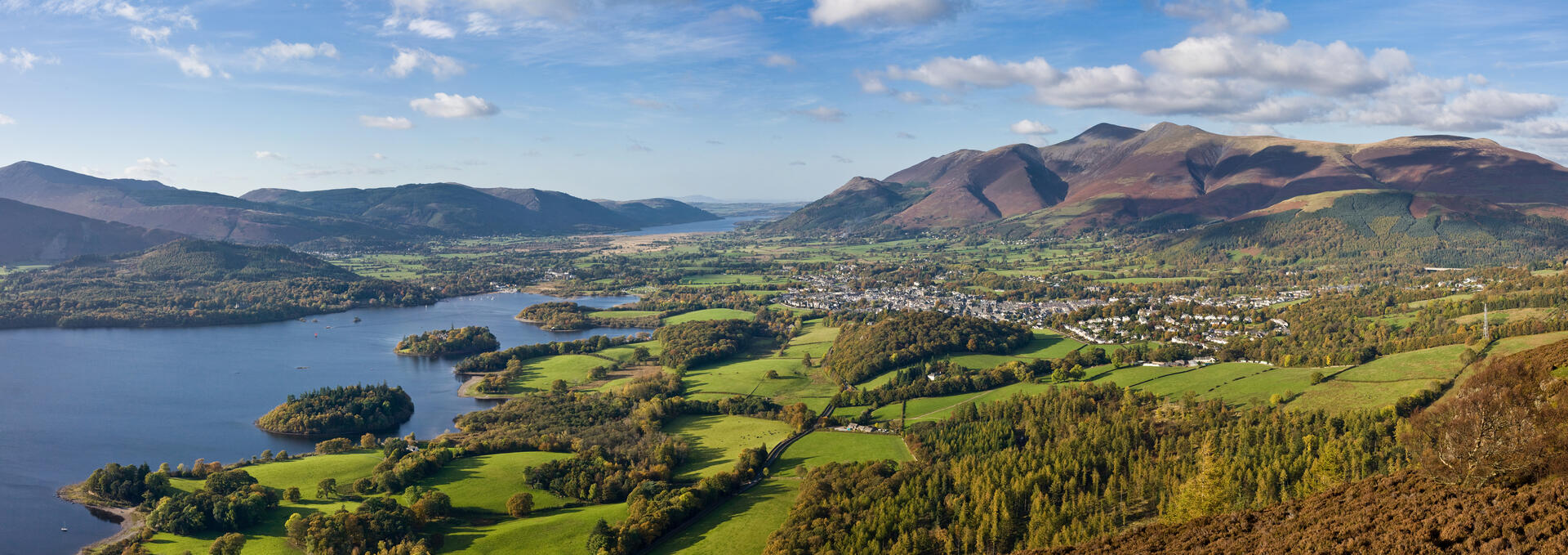
© Diliff, CC BY-SA 3.0 Resized from original. (This derivative is under the same CC BY-SA license.)
World Heritage Research
Discover scientific research and academic studies that deepen our understanding of The English Lake District from its history and significance to its conservation, management, and contemporary challenges.
-
Mapping the English Lake District: a literary GIS
This study demonstrates the potential of literary GIS to map qualitative spatial experiences, offering new methodological and critical approaches for analyzing textual accounts of place. By comparing Thomas Gray's proto-Picturesque journey through the English Lake District in 1769 with Samuel Taylor Coleridge’s post-Picturesque circumcursion in 1802, the research reveals how GIS can capture subjective spatial narratives beyond traditional quantitative data. The findings highlight the utility of literary GIS in spatial literary criticism, providing a framework to explore the critical possibilities and challenges of digitizing space and place in literature.
Cooper, D., & Gregory, I. N. (2010). Mapping the English Lake District: a literary GIS. Transactions of the Institute of British Geographers, 36(1), 89–108. Portico. https://doi.org/10.1111/j.1475-5661.2010.00405.x
View Publication Record | Read Publication