World Heritage Identification Number: 429
World Heritage since: 2001
Category: Cultural Heritage
WHE Type: Buildings & Architectural Ensembles
Transboundary Heritage: No
Endangered Heritage: No
Country: 🇬🇧 United Kingdom of Great Britain and Northern Ireland
Continent: Europe
UNESCO World Region: Europe and North America
Map
New Lanark: A Model Industrial Community in Scotland
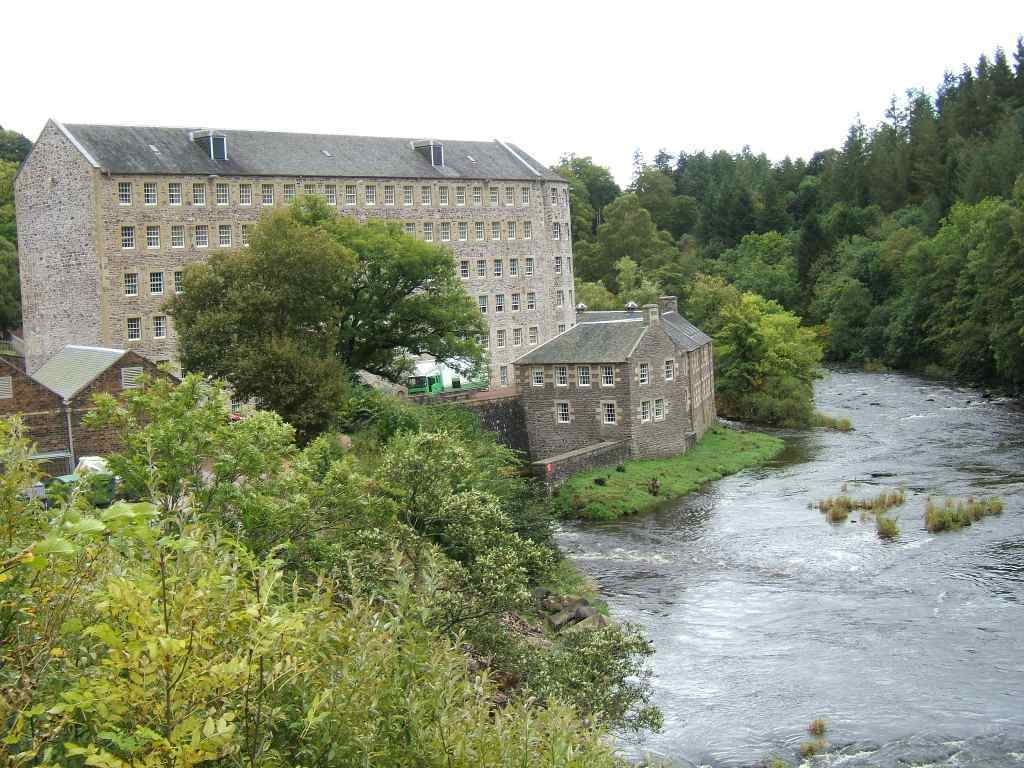
New Lanark, located approximately 1.4 miles from Lanark in Lanarkshire, Scotland, is a significant historical site that offers a unique glimpse into the early days of the Industrial Revolution. Founded in 1785 and opened in 1786 by David Dale, this small village on the River Clyde has left an indelible mark on the annals of urban planning and social reform.
More to come…UNESCO Description of the World Heritage Site
New Lanark is a small 18th- century village set in a sublime Scottish landscape where the philanthropist and Utopian idealist Robert Owen moulded a model industrial community in the early 19th century. The imposing cotton mill buildings, the spacious and well-designed workers' housing, and the dignified educational institute and school still testify to Owen's humanism.
UNESCO Justification of the World Heritage Site
Criterion (ii): When Richard Arkwright’s new factory system for textile production was brought to New Lanark the need to provide housing and other facilities for the workers and managers was recognised. It was there that David Dale and Robert Owen created a model for industrial communities that was to spread across the world in the 19th and 20th centuries.
Criterion (iv): New Lanark saw the construction not only of well designed and equipped workers’ housing but also public buildings designed to improve their spiritual as well as their physical needs.
Criterion (vi): The name of New Lanark is synonymous with that of Robert Owen and his social philosophy in matters such as progressive education, factory reform, humane working practices, international cooperation, and garden cities, which was to have a profound influence on social developments throughout the 19th century and beyond.
Encyclopedia Record: New Lanark
New Lanark is a village on the River Clyde, approximately 1.4 miles from Lanark, in Lanarkshire, and some 25 miles (40 km) southeast of Glasgow, Scotland. It was founded in 1785 and opened in 1786 by David Dale, who built cotton mills and housing for the mill workers. Dale built the mills there in a brief partnership with the English inventor and entrepreneur Richard Arkwright to take advantage of the water power provided by the only waterfalls on the River Clyde. Under the ownership of a partnership that included Dale's son-in-law, Robert Owen, a Welsh utopian socialist and philanthropist, New Lanark became a successful business and an early example of a planned settlement and so an important milestone in the historical development of urban planning.Additional Site Details
Area: 146 hectares
Number of Components: 1
(iv) — Outstanding example of a type of building or landscape
(vi) — Directly associated with events or living traditions
Coordinates: 55.66333333 , -3.783055556
World Heritage Research
Discover scientific research and academic studies that deepen our understanding of New Lanark from its history and significance to its conservation, management, and contemporary challenges.
-
Address to the Inhabitants of New Lanark
New Lanark, Scotland, stands as a pioneering example of industrial philanthropy and social reform. In 1800, Robert Owen transformed the living conditions for cotton mill workers by providing decent housing and education, leading to significant success. This model inspired broader social experiments, including the establishment of New Harmony, Indiana, in 1824, though it ultimately faced collapse. Owen's address to the inhabitants of New Lanark reflects his visionary approach, emphasizing the potential for industrial progress to coexist with social welfare and community development.
Owen, R. (2019). Address to the Inhabitants of New Lanark. Ideals and Ideologies, 239–242. https://doi.org/10.4324/9780429286827-42
View Publication Record | Read Publication -
Robert Owen's Experiment at New Lanark: From Paternalism to Socialism
Ophélie Siméon's study challenges the dominant narrative of Robert Owen's role at New Lanark, revealing that the factory village was not merely a passive recipient of his reformist ideas but an active 'laboratory' where his socialist principles were developed and refined. Through meticulous archival analysis, she demonstrates that key elements of Owenite socialism—such as labor notes and committee representation systems—emerged from practices already in place at New Lanark before Owen's tenure. Siméon also highlights the contributions of David Dale, Owen's father-in-law, and the tensions between Owen's paternalistic management style and worker resistance, which foreshadowed later failures in his utopian experiments. Her work demythologizes New Lanark while acknowledging Owen's transformative impact, offering a nuanced perspective on the origins of British socialism.
Allison, M. (2018). Robert Owen’s Experiment at New Lanark: From Paternalism to Socialism. Utopian Studies, 29(3), 417–420. https://doi.org/10.5325/utopianstudies.29.3.0417
View Publication Record | Read Publication -
Historic New Lanark
New Lanark, a former cotton spinning village, stands as a pioneering example of technological and social transformation during the Industrial Revolution. Recognized today as a UNESCO World Heritage Site, its history from 1785 to the present is meticulously chronicled in this updated edition. The publication highlights key developments, including a new chapter on its World Heritage status and revisions on restoration efforts, offering essential insights into Scottish social history.
Donnachie, I., & Hewitt, G. (2015). Historic New Lanark (, Ed.). Edinburgh University Press. https://doi.org/10.1515/9781474407823
View Publication Record | Read Publication -
A Quest for Harmony: The Role of Music in Robert Owen's New Lanark Community
Robert Owen's New Lanark community, established in 1800, demonstrated the transformative power of music in fostering social harmony. This study reveals that lavishly funded musical activities were integral to Owen's educational curriculum and community life, binding people from diverse backgrounds together. The research draws on travel journals and letters, including previously unpublished sources, to provide fascinating insights into the daily lives of New Lanark residents. Owen's innovative approach, which combined improved living conditions, education, and medical care with music, offers a unique model for understanding how cultural elements can contribute to societal transformation.
Lorna Davidson. (2010). A Quest for Harmony: The Role of Music in Robert Owen’s New Lanark Community. Utopian Studies, 21(2), 232–251. https://doi.org/10.1353/utp.2010.0010
View Publication Record | Read Publication -
A Quest for Harmony: The Role of Music in Robert Owen’s New Lanark Community
Robert Owen's New Lanark community, established in 1800, demonstrated the transformative potential of music as a unifying force. Through lavishly funded musical activities integrated into education and daily life, Owen aimed to foster harmony among diverse backgrounds, reflecting his broader vision for societal reform. The study reveals that music played a pivotal role in shaping community cohesion, supported by historical accounts from visitors' journals and letters, some previously unpublished. This innovative approach underscores the power of artistic expression in creating progressive social environments.
Davidson, L. (2010). A Quest for Harmony: The Role of Music in Robert Owen’s New Lanark Community. Utopian Studies, 21(2), 232–251. https://doi.org/10.5325/utopianstudies.21.2.0232
View Publication Record | Read Publication