World Heritage Identification Number: 728
World Heritage since: 1995
Category: Cultural Heritage
WHE Type: Historic Cities & Urban Areas
Transboundary Heritage: No
Endangered Heritage: No
Country: 🇬🇧 United Kingdom of Great Britain and Northern Ireland
Continent: Europe
UNESCO World Region: Europe and North America
Map
Old and New Towns of Edinburgh: A Harmonious Juxtaposition of History and Modernity
The Old and New Towns of Edinburgh, inscribed as a UNESCO World Heritage Site in 1995, offer a captivating blend of history and modernity that sets this Scottish capital apart. Situated in southeast Scotland, Edinburgh's unique charm lies in the harmonious coexistence of its two distinct areas: the medieval Old Town and the neoclassical New Town.
The Old Town, dating back to the 12th century, serves as a testament to Edinburgh's rich historical roots. Dominated by the imposing Edinburgh Castle, the Old Town is characterized by narrow, winding streets, tenements, and hidden courtyards. The Royal Mile, stretching from Edinburgh Castle to Holyrood Palace, provides a glimpse into the city's past, with significant landmarks such as St Giles' Cathedral and the Palace of Holyroodhouse. The modern Scottish Parliament Building, although located adjacent to Holyrood Palace, sits just off the Royal Mile.
In stark contrast, the New Town emerged during the 18th century as a response to overcrowding in the Old Town. This planned development, influenced by the Enlightenment, boasts wide, straight streets, grand townhouses, and public squares. Notable examples include Princes Street, George Street, and St Andrew Square, which house iconic structures like the Scott Monument, the Balmoral Hotel, and the National Gallery of Scotland —situated on The Mound at the edge of the New Town.
The harmonious juxtaposition of these two contrasting historic areas is what gives Edinburgh its distinctive character. The Old Town's labyrinthine layout and rich historical tapestry stand in stark contrast to the New Town's orderly grid pattern and neoclassical architecture. Yet, they seamlessly intertwine, creating a vibrant cityscape that reflects Edinburgh's dynamic evolution.
Edinburgh's status as the Scottish capital since the 15th century has shaped its identity and culture. With an estimated population of some 530,000 in 2024, the city continues to thrive as a hub for arts, education, and politics. Its Old and New Towns serve as a living museum, offering visitors a unique opportunity to explore centuries of history while experiencing the contemporary spirit of this remarkable city.
To sum it up, the Old and New Towns of Edinburgh represent a harmonious blend of history and modernity. Their inclusion as a UNESCO World Heritage Site highlights their significance not only in Scottish history but also in the broader context of European urban planning. The Old Town's medieval charm and the New Town's neoclassical elegance create a captivating cityscape that invites exploration and discovery.
UNESCO Description of the World Heritage Site
Edinburgh has been the Scottish capital since the 15th century. It has two distinct areas: the Old Town, dominated by a medieval fortress; and the neoclassical New Town, whose development from the 18th century onwards had a far-reaching influence on European urban planning. The harmonious juxtaposition of these two contrasting historic areas, each with many important buildings, is what gives the city its unique character.
UNESCO Justification of the World Heritage Site
Criterion (ii): The successive planned extensions of the New Town, and the high quality of its architecture, set standards for Scotland and beyond, and exerted a major influence on the development of urban architecture and town planning throughout Europe, in the 18th and 19th centuries.
Criterion (iv): The Old and New Towns together form a dramatic reflection of significant changes in European urban planning, from the inward looking, defensive walled medieval city of royal palaces, abbeys and organically developed burgage plots in the Old Town, through the expansive formal Enlightenment planning of the 18th and 19th centuries in the New Town, to the 19th century rediscovery and revival of the Old Town with its adaptation of a distinctive Baronial style of architecture in an urban setting.
Encyclopedia Record: Edinburgh
Edinburgh is the capital city of Scotland and one of its 32 council areas. It is located in southeast Scotland and is bounded to the north by the Firth of Forth and to the south by the Pentland Hills. Edinburgh had a population of 506,520 in 2020, making it the second-most-populous city in Scotland and the seventh-most-populous in the United Kingdom. The wider metropolitan area had a population of 912,490 in the same year.Additional Site Details
Area: Not available
Number of Components: 1
(iv) — Outstanding example of a type of building or landscape
Coordinates: 55.95 , -3.216666667
Image
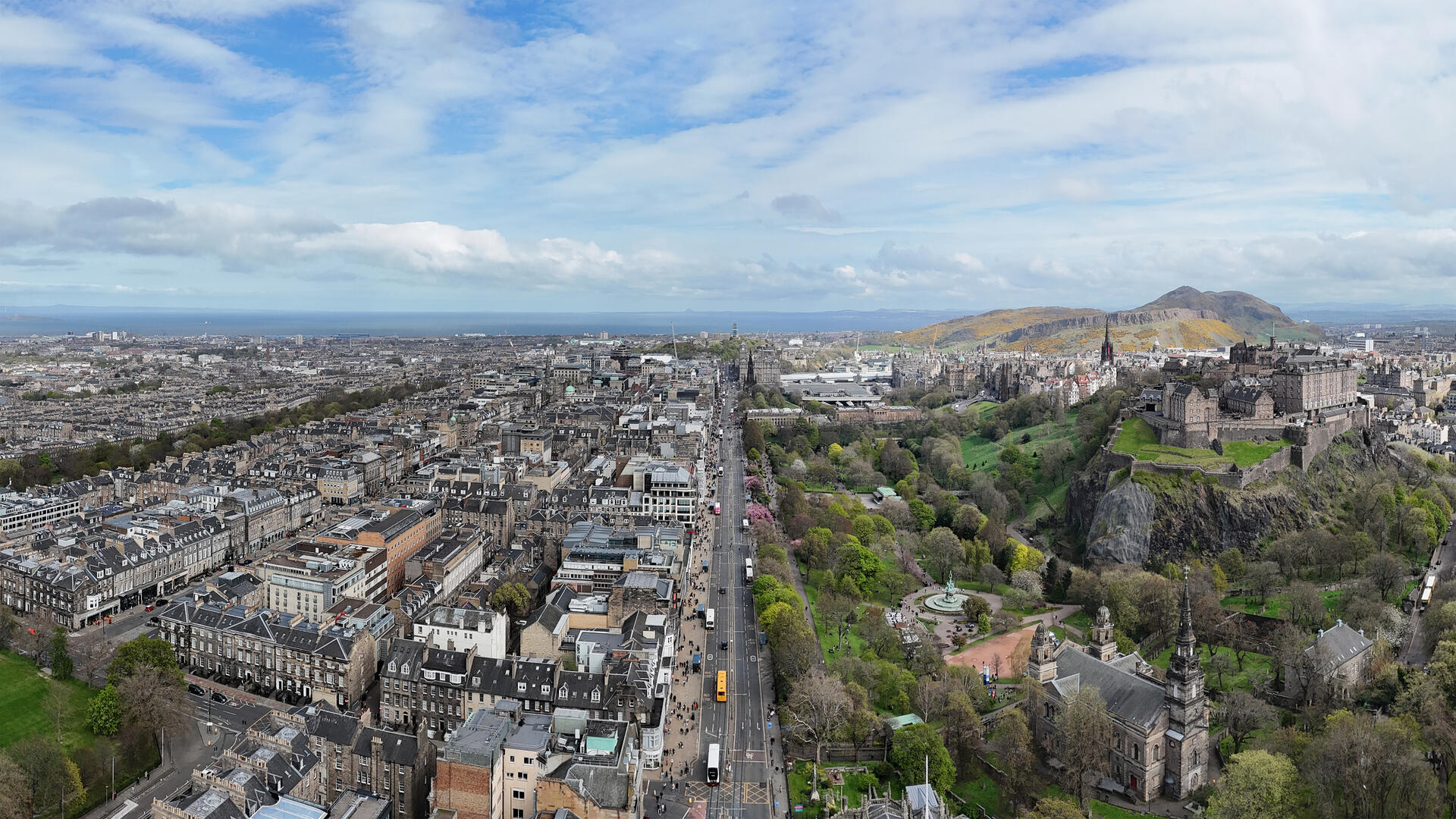
© 瑞丽江的河水, CC BY-SA 4.0 Resized from original. (This derivative is under the same CC BY-SA license.)
World Heritage Research
Discover scientific research and academic studies that deepen our understanding of Old and New Towns of Edinburgh from its history and significance to its conservation, management, and contemporary challenges.
-
The Old and New Towns of Edinburgh
Edinburgh's Old and New Towns demonstrate a highly effective model for protecting world cultural heritage, even amid global pressures from tourism and commercial development. The city's approach integrates top-down and bottom-up strategies, involving municipal officials and the independent Edinburgh World Heritage Trust. Strict planning regulations at national, regional, and local levels ensure the authenticity and integrity of its heritage sites. This legal framework is detailed, standardized, and operationally effective, serving as a benchmark for safeguarding world heritage. The study highlights how a comprehensive, multi-layered system can balance development with preservation, offering valuable insights for other UNESCO World Heritage Sites.
Liu, C., & Liu, C. (2024). The Old and New Towns of Edinburgh. OALib, 11(03), 1–7. https://doi.org/10.4236/oalib.1111375
View Publication Record | Read Publication -
Edinburgh - The Making of a Capital City
Edinburgh stands out as a uniquely preserved capital city, with its development intricately linked to European urban and architectural influences, conservation efforts, and governance. A key insight is the city's deliberate cultivation of identity, blending Old and New Towns holistically rather than treating them as isolated historical events. This approach extends beyond the city center, integrating suburban edges and offering a comprehensive perspective on Edinburgh's evolution over nearly 1,000 years. The study employs a thematic framework centered on architecture, landscape, sustainability, and governance to analyze these dynamics, revealing how political and institutional investments have shaped Edinburgh's distinct character—unmatched in the UK for its careful preservation of image and identity.
Edwards, B., & Jenkins, P. (2019). Edinburgh - The Making of a Capital City (, Ed.). Edinburgh University Press. https://doi.org/10.1515/9781474467988
View Publication Record | Read Publication