World Heritage Identification Number: 192
World Heritage since: 1982
Category: Cultural Heritage
WHE Type: Historic Cities & Urban Areas
Transboundary Heritage: No
Endangered Heritage: Yes
Country: 🇾🇪 Yemen
Continent: Asia
UNESCO World Region: Arab States
Map
The Vertical Metropolis of the Desert: A Journey Through the Old Walled City of Shibam
The Old Walled City of Shibam, nestled within the rugged terrain of Wadi Hadhramaut in eastern Yemen, stands as a testament to human ingenuity and resilience. Inscribed as a UNESCO World Heritage Site in 1982, this ancient urban center offers a unique blend of architectural prowess, cultural richness, and historical significance that continues to captivate visitors from around the globe.
More to come…UNESCO Description of the World Heritage Site
Surrounded by a fortified wall, the 16th-century city of Shibam is one of the oldest and best examples of urban planning based on the principle of vertical construction. Its impressive tower-like structures rise out of the cliff and have given the city the nickname of ‘the Manhattan of the desert’.
UNESCO Justification of the World Heritage Site
Criterion (iii): The defensive character of Shibam with its dense conglomeration of many-storeyed buildings with almost no fenestration at ground level is an exceptional testimony to the strong competition that existed between rival families over this region. While the highly homogenous society traces its roots to Shibam over centuries, the traditional way of life exemplified by the city and its tower houses is threatened by social and economic change.
Criterion (iv): Surrounded by a fortified wall, the historic city of Shibam is one of the oldest and best examples of urban planning based on multi-storeyed construction. It represents the most accomplished example of traditional Hadrami urban architecture, both in the grid lay-out of its streets and squares, and in the visual impact of its form rising out of the flood plain of the wadi, due to the height of its mud brick tower houses. These illustrate the key period of Hadrami history from the 16th to the 19th centuries, when local traders developed economic and political prestige through travel and trade abroad.
Criterion (v): Located between two mountains on the edge of a giant flood wadi and almost completely isolated from any other urban settlement, Shibam and its setting preserve the last surviving and comprehensive evidence of a traditional society that has adapted to the precarious life of a spate agriculture environment. It is vulnerable to social and economic change and the constant threat of annual flood incursions.
Encyclopedia Record: Shibam
Shibam, officially the Old Walled City of Shibam, is a town in Wadi Hadhramaut in eastern Yemen with about 7,000 inhabitants. It is the seat of the Shibam District in the Hadhramaut Governorate. It is known for its mudbrick-made high-rise buildings, with some of the buildings reaching as high as 11 stories. The design centred around protecting the residents of the city from Bedouin attacks.Additional Site Details
Area: Not available
Number of Components: 1
(iv) — Outstanding example of a type of building or landscape
(v) — Outstanding example of traditional human settlement
Coordinates: 15.92694 , 48.62667
Image
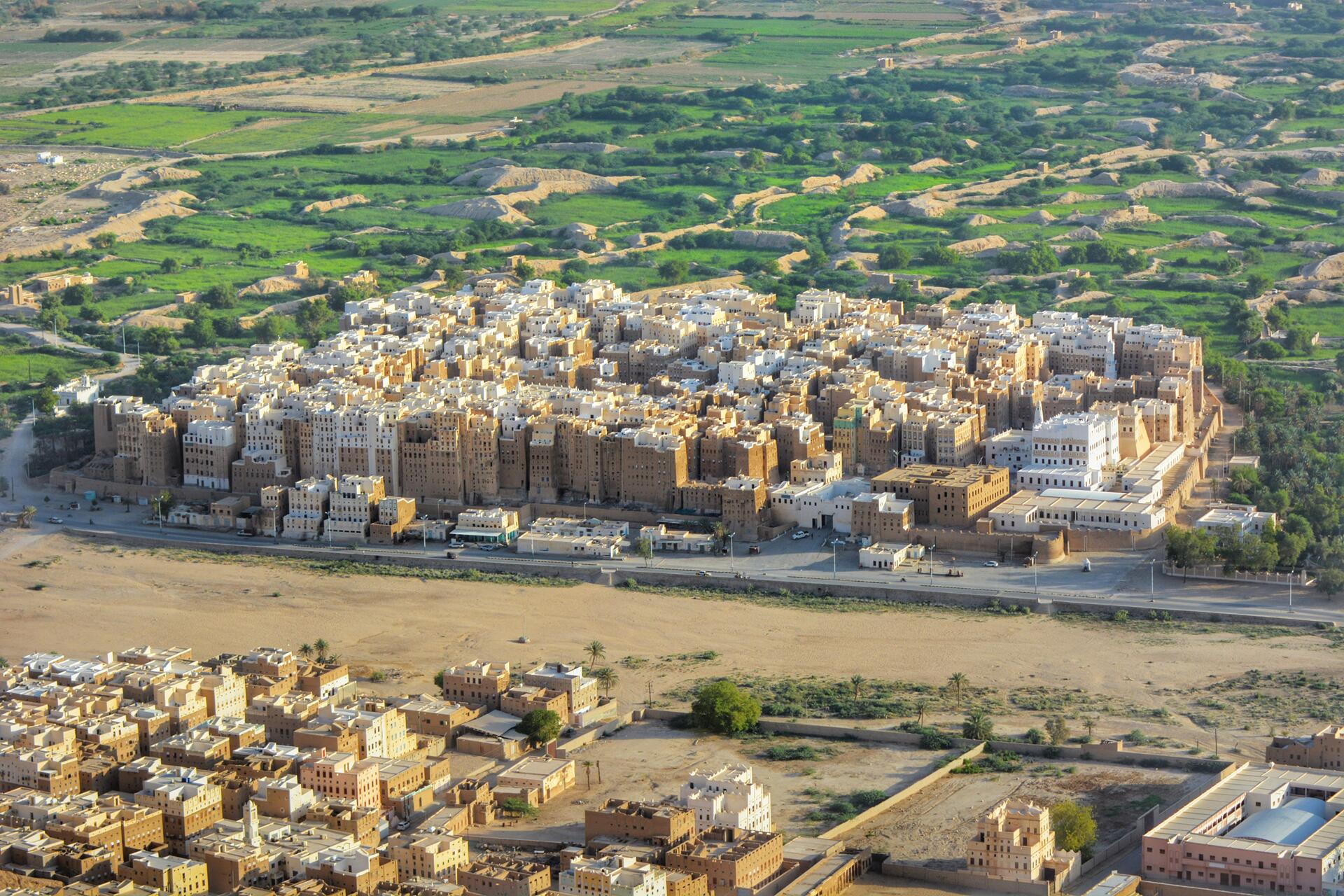
© Bkar6190, CC BY-SA 4.0 Resized from original. (This derivative is under the same CC BY-SA license.)
World Heritage Research
Discover scientific research and academic studies that deepen our understanding of Old Walled City of Shibam from its history and significance to its conservation, management, and contemporary challenges.
-
Using Three- Dimensional Modeling Techniques in Digital Preservation of Urban Plans for the Old Walled City of Shibam Hadramawt
A digital preservation platform for Shibam's historic urban landscape, leveraging 3D modeling and metadata, offers a transformative approach to safeguarding cultural heritage. This method circumvents traditional preservation challenges posed by political and economic instability, enabling efficient documentation of urban elements. The study employed a descriptive inductive approach to analyze theoretical frameworks while developing the platform using practical 3D modeling techniques. By associating metadata with each graphic object, this innovation provides a scalable solution for digital archiving, preserving Shibam's unique architectural and topographic identity for future generations.
Al-Asta, S. K. A., & Al-Dhubhani, B. R. A. (2023). Using Three- Dimensional Modeling Techniques in Digital Preservation of Urban Plans for the Old Walled City of Shibam Hadramawt. University of Science and Technology Journal for Engineering and Technology, 1(1), 1–27. https://doi.org/10.59222/ustjet.1.1.1
View Publication Record | Read Publication -
Smart cities, metaverses, and the relevance of place
Ancient urban design wisdom offers sustainable lessons for modern smart cities. The 16th-century walled city of Shibam, a UNESCO World Heritage Site in Yemen, demonstrates sophisticated passive environmental strategies—using locally sourced mud and dense street layouts—to achieve thermal comfort in extreme heat without energy-intensive cooling. Unlike contemporary cities like Riyadh, which rely on high-energy steel-and-glass structures, Shibam’s design embeds deep local knowledge, reducing carbon footprints by 70% or more compared to modern alternatives. The study argues that smart city innovations must integrate such context-aware approaches rather than discard traditional designs, emphasizing that technological advancement without place-based understanding risks inefficiency and unsustainability.
Aurigi, A. (2022). Smart cities, metaverses, and the relevance of place. IET Smart Cities, 4(3), 157–159. Portico. https://doi.org/10.1049/smc2.12030
View Publication Record | Read Publication -
The Conservation of the Urban Architectural Heritage of Yemen
Yemen's architectural heritage, particularly the UNESCO-listed Old Walled City of Shibam, has gained global recognition for its millennia-old tradition of high-quality design and construction. This study highlights the unique urban culture in Yemen, where streets serve as multifunctional spaces for living, working, and social interaction, contributing to the preservation of architectural heritage. The research emphasizes the need for international conservation efforts, following appeals by Yemeni governments and UNESCO, to protect these significant cultural sites from degradation.
Lewcock, R. (2021). The Conservation of the Urban Architectural Heritage of Yemen. Economy, Society & Culture in Contemporary Yemen, 215–225. https://doi.org/10.4324/9781003165156-19
View Publication Record | Read Publication