World Heritage Identification Number: 1699
World Heritage since: 2023
Category: Natural Heritage
WHE Type: Protected Areas & National Parks
Transboundary Heritage: No
Endangered Heritage: No
Country: 🇸🇦 Saudi Arabia
Continent: Asia
UNESCO World Region: Arab States
Map
A Journey Through 'Uruq Bani Ma'arid: A Desert Haven in Southern Saudi Arabia
Nestled within the vast expanse of the Rub' al Khali, the largest continuous sand sea on Earth, lies 'Uruq Bani Ma'arid, a protected area that stands as a testament to the resilience of nature and human coexistence. Inscribed as a UNESCO World Heritage Site in 2023, this remarkable region offers a unique blend of breathtaking landscapes, diverse ecosystems, and a rich cultural heritage.
More to come…UNESCO Description of the World Heritage Site
The property encompasses the western part of the greatest expanse of windblown sand on Earth, known as Ar Rub' al-KhaIi, and conserves a portion of one of the Earth’s most spectacular desert landscapes. The varied topography of the property creates a wide range of ecosystems. The site is globally notable due to the reintroduction of iconic desert animals, including the Arabian Oryx (Oryx leucoryx) and Arabian Sand Gazelle (Gazella marica). In the case of the oryx, this was after decades of extinction in the wild. The mobile dunes also provide an excellent and well-oxygenated habitat for sand-diving invertebrates and reptiles, while incised wadis in the limestone plateau harbor rare relict plants. The area has also been used for generations by pastoral, nomadic Bedu.
UNESCO Justification of the World Heritage Site
Criterion (vii): 'Uruq Bani Ma'arid is an iconic hyper-arid sand desert representing the largest sand sea on Earth, Ar-Rub' al-Khali. Where the sands meet the Tuwayq escarpment, they form an extraordinary spectrum of juxtaposed contrasts and fusions of forms and colours. 35 longitudinal sand dunes (‘uruq in Arabic) reach up to 200 km in length and rise up to 170 m in height. Their wavelength ranges between 2.5 and 4.5 km. The property is also distinguished by the widespread presence of zibars, which are particularly well-developed in the property. Zibars are features that are generally of low relief, without well-formed slip faces, and composed of coarse and relatively poorly-sorted sand. The property serves as an ecological refuge for iconic wildlife of the desert and offers a world-class panorama of the windblown sands of the Ar-Rub' al-Khali desert, with some of the world’s highest longitudinal dune fields, and inter-dunal corridors, eastward-flowing high vegetation wadis, the Tuwayq Escarpment engulfed by westward flowing sands, and low sand plains to the west of the escarpment. A wide spectrum of colour harmonies derives from the resonance of contrasting hues of the sand grains in the ripples that cover the dunes. A true portrait of the desert where the light-coloured Arabian Oryx (or wudayhi, meaning clear in Arabic) contrasts against the large-scale and dramatic backdrop of the hyper-arid environment.
Criterion (ix): The varied topography of the property creates a wide range of wildlife habitats and niches, including ecological refuges for the Arabian Oryx, Arabian Sand Gazelles and Arabian Mountain Gazelles, successfully reintroduced into their natural habitats (in the case of the Arabian Oryx, after decades of extinction in the wild), with each having 19%, 25% and 2% respectively of their total worldwide population present within the property. The animal populations are completely free ranging in a huge area with a high level of ecological integrity. Ingenious adaptations by plant and animal species to the hostile environment and speciation processes can be observed. The Arabian Sand Gazelle is adapted to great extremes of temperature and drought and the Arabian Oryx is able to adapt to rising temperatures. The property counts 526 recorded species at the time of inscription, forming an intact ecosystem. The Tuwayq Escarpment and its associated network of inland wadis play a vital role to support woody perennial plants, which are essential as feeding and shelter areas for the flagship species. Whilst low on biodiversity compared to other desert properties globally, 'Uruq Bani Ma'arid appears to exhibit the richest flora in the Ar-Rub’ al-Khali with 118 plant species recorded and a high level of endemism. The area also hosts five reptile species endemic to Arabia and it is a critical site for plant conservation, with locally endemic, near-endemic, regionally endemic and/or regional range-restricted taxa.
Encyclopedia Record: 'Uruq Bani Ma'arid
'Uruq Bani Ma'arid is a protected area in southern Saudi Arabia, located on the western edge of the Rub' al Khali, the largest sandy desert in the world. The protected area is divided into three sections; a core nature reserve; a zone where controlled grazing is permitted; and a hunting zone.Additional Site Details
Area: 1,276,500 hectares
Number of Components: 1
(ix) — Outstanding example representing ecological and biological processes
Coordinates: 19.3638888889 , 45.5983333333
IUCN World Heritage Outlook
The 2025 Conservation Outlook on ‘Uruq Bani Ma’arid reports the following assessment:
Source: International Union for Conservation of Nature (IUCN) · View assessment
Image
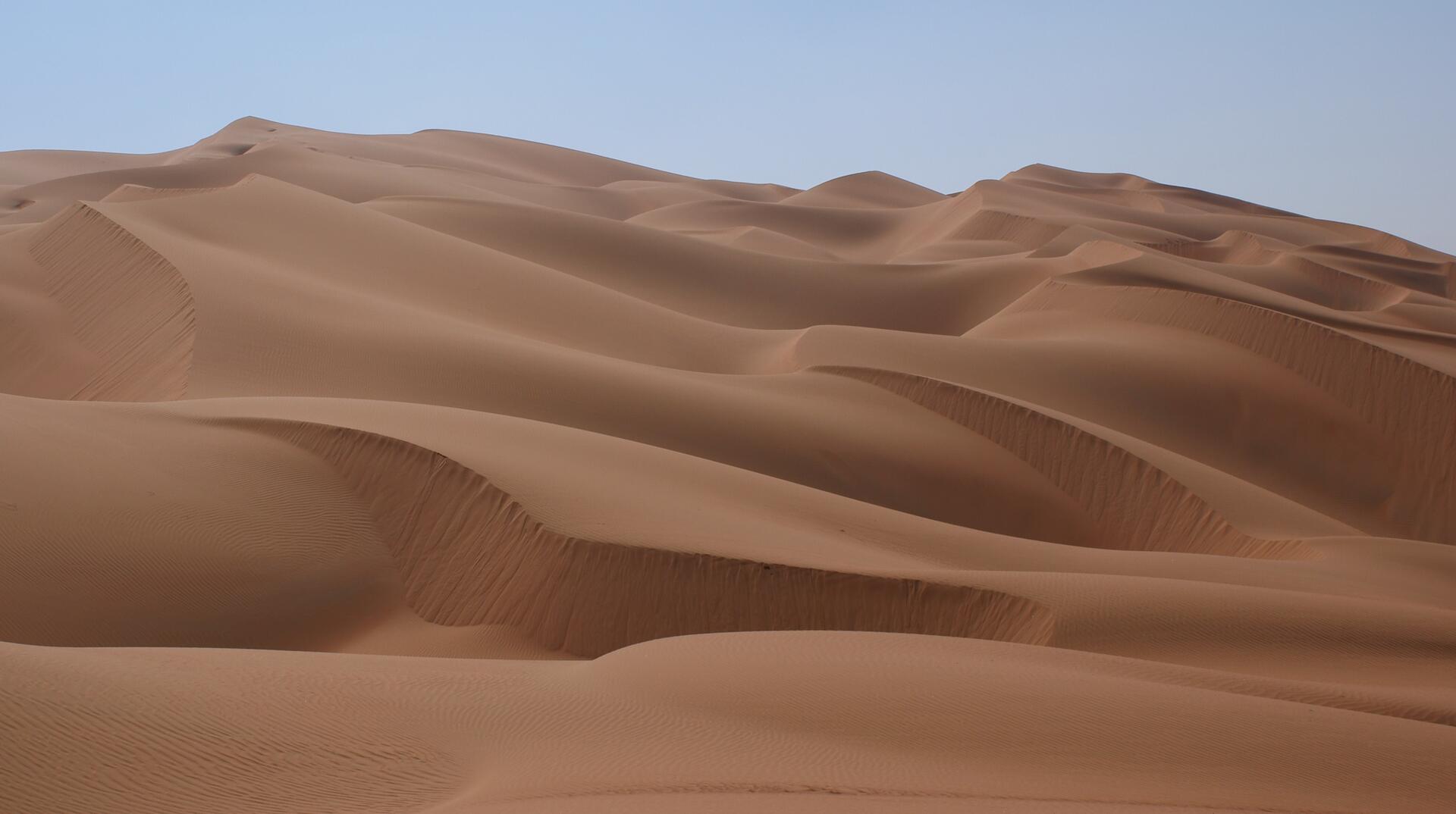
© Nepenthes, CC BY-SA 3.0 Resized from original. (This derivative is under the same CC BY-SA license.)
World Heritage Research
Discover scientific research and academic studies that deepen our understanding of ‘Uruq Bani Ma’arid from its history and significance to its conservation, management, and contemporary challenges.
-
The conservation status of the threatened gazelles of Ar Rub’ al-Khālī, Saudi Arabia
A long-term conservation effort involving the reintroduction of 313 captive-bred gazelles—240 Arabian sand gazelles and 73 Arabian gazelles—into the Uruq Bani Ma'arid Protected Area in Saudi Arabia's Ar Rub’ al-Khālī desert has shown promising results. Two decades after release, both species established stable populations with distinct habitat preferences: Arabian gazelles thrived on the western side, while sand gazelles spread across the central protected area, exhibiting seasonal movements tied to temperature shifts. The study also revealed that these gazelles adapt their activity patterns seasonally, becoming more nocturnal during hot months and diurnal in cooler periods. This research demonstrates that strategic reintroduction of desert gazelles into protected habitats can lead to successful population establishment, even in complex environments where conventional monitoring is challenging.
Wacher, T., Alboug, A., Barichievy, C., Mir, Z. R., Bruce, T., Olson, D., & Amin, R. (2025). The conservation status of the threatened gazelles of Ar Rub’ al-Khālī, Saudi Arabia. Journal of Arid Environments, 229, 105396. https://doi.org/10.1016/j.jaridenv.2025.105396
View Publication Record | Read Publication -
Reptile richness and topographic heterogeneity in the 'Uruq Bani Ma'arid Protected Area, southern Saudi Arabia
A survey of reptiles in the 'Uruq Bani Ma'arid Protected Area, southern Saudi Arabia, revealed that species richness and occupancy are positively linked to topographic heterogeneity. Eighteen reptile species were detected, with higher diversity found in areas combining rocky and sandy habitats. This finding suggests that topographic complexity could be a key factor influencing reptile distribution in arid environments. The study employed a robust survey design and multi-species occupancy modeling, providing preliminary evidence that satellite-derived topographic data may aid in identifying potential protected sites for reptiles. Further research is needed to validate these patterns across broader arid landscapes.
Al Mutairi, M., Smith, M., Alqahtani, A. R., Mir, Z. R., Ahmed, R., & Alsubaie, S. (2024). Reptile richness and topographic heterogeneity in the ’Uruq Bani Ma’arid Protected Area, southern Saudi Arabia. Reptiles & Amphibians, 31(1), e21181. https://doi.org/10.17161/randa.v31i1.21181
View Publication Record | Read Publication -
A new distribution record of Arnold’s Gecko, Pristurus minimus (Arnold, 1977) (Squamata, Sphaerodactylidae), in Saudi Arabia
A new distribution record of Arnold’s Gecko, Pristurus minimus, expands the known range of this species within Saudi Arabia. Previously documented from Oman and Yemen, four individuals were confirmed through physical and genetic analysis in the Uruq Bani Ma’arid Protected Area (UBM), marking the first record for Saudi Arabia. This discovery increases the number of Pristurus species in the Kingdom to five, contributing critical data to the understanding of its reptile fauna. The study highlights the importance of comprehensive taxonomic and distributional research for effective conservation strategies, particularly in regions with understudied biodiversity.
Al Mutairi, M., Alqahtani, A., Mir, Z. R., Ahmad, R., Alsubaie, S., & Smith, M. (2023). A new distribution record of Arnold’s Gecko, Pristurus minimus (Arnold, 1977) (Squamata, Sphaerodactylidae), in Saudi Arabia. Biodiversity Data Journal, 11. https://doi.org/10.3897/bdj.11.e101647
View Publication Record | Read Publication -
The status and ecology of the sand cat in the Uruq Bani Ma’arid Protected Area, Empty Quarter of Saudi Arabia
A groundbreaking camera-trap survey in the Uruq Bani Ma’arid Protected Area, part of the Empty Quarter in Saudi Arabia, has revealed a significantly larger and more widespread population of sand cats than previously believed. The study, one of the largest desert-based surveys of its kind, captured over 1500 images across 100 camera-traps spread over 2400 km². Sand cats were found in all major habitats—escarpment plateaus, sand dunes, and interdunal gravel valleys—but showed a preference for the interior parallel dune system with gravel valleys during hot seasons. Unlike larger predators like the Arabian red fox or honey badger, which favored escarpment plateaus, sand cats exhibited minimal spatial interaction with other carnivores, except for Rueppell’s fox in the main dune system. Their strictly nocturnal behavior was also marked by 14% higher activity during hot seasons compared to cooler periods.
Amin, R., Wacher, T., Bruce, T., & Barichievy, C. (2021). The status and ecology of the sand cat in the Uruq Bani Ma’arid Protected Area, Empty Quarter of Saudi Arabia. Mammalia, 85(3), 220–226. https://doi.org/10.1515/mammalia-2020-0031
View Publication Record | Read Publication