World Heritage Identification Number: 385
World Heritage since: 1986
Category: Cultural Heritage
WHE Type: Historic Cities & Urban Areas
Transboundary Heritage: No
Endangered Heritage: Yes
Country: 🇾🇪 Yemen
Continent: Asia
UNESCO World Region: Arab States
Map
Ancient Wonders of the Old City of Sana'a: A Testament to Islamic History and Architectural Mastery
The Old City of Sana'a, nestled in a mountain valley at an elevation of approximately 2,200 meters above sea level, stands as a testament to the rich cultural and historical heritage of Yemen. Designated a UNESCO World Heritage Site in 1986, this ancient city has been inhabited for more than 2,500 years, making it one of the most significant historic urban centers in the Middle East.
UNESCO recognizes the city for its outstanding architectural heritage, unique urban landscape, and exceptional testimony to the cultural traditions of the Arabian Peninsula. Situated within the Amanat Al Asimah Governorate, the Old City of Sana'a serves as a living museum, offering visitors a glimpse into the past through its remarkable collection of well-preserved architectural structures. Unlike many static archaeological sites, this historic district thrives as a living, breathing community that continues to preserve the essence of Yemeni culture and tradition.
Among the most famous historic landmarks associated with Sana'a is the legendary Ghumdan Palace, a pre-Islamic structure whose origins remain uncertain. Although little of the original building survives today, it occupies an important place in Yemeni history and tradition, reflecting the architectural achievements of the region's early civilizations.
During the 7th and 8th centuries, Sana'a emerged as a major center for the propagation of Islam, leaving a lasting impact on the city's religious, cultural, and political landscape. Today, the city boasts over 100 mosques, at least 12 hammams (public baths), and over 6,000 traditional tower houses. Many of these structures trace their origins to the centuries before the 11th century and collectively illustrate the city's long and continuous development.
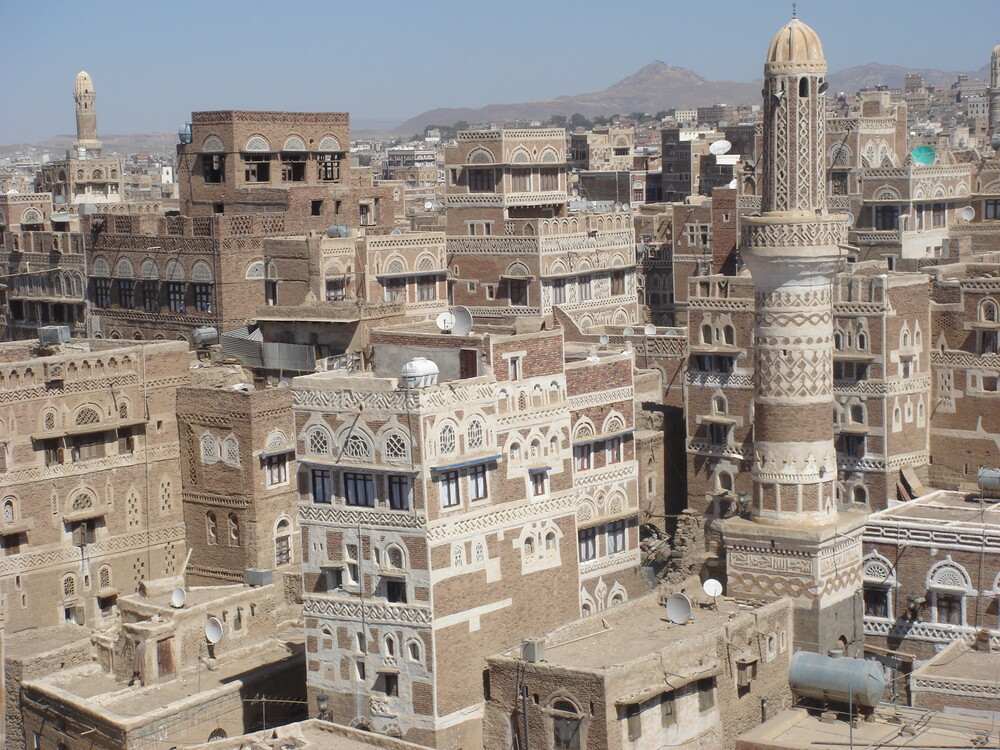
The architecture of the Old City of Sana'a is renowned for its distinctive multi-story tower houses, many of which rise between five and nine stories high. Constructed primarily from stone, brick, and earth, these buildings are decorated with intricate white gypsum patterns and colorful stained-glass windows known as qamariyah. Designed to accommodate extended families while maximizing limited urban space, the houses represent one of the world's most remarkable examples of traditional high-rise architecture and have become a defining symbol of Yemeni cultural identity.
Among the most notable religious landmarks in the Old City is the Great Mosque of Sana'a, which dates back to the earliest years of Islam and is more than 1,400 years old, making it one of the oldest mosques in the Islamic world. Founded during the lifetime of the Prophet Muhammad or shortly thereafter, it has served as a center of worship, learning, and community life for more than fourteen centuries. The mosque is also renowned for the discovery of some of the oldest known Quranic manuscripts, which have provided valuable insights into the early history of Islam.
Beyond its religious importance, Sana'a has long served as a center of commerce, learning, and craftsmanship. For centuries, its bustling markets connected merchants from different parts of Arabia and beyond, while local artisans became renowned for their expertise in metalworking, jewelry making, textiles, and woodworking. The city's historic souqs continue to preserve many of these traditions, offering valuable insight into the social and economic life that has shaped Sana'a throughout its long history.
The Old City of Sana'a is surrounded by ancient clay walls that reach heights of approximately 9–14 meters (30–46 feet). Within these walls, visitors encounter a labyrinthine network of narrow streets lined with distinctive multi-story tower houses adorned with elaborate friezes, intricately carved frames, and stained-glass windows. Often rising several stories high, these buildings create a striking skyline that has become one of the city's defining features.
Despite its remarkable state of preservation, the Old City of Sana'a faces numerous challenges in the modern era. Armed conflict, environmental pressures, aging infrastructure, and periodic flooding have threatened many of its historic structures. Recognizing these dangers, UNESCO has placed the site on the List of World Heritage in Danger, drawing international attention to the urgent need for conservation. Ongoing restoration projects aim to safeguard the city's architectural heritage while ensuring that it remains a living community for future generations.
In summary, the Old City of Sana'a offers a captivating glimpse into the rich tapestry of Yemeni history and culture. With its ancient mosques, hammams, and traditional tower houses, the city stands as a testament to the enduring legacy of Islamic civilization and the remarkable skill of its builders. As we continue to study and appreciate the wonders of the Old City of Sana'a, we are reminded of the importance of preserving our shared cultural heritage for future generations.
UNESCO Description of the World Heritage Site
Situated in a mountain valley at an altitude of 2,200 m, Sana’a has been inhabited for more than 2,500 years. In the 7th and 8th centuries the city became a major centre for the propagation of Islam. This religious and political heritage can be seen in the 103 mosques, 14 hammams and over 6,000 houses, all built before the 11th century. Sana’a’s many-storeyed tower-houses built of rammed earth (pisé) add to the beauty of the site.
UNESCO Justification of the World Heritage Site
Criterion (iv): Within its partially preserved wall, it offers an outstanding example of a homogeneous architectural ensemble, which design and detail translate an organization of space characteristic of the early centuries of Islam which has been respected over time.
Criterion (v): The houses of Sana'a, which have become vulnerable as a result of contemporary social changes, are an outstanding example of an extraordinary masterpiece, traditional human settlement.
Criterion (vi): Sana'a is directly and tangibly associated with the history of the spread of Islam in the early years of the Hegira. The Great mosque of Sana'a, built in year 6 of Hegira, is known as the first mosque built outside Mecca and Medina.The Old City of Sana'a has contributed to and played a major role in Yemeni, Arab and Islamic World history through the contributions of historical Yemeni figures including Al Hassan B. Ahmed Al Hamdany, Ahamed Al Razy and Al Shawkany.
Encyclopedia Record: Old City of Sanaa
The Old City of Sanaʽa is a recognised UNESCO World Heritage Site in the Amanat Al Asimah Governorate, Yemen. As of 2003, the district had a population of 63,398 inhabitants. The old fortified city has been inhabited for more than 2,500 years and contains many intact architectural sites. The oldest, partially standing architectural structure in the Old City of Sanaʽa is Ghumdan Palace. The city was declared a World Heritage Site by the United Nations in 1986. Efforts are underway to preserve some of the oldest buildings some of which, such as the Samsarh and the Great Mosque of Sanaʽa, is more than 1,400 years old. Surrounded by ancient clay walls that stand 9–14 metres (30–46 ft) high, the Old City contains more than 100 mosques, 12 hammams (baths), and 6,500 houses. Many of the houses resemble ancient skyscrapers, reaching several stories high and topped with flat roofs. They are decorated with elaborate friezes and intricately carved frames and stained-glass windows.Additional Site Details
Area: Not available
Number of Components: 1
(v) — Outstanding example of traditional human settlement
(vi) — Directly associated with events or living traditions
Coordinates: 15.35555556 , 44.20805556
World Heritage Research
Discover scientific research and academic studies that deepen our understanding of Old City of Sana'a from its history and significance to its conservation, management, and contemporary challenges.
-
An Approach for Preserving Ottoman Cultural Heritage Under Threat in Yemen: A Case Study " The Old City of Sana'a"
Yemen's Old City of Sana'a faces severe threats to its Ottoman-era cultural heritage due to conflict. A study proposes a preservation approach based on the European Standard (EN 16096:2012) to assess war damage and develop conservation strategies for at-risk structures. The research focuses on 28 Ottoman establishments in Sana'a, with 21 still standing and seven destroyed, highlighting the broader impact on Yemen's historical sites. This method offers a structured framework for safeguarding cultural heritage under adversity.
Alamri, Y. A., EKİMCİ, B., & İNCEOĞLU, M. (2022). AN APPROACH FOR PRESERVING OTTOMAN CULTURAL HERITAGE UNDER THREAT IN YEMEN: A CASE STUDY ” THE OLD CITY OF SANA’A”. Journal of Islamic Architecture, 7(1), 73–81. https://doi.org/10.18860/jia.v7i1.13048
View Publication Record | Read Publication -
Analysis of the Public Space in the Old Sana'a City
A balanced distribution of public spaces and buildings in the Old City of Sana'a enhances urban comfort, social interaction, and cultural activities. This study highlights how narrow, curved streets provide shade and reduce temperatures, contributing to improved climate conditions among residential neighborhoods. The research also notes the diversity of functions within these public spaces, which cater to the needs of residents while raising economic and social levels. Analytical and descriptive methodologies were employed to reach these conclusions.
Al-Jabali, M. A. S., & Prof. Gao Jing. (2022). Analysis of the Public Space in the Old Sana'a City. Zenodo. https://doi.org/10.5281/ZENODO.6218353
View Publication Record | Read Publication -
Investigating the Applicability of Sustainable Urban Form and Design to Traditional Cities, Case Study: The Old City of Sana'a
Traditional urban layouts, exemplified by the Old City of Sana'a, demonstrate superior sustainability compared to modern designs. A study applying principles of form and density, walkability and connectivity, and building energy found that traditional cities excel in compactness, intersection rates, and solar access. Using GIS, ECOTECT, and Space Syntax modeling, researchers confirmed that older urban forms provide higher integration, fewer angular changes, and optimal solar exposure year-round. These findings underscore the potential of historical urban planning as a model for sustainable development.
Ali, H. H., Al-Hashimi, I. A., & Al-Samman, F. (2018). INVESTIGATING THE APPLICABILITY OF SUSTAINABLE URBAN FORM AND DESIGN TO TRADITIONAL CITIES, CASE STUDY: THE OLD CITY OF SANA’A. International Journal of Architectural Research: ArchNet-IJAR, 12(2), 57. https://doi.org/10.26687/archnet-ijar.v12i2.1391
View Publication Record | Read Publication -
Reviving the heritage of the old city of Sana'a in the shop design
The Old City of Sana'a, a UNESCO World Heritage Site since 1986, faces significant challenges due to architectural and design irregularities that threaten its heritage status. A study by Imam et al. (2018) highlights the urgent need for reviving traditional shop designs within the city to preserve its unique character. The research focuses on integrating modern commercial practices with historical aesthetics, aiming to restore the city's original charm while addressing contemporary demands. Using a combination of architectural analysis and design interventions, the study proposes innovative solutions to maintain Sana'a's cultural identity, ensuring it meets UNESCO's criteria for heritage conservation. This approach balances functionality with authenticity, offering a model for other historic urban centers.
Imam, M., Gamal, D., & Sagheer, A. (2018). Reviving the heritage of the old city of Sana’a in the shop design. International Design Journal, 8(3), 259–267. https://doi.org/10.21608/idj.2018.85480
View Publication Record | Read Publication -
Traditional Neighborhood Adaptive Reuse in the Old City Sana'a, Yemen
Adaptive reuse of traditional neighborhoods (Haras) in Sana'a's Old City has shown mixed outcomes, with economic benefits for residents and the revival of traditional handicrafts. However, increased vehicular accessibility and the conversion of public spaces into parking areas have disrupted resident privacy, particularly affecting women, who have retreated indoors. The study, conducted through on-site spatial observations, measurements, and structured interviews in Hara Al-Abhar, highlights these trade-offs, offering insights for balancing development with cultural preservation in UNESCO World Heritage Sites.
Ahmed Haidar, L., & Talib, A. (2018). Traditional Neighborhood Adaptive Reuse in the Old City Sana’a, Yemen. Asian Journal of Environment-Behaviour Studies, 3(10), 187–197. https://doi.org/10.21834/aje-bs.v3i10.326
View Publication Record | Read Publication -
Adaptive Reuse in the Traditional Neighbourhood of the Old City Sana’a -Yemen
Adaptive reuse in Sana'a's traditional neighborhoods, such as Hara Al-Abhar, has shown mixed outcomes. While it boosts household income and revitalizes local handicrafts, increased vehicular access and the conversion of public spaces into parking areas disrupt residents' privacy, particularly for women, who retreat indoors. The study employed on-site spatial observations, measurements, and structured interviews to assess these impacts, revealing a complex balance between economic benefits and social consequences in preserving the cultural heritage of Yemen's Old City.
Haidar, L. A., & Talib, A. (2013). Adaptive Reuse in the Traditional Neighbourhood of the Old City Sana’a -Yemen. Procedia - Social and Behavioral Sciences, 105, 811–822. https://doi.org/10.1016/j.sbspro.2013.11.084
View Publication Record | Read Publication -
The Influence of Changing Human Aspects on Plaza Spaces in Old Sana'a City
Plaza spaces in Old Sana'a City, once vibrant hubs of social, economic, and cultural activity, have lost their significance due to changing human aspects. The study identifies key factors such as immigration, cultural and economic opening, technological progress post-1962 revolution, and republican regime influence that contributed to the decline of these spaces. The research proposes revitalizing plazas by enhancing traditional social and cultural values and introducing sustainable activities. An inferring analytical methodology was used to analyze plaza types, functions, human roles, major changes, and potential solutions for revival.
Anas, S. M., Mosa, M. A., El-Kadi, Sh. E.-K., & Morghany, E. A. (2013). THE INFLUENCE OF CHANGING HUMAN ASPECTS ON PLAZA SPACES IN OLD SANA’A CITY. JES. Journal of Engineering Sciences, 41(3), 1189–1211. https://doi.org/10.21608/jesaun.2013.114788
View Publication Record | Read Publication -
On Structural Features of the Old City of Sana'a, Yemen
The Old City of Sana'a exhibits distinct structural features within its traditional neighborhood units known as harat. Comprising 56 harat, each contains key elements such as mosques, maqushama (green fields), houses, streets, and sharhat (small open squares). This study reveals how modernization, including the installation of water supply and sewerage systems, has significantly altered these traditional units politically, socially, and physically. The research highlights the impact of such changes on Sana'a's historic environment, emphasizing the need to preserve its unique urban fabric while adapting to contemporary demands.
YOSHIDA, M. (2010). ON STRUCTURAL FEATURES OF THE OLD CITY OF SANA’A, YEMEN. Journal of Architecture and Planning (Transactions of AIJ), 75(657), 2747–2753. https://doi.org/10.3130/aija.75.2747
View Publication Record | Read Publication