World Heritage Identification Number: 381
World Heritage since: 1988
Category: Cultural Heritage
WHE Type: Historic Cities & Urban Areas
Transboundary Heritage: No
Endangered Heritage: No
Country: 🇪🇸 Spain
Continent: Europe
UNESCO World Region: Europe and North America
Map
A Historical Journey Through the Old City of Salamanca
The Old City of Salamanca, located in the heart of Spain, offers a unique blend of history, culture, and architectural splendor that makes it a must-visit destination for travelers. Inscribed as a UNESCO World Heritage Site in 1988, this ancient university town boasts a rich heritage dating back to the 3rd century B.C., making it a testament to the enduring spirit of human civilization.
More to come…UNESCO Description of the World Heritage Site
This ancient university town north-west of Madrid was first conquered by the Carthaginians in the 3rd century B.C. It then became a Roman settlement before being ruled by the Moors until the 11th century. The university, one of the oldest in Europe, reached its high point during Salamanca's golden age. The city's historic centre has important Romanesque, Gothic, Moorish, Renaissance and Baroque monuments. The Plaza Mayor, with its galleries and arcades, is particularly impressive.
UNESCO Justification of the World Heritage Site
Criterion (i): The Plaza Mayor of Salamanca, built as a result of a solemn decision by King Philip V in 1710, is a unique artistic achievement in Baroque art, and considered by many the heart of the Golden City (La Dorada). Begun in 1729 according to plans drawn by Alberto de Churriguera, and finished in 1755 by Andrés García de Quiñones, and with contributions from Nicolás de Churriguera and José de Lara de Churriguera, it is one of the most important urban ensembles of 18th century Europe.
Criterion (ii): With the Plaza Mayor, the Clerecía (the Jesuit seminary), the college of Calatrava, the Colegio San Ambrosio, the churches of San Sebastián and Santa Cruz de Cañizares, the New Cathedral, and San Esteban, Salamanca is one of the essential art centres of the Churriguera family dynasty of architects, decorators and sculptors of Catalonia. The “churrigueresque” style exerted considerable influence in the 18th century not only in the Iberian Peninsula, but also in Latin America.
Criterion (iv): Although founded later than those of Bologna, Paris, and Oxford, the University of Salamanca had already established itself as one of the best academic institutions in Europe by 1250. It conserves an admirable architectural heritage that illustrates the diverse functions of a university institution in the Christian world. The Hospital del Estudio, the Escuelas Mayores, the Escuelas Menores, and the various colleges, which multiplied between the 15th and 18th centuries, form a group of exceptional coherence within a historic city also remarkable for its numerous civil and religious monuments.
Encyclopedia Record: Salamanca
Salamanca is a municipality and city in the autonomous community of Castile and León in Spain, and the capital of the Province of Salamanca. Attached to the comarca of Campo Charro, the city lies on the northern half of the Meseta Central, in the western-central part of the Iberian Peninsula, straddling the Tormes river. Its population in 2024 was 144,458, making Salamanca the 46th-largest municipality in Spain. The University of Salamanca, founded in 1218, is one of the oldest in Western Europe, and the Old City of Salamanca is a UNESCO World Heritage Site, which every year attracts a significant number of students and cultural tourists.Additional Site Details
Area: 50.78 hectares
Number of Components: 8
(ii) — Significant interchange of human values
(iv) — Outstanding example of a type of building or landscape
Coordinates: 40.96525 , -5.6645
Image
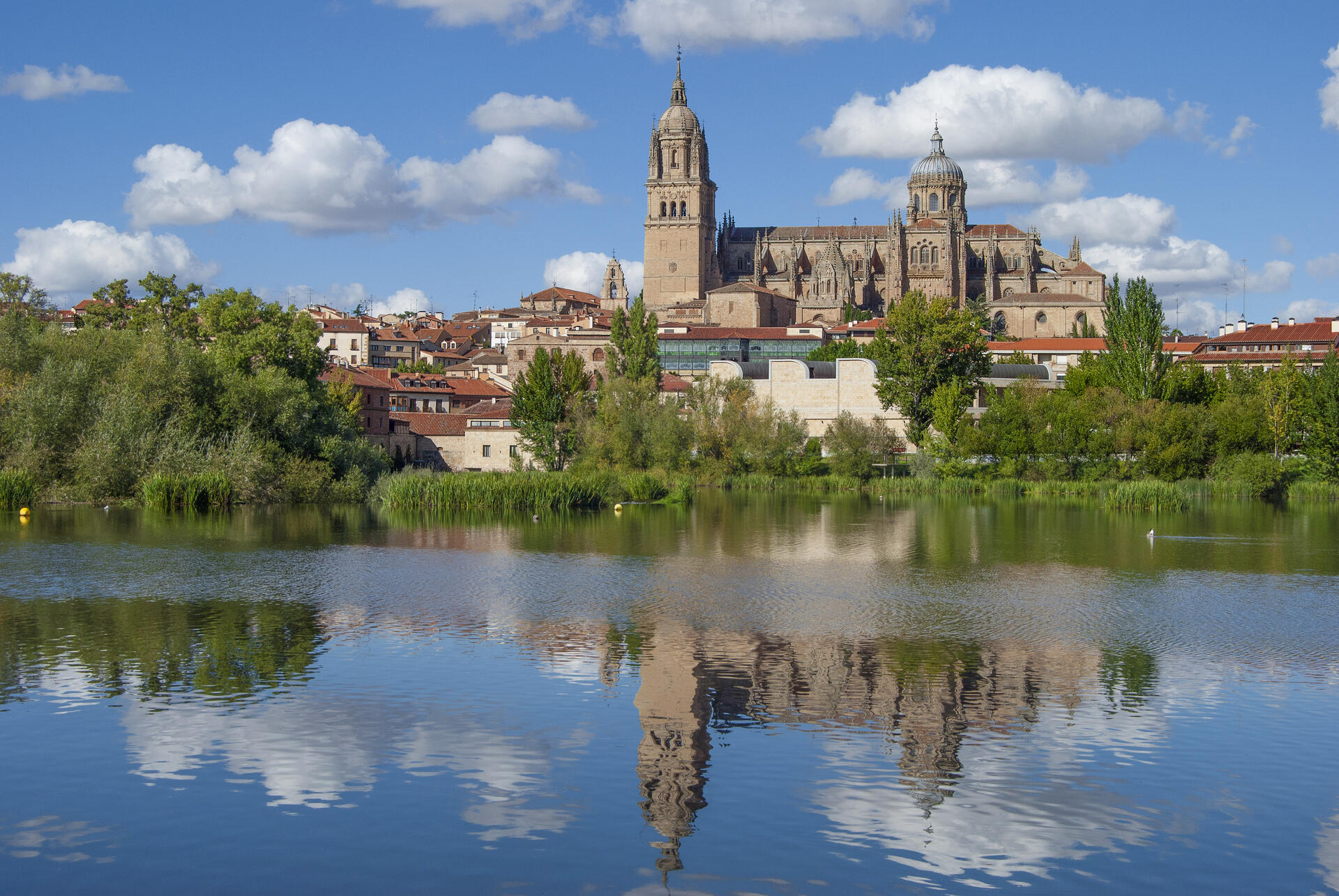
© Santiagova, CC BY-SA 3.0 es Resized from original. (This derivative is under the same CC BY-SA license.)
World Heritage Research
Discover scientific research and academic studies that deepen our understanding of Old City of Salamanca from its history and significance to its conservation, management, and contemporary challenges.
-
Suitable Re-Use of Abandoned Quarries for Restoration and Conservation of the Old City of Salamanca—World Heritage Site
Abandoned granite quarries near the Old City of Salamanca hold potential for supplying high-quality stone blocks for monument restoration. Research reveals that Martinamor granite outcrops exhibit a dense fracturing pattern with joint spacing less than one meter, making large-scale exploitation impractical. Instead, only small blocks suitable for heritage conservation can be extracted, necessitating the protection of these sites to preserve both historical extraction techniques and geological significance. The study proposes geoconservation strategies to safeguard quarries, ancient mining areas, and their role as a reminder of society's reliance on geological materials.
Sousa, L., Lourenço, J., & Pereira, D. (2019). Suitable Re-Use of Abandoned Quarries for Restoration and Conservation of the Old City of Salamanca—World Heritage Site. Sustainability, 11(16), 4352. https://doi.org/10.3390/su11164352
View Publication Record | Read Publication -
Villamayor Stone (Golden Stone) as a Global Heritage Stone Resource from Salamanca (NW of Spain)
Villamayor Stone (VS), also known as Golden Stone or Franca Stone, is proposed as a Global Heritage Stone Resource due to its historical significance and unique characteristics. This arkosic stone, quarried in Villamayor de Armuña, Salamanca, Spain, is renowned for its ochreous/golden patina and has been used in the construction of prominent monuments such as the Old Cathedral, New Cathedral, University façade, and the Roman Bridge. The study highlights VS's importance in Salamanca's architectural heritage, noting its continued use in monument restoration despite economic challenges that have reduced its application in new buildings. The research emphasizes the need to protect its quarries and masonry craft for future generations, advocating for its recognition as a Global Heritage Stone Resource.
Garcia-Talegón, J., Iñigo, A. C., Alonso-Gavilán, G., & Vicente-Tavera, S. (2014). Villamayor Stone (Golden Stone) as a Global Heritage Stone Resource from Salamanca (NW of Spain). Geological Society, London, Special Publications, 407(1), 109–120. https://doi.org/10.1144/sp407.19
View Publication Record | Read Publication -
Building stone as a part of a World Heritage Site: ‘Piedra Pajarilla’ Granite and the city of Salamanca, Spain
A unique granite, 'Piedra Pajarilla,' has been identified as the primary building material for many of Salamanca's monuments, now part of a UNESCO World Heritage Site. This study highlights the importance of preserving and using the original building stone for restoration to maintain architectural integrity, avoiding the pitfalls seen with alternative materials. The research emphasizes the durability and historical significance of local granites, drawing parallels with ancient Roman engineering practices that prioritized longevity and local sourcing. By analyzing the properties and historical use of 'Piedra Pajarilla,' the study advocates for its preservation to ensure the authenticity and resilience of Salamanca's heritage structures.
Pereira, D., & Cooper, B. J. (2013). Building stone as a part of a World Heritage Site: ‘Piedra Pajarilla’ Granite and the city of Salamanca, Spain. Geological Society, London, Special Publications, 391(1), 7–16. https://doi.org/10.1144/sp391.3
View Publication Record | Read Publication -
The sustainability of management practices in the Old City of Salamanca
Research reveals that the Old City of Salamanca lacks consistent management practices for preservation, putting its outstanding universal value at risk from new urban developments. The study examines the city's situation before, during, and after its nomination as a World Heritage Site, using the Auditorium project as a case example to illustrate threats to heritage integrity. It highlights the challenges in regulating development while preserving cultural significance, offering insights for local authorities to mitigate risks. This work contributes to discussions on sustainable urban development and heritage conservation, providing evidence-based guidance for similar sites globally.
Pons, A., Pereira Roders, A. R., & Turner, M. (2011). The sustainability of management practices in the Old City of Salamanca. Facilities, 29(7/8), 326–338. https://doi.org/10.1108/02632771111130933
View Publication Record | Read Publication