World Heritage Identification Number: 148
World Heritage since: 1981
Category: Cultural Heritage
WHE Type: Historic Cities & Urban Areas
Transboundary Heritage: No
Endangered Heritage: Yes
Country: Jerusalem (Site proposed by Jordan)
Continent: Asia
UNESCO World Region: Arab States
Map
The Old City of Jerusalem and Its Significant Walls: A Cultural and Religious Hub
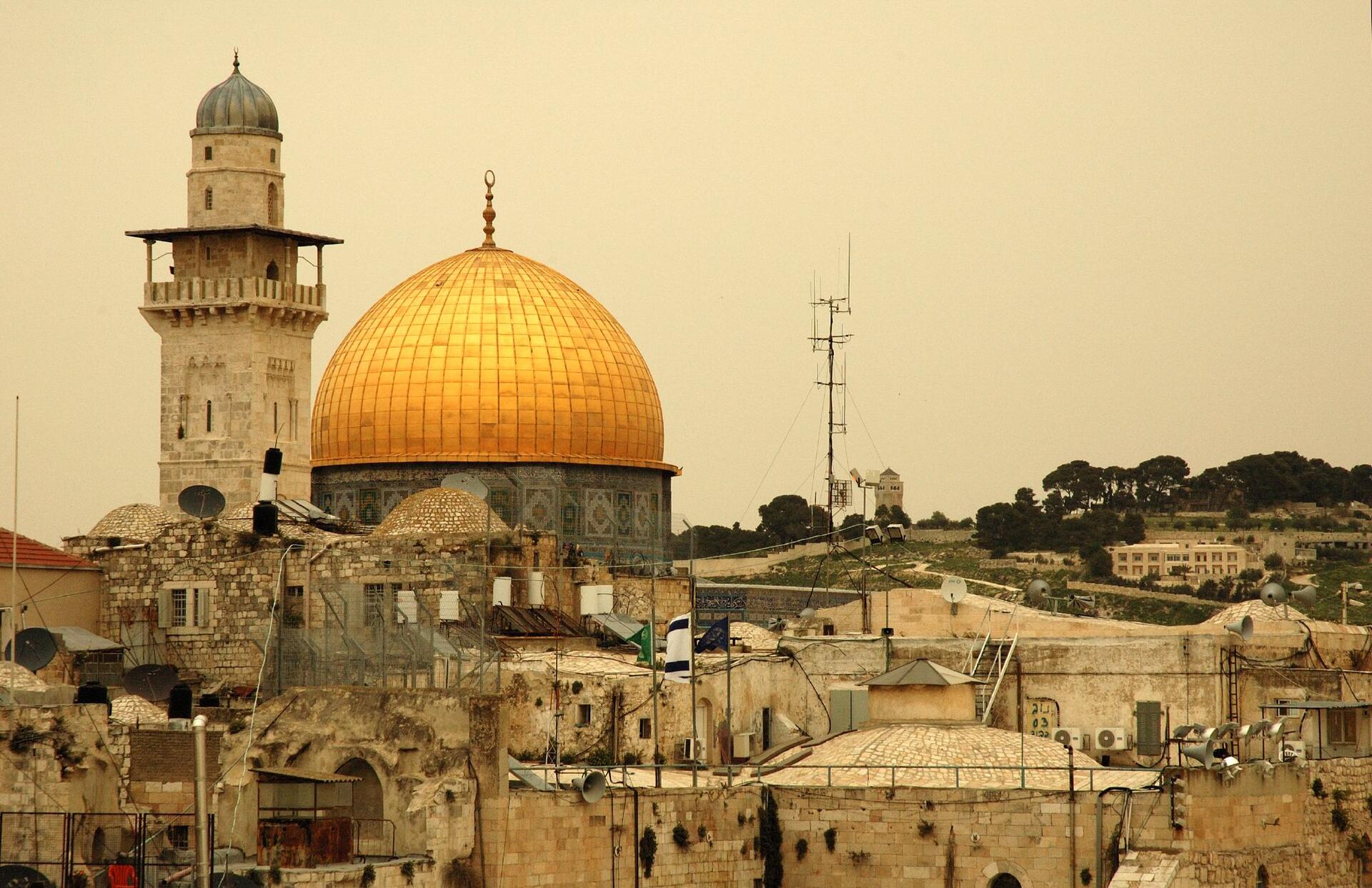
The Old City of Jerusalem, encompassing approximately 0.9 square kilometers within its ancient walls, serves as a cultural and religious epicenter for millions worldwide. Inscribed as a UNESCO World Heritage Site in 1981, this historic city holds immense significance for Judaism, Christianity, and Islam, making it one of the most important sites in human history.
More to come…UNESCO Description of the World Heritage Site
As a holy city for Judaism, Christianity and Islam, Jerusalem has always been of great symbolic importance. Among its 220 historic monuments, the Dome of the Rock stands out: built in the 7th century, it is decorated with beautiful geometric and floral motifs. It is recognized by all three religions as the site of Abraham's sacrifice. The Wailing Wall delimits the quarters of the different religious communities, while the Resurrection rotunda in the Church of the Holy Sepulchre houses Christ's tomb.
Encyclopedia Record: Old City of Jerusalem
The Old City of Jerusalem is a 0.9-square-kilometre (0.35 sq mi) walled area in East Jerusalem.Additional Site Details
Area: Not available
Number of Components: 1
(iii) — Unique or exceptional testimony to a cultural tradition
(vi) — Directly associated with events or living traditions
Coordinates: 31.7777777778 , 35.2316666667
World Heritage Research
Discover scientific research and academic studies that deepen our understanding of Old City of Jerusalem and its Walls from its history and significance to its conservation, management, and contemporary challenges.
-
Women of, for, and at the Wall: A Performative Analysis of Gender Politics at the Western Wall in Jerusalem
A performative analysis reveals how the Women of the Wall (WoW) and Women for the Wall (W4W) challenge and contest gendered religious practices at the Western Wall, using bodily performances to assert agency and critique traditional norms. The study highlights the impact of surveillance, media, and opposition on WoW's practices, demonstrating how their actions both challenge orthodox standards and expose the complexities of liberal agency in cultural and religious contexts.
Sermer, T. (2019). Women of, for, and at the Wall: A Performative Analysis of Gender Politics at the Western Wall in Jerusalem. Women and Music: A Journal of Gender and Culture, 23(1), 48–74. https://doi.org/10.1353/wam.2019.0003
View Publication Record | Read Publication -
A Brief History of Jerusalem: From the Earliest Settlement to the Destruction of the City in AD 70
Jerusalem's archaeological history, from its earliest settlement to the Roman destruction in AD 70, remains largely unexplored due to continuous habitation and dense urbanization. A recent study by Klaus Bieberstein synthesizes existing data, highlighting significant gaps and challenges in excavation efforts, particularly in matching radiocarbon dating with archaeological finds. While early excavations (1960s–80s) provided preliminary insights, many findings remain unpublished or require reevaluation. The study emphasizes the need for a balanced approach to historical texts, noting that biblical narratives contrast with more straightforward interpretations of Josephus and the Maccabees books. Despite limitations, this work offers a foundational overview, serving as a springboard for future research.
Wegner, P. D. (2018). A Brief History of Jerusalem: From the Earliest Settlement to the Destruction of the City in AD 70. Bulletin for Biblical Research, 28(3), 455–457. https://doi.org/10.5325/bullbiblrese.28.3.0455
View Publication Record | Read Publication -
Israeli Jerusalem
Following the 1948 war, Jerusalem was divided between Israel and Jordan, with East Jerusalem, including the Old City, under Jordanian control. This division left Jewish Jerusalem yearning for the Old City and Western Wall, while Palestinians in Jordanian Jerusalem felt their city was incomplete without the lost neighborhoods in West Jerusalem. The 1967 war dramatically altered the city's landscape under Israel's occupation of East Jerusalem and the West Bank, leading to significant changes that reshaped the city's geopolitical and cultural dynamics.
Reiter, Y. (2018). Israeli Jerusalem. Routledge Handbook on Jerusalem, 156–166. https://doi.org/10.4324/9781315676517-14
View Publication Record | Read Publication -
Toward Decolonization in Tourism: Engaged Tourism and the Jerusalem Tourism Cluster
Tourism in Jerusalem, particularly through the lens of the Old City, serves as a tool that perpetuates colonial narratives and power imbalances between Israelis and Palestinians. This study highlights how different tour guides—one Israeli and one Palestinian—present contrasting narratives about the city's religious and political landscape, revealing the embedded colonial dynamics in tourism practices. The research demonstrates that tourism normalizes dominant, often Orientalist, narratives while erasing Palestinian perspectives, thereby reinforcing colonial structures. By comparing two distinct tours, the study exposes how power relations shape historical and contemporary perceptions of Jerusalem, suggesting that engaged tourism can challenge and decolonize these narratives.
Vanden Boer, D. (2016). Toward Decolonization in Tourism: Engaged Tourism and the Jerusalem Tourism Cluster. Jerusalem Quarterly, (65), 9. https://doi.org/10.70190/jq.i65.p9
View Publication Record | Read Publication -
Earthquake Damage and Repair: New Evidence from Jerusalem on the 1927 Jericho Earthquake
A field survey in Jerusalem's Old City uncovered numerous iron anchors used to stabilize earthquake-damaged structures following the 1927 Jericho earthquake, revealing a previously undocumented repair technique. These anchors, classified into six types and found on pre-twentieth-century walls, were part of a strategy implemented by the British Mandate to reinforce weakened buildings. The study maps their locations, characterizes their host structures, and provides new evidence of the earthquake's impact on Jerusalem, located 30 km from the epicenter near the Dead Sea.
Zohar, M., Rubin, R., & Salamon, A. (2014). Earthquake Damage and Repair: New Evidence from Jerusalem on the 1927 Jericho Earthquake. Seismological Research Letters, 85(4), 912–922. https://doi.org/10.1785/0220140009
View Publication Record | Read Publication -
New Discoveries from Excavations inside Jaffa Gate of Old City Jerusalem
Recent excavations near Jaffa Gate in Jerusalem's Old City have uncovered significant ancient architectural features, including a segment of the Byzantine-era upper aqueduct integrated into the city wall and a section of the Decumanus, the main east-west street. A spacious building from the Ayyubid and Mamluk periods, possibly part of the western gate structure, was also discovered above these ruins. Additionally, the outer walls of the Tower of David’s Citadel moat were exposed, revealing its evolution from the medieval period to the 12th century. Among the finds were remnants of a city wall demolished before Kaiser Wilhelm II's 1898 visit and modern structures from Jordanian rule. These discoveries provide new insights into Jerusalem's urban development, water supply systems, and road networks during the Second Temple, Roman, and Byzantine periods.
Sion, O., & Rapuano, Y. (2014). New Discoveries from Excavations inside Jaffa Gate of Old City Jerusalem. Liber Annuus, 64, 453–490. https://doi.org/10.1484/j.la.5.105505
View Publication Record | Read Publication -
Remaking the City: Archaeological Projects of Political Import in Jerusalem's Old City and in the Village of Silwan
Archaeological excavations in Jerusalem's Old City and the village of Silwan serve as powerful tools for political narrative shaping, directly influencing land control and historical interpretation. These projects, such as the Givati Parking Lot site planned to become the 'Kedem Center,' aim to connect key Israeli heritage sites like the 'City of David' archaeological park and the Western Wall plaza through underground tunnels. This approach alters the landscape and perception of the area, often sidelining the present-day Palestinian Muslim reality in favor of a narrative rooted in ancient periods significant to Israeli identity. Recent excavations have exposed ancient underground complexes, offering visitors an imagined historical experience that reinforces specific political and cultural claims.
Veeder, A., & Mizrachi, Y. (2014). Remaking the City: Archaeological Projects of Political Import in Jerusalem’s Old City and in the Village of Silwan. Approaching Religion, 4(2), 141–147. https://doi.org/10.30664/ar.67557
View Publication Record | Read Publication -
The making of Jerusalem's ‘Holy Basin’
Jerusalem's 'Holy Basin,' a geographical zone encompassing the historic Old City and containing sites sacred to Islam, Judaism, and Christianity, has been significantly shaped by Western conservation practices and Romantic landscape perceptions introduced during the 19th century. This study reveals how these imperialist influences, first implemented by the British, have not only altered Jerusalem's urban fabric but also redefined its historic parts' role in modern planning. While the Holy Basin is now central to contemporary political discussions and conflict narratives, this research focuses on its historical development, highlighting the profound impact of Western conservation practices on the city's understanding and integration.
Pullan, W., & Sternberg, M. (2012). The making of Jerusalem’s ‘Holy Basin’. Planning Perspectives, 27(2), 225–248. https://doi.org/10.1080/02665433.2012.646772
View Publication Record | Read Publication